


Strasbourg introduces new language in resolution on Karabakh.

The Political Committee of the Parliamentary Assembly of the Council of Europe (PACE) on Wednesday (4 November) adopted a draft for a resolution on the Karabakh conflict to be discussed in the Plenary Session of PACE in January. In a move seen as breaking with past practice the text uses language which is significantly different from what has been the case so far in resolutions related to the Nagorno-Karabakh conflict adopted by European and international bodies. 

Reporting the development, the website of PACE stated:

"In a draft resolution approved today, the Political Affairs Committee of the Parliamentary Assembly of the Council of Europe (PACE) has called for “the withdrawal of Armenian armed forces and other irregular armed forces from Nagorno-Karabakh and the other occupied territories of Azerbaijan, and the establishment of full sovereignty of Azerbaijan in these territories", in the framework of the OSCE Minsk process.

The committee also called for "the convening of a plenary meeting of the Minsk Group to establish an interim status for Nagorno-Karabakh guaranteeing security and internal self-governance, with an agreed corridor linking Armenia to Nagorno-Karabakh, and other confidence-building measures, including an access corridor to Nakhchivan".

Strongly condemning the deliberate targeting of civilian settlements close to the line of contact, the committee said it regretted that the Nagorno-Karabakh problem has been side-lined by other major international crises. "Further procrastination only complicates the settlement of this 'un-frozen' conflict which has claimed over a hundred human lives since the beginning of 2014, and which may escalate into a real war between two Council of Europe member States", it added.

Recalling that both Armenia and Azerbaijan committed themselves, when joining the Council of Europe in 2001, to use only peaceful means for settling their conflict over the Nagorno-Karabakh region, the committee urged both governments to refrain from using armed force.

The committee also called for the establishment by the OSCE of an international peacekeeping force to maintain security within Nagorno-Karabakh and the other occupied territories and to ensure the safe return and resettlement of displaced persons, as well as the creation of a mechanism to investigate ceasefire violations.

The draft resolution, based on a report by Robert Walter (United Kingdom, EC), is due to be debated by the Assembly at its January 2016 session."

Commonspace.eu political editor said in a comment that "whilst in essence the resolution does not say things that are much different from what the international community has been saying for a long time the language used in the text of the resolution adopted by the PACE Political Committee is significantly different. This will be welcomed in Azerbaijan but scorned at in Armenia. Baku will be encouraged by the call for the withdrawal of Armenian forces from territories it lost in the conflict more than two decades ago. Armenia however insists that the internatiuonal community should adhere strictly to the terminology adopted by the OSCE Minsk Group co-Chair, and recognises only them as mediators in the conflict. For this reasons Armenia has adopted a policy of not engaging with other initiaitives that seem to be pursuing a different approach. The PACE resolution, even if adopted by the full plenary of the Assembly in January - by no means a certainty - can be dismissed as simply another piece of paper with no consequence on the situation on the ground. Yet it sets an important precedent, and can lead to similar texts being issued by other international fora, something that Armenia wants to avoid at all costs."

source: commonspace.eu with www.coe.int

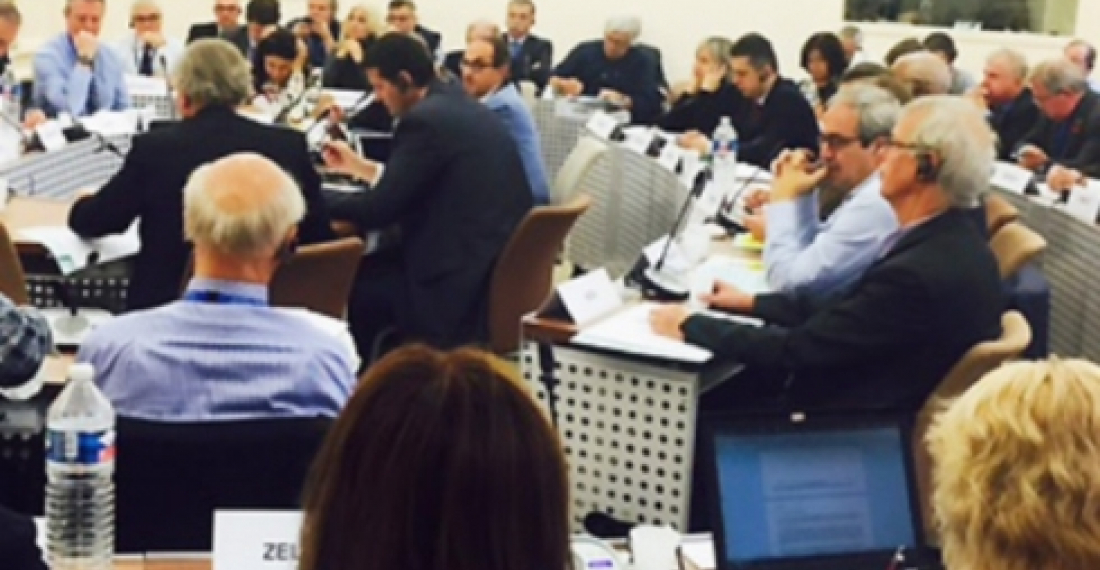
photo: The Political Committee of the Parliamentary Assembly of the Council of Europe (archive picture).


 

Related articles

Editor's choice
News
Borrell tells the European Parliament that the situation in Afghanistan was critical, but the EU will remain engaged

Borrell tells the European Parliament that the situation in Afghanistan was critical, but the EU will remain engaged

Borrell underlined that the European Union will make every effort to support the peace process and to remain a committed partner to the Afghan people. "Of course, we will have to take into account the evolving situation, but disengagement is not an option.  We are clear on that: there is no alternative to a negotiated political settlement, through inclusive peace talks.
Editor's choice
News
Pope's visit to Türkiye and Lebanon has a strong ecumenical character, and places interreligious dialogue at its centre

Pope's visit to Türkiye and Lebanon has a strong ecumenical character, and places interreligious dialogue at its centre

Pope Leo XIV has begun the first overseas trip of his pontificate, a six-day visit to Türkiye and Lebanon, which started yesterday (27 November) and ends on Tuesday (2 December). According to Vatican Radio, the visit "carries a strong ecumenical character and places interreligious dialogue at its centre. It will also be a moment of closeness to Christian communities and local populations across the region".   During nearly a week in the region, Pope Leo XIV will meet civil and religious authorities, visit mosques and ancient churches, pray at Beirut’s port in memory of the victims of the 2020 explosion, and hold private meetings with Presidents Recep Tayyip Erdoğan and Joseph Aoun.   A highlight of the visit will be a visit to Nicaea, where the Pope will mark the anniversary of the Council of Nicaea. Christians of many traditions recognise the Council of Nicaea as a foundation of shared faith. One of the most anticipated moments will be the Pope’s encounter with Lebanese youth in Bkerké, at the Maronite Patriarchate, a meeting expected to carry strong messages of hope in the Jubilee Year. A central event will be the ecumenical celebration in İznik, where the Pope and Ecumenical Patriarch Bartholomew will walk together toward the ruins of the Basilica of St Neophytos. The prayer, held before icons of Christ and the Council, will conclude with the lighting of a candle—a symbolic gesture of unity. The journey will also highlight interreligious engagement.   Memorable moments are expected throughout the trip: a wreath at Atatürk’s mausoleum, prayer inside the Blue Mosque, Mass at Istanbul’s Volkswagen Arena, the planting of a cedar at the presidential palace in Beirut, and prayer at the tomb of St Charbel in Lebanon. The Vatican said that "Pope Leo XIV’s pilgrimage to Türkiye and Lebanon aims to offer a voice of peace, unity, and hope at the heart of the Middle East."

Popular

Editor's choice
News
Pope's visit to Türkiye and Lebanon has a strong ecumenical character, and places interreligious dialogue at its centre

Pope's visit to Türkiye and Lebanon has a strong ecumenical character, and places interreligious dialogue at its centre

Pope Leo XIV has begun the first overseas trip of his pontificate, a six-day visit to Türkiye and Lebanon, which started yesterday (27 November) and ends on Tuesday (2 December). According to Vatican Radio, the visit "carries a strong ecumenical character and places interreligious dialogue at its centre. It will also be a moment of closeness to Christian communities and local populations across the region".   During nearly a week in the region, Pope Leo XIV will meet civil and religious authorities, visit mosques and ancient churches, pray at Beirut’s port in memory of the victims of the 2020 explosion, and hold private meetings with Presidents Recep Tayyip Erdoğan and Joseph Aoun.   A highlight of the visit will be a visit to Nicaea, where the Pope will mark the anniversary of the Council of Nicaea. Christians of many traditions recognise the Council of Nicaea as a foundation of shared faith. One of the most anticipated moments will be the Pope’s encounter with Lebanese youth in Bkerké, at the Maronite Patriarchate, a meeting expected to carry strong messages of hope in the Jubilee Year. A central event will be the ecumenical celebration in İznik, where the Pope and Ecumenical Patriarch Bartholomew will walk together toward the ruins of the Basilica of St Neophytos. The prayer, held before icons of Christ and the Council, will conclude with the lighting of a candle—a symbolic gesture of unity. The journey will also highlight interreligious engagement.   Memorable moments are expected throughout the trip: a wreath at Atatürk’s mausoleum, prayer inside the Blue Mosque, Mass at Istanbul’s Volkswagen Arena, the planting of a cedar at the presidential palace in Beirut, and prayer at the tomb of St Charbel in Lebanon. The Vatican said that "Pope Leo XIV’s pilgrimage to Türkiye and Lebanon aims to offer a voice of peace, unity, and hope at the heart of the Middle East."

