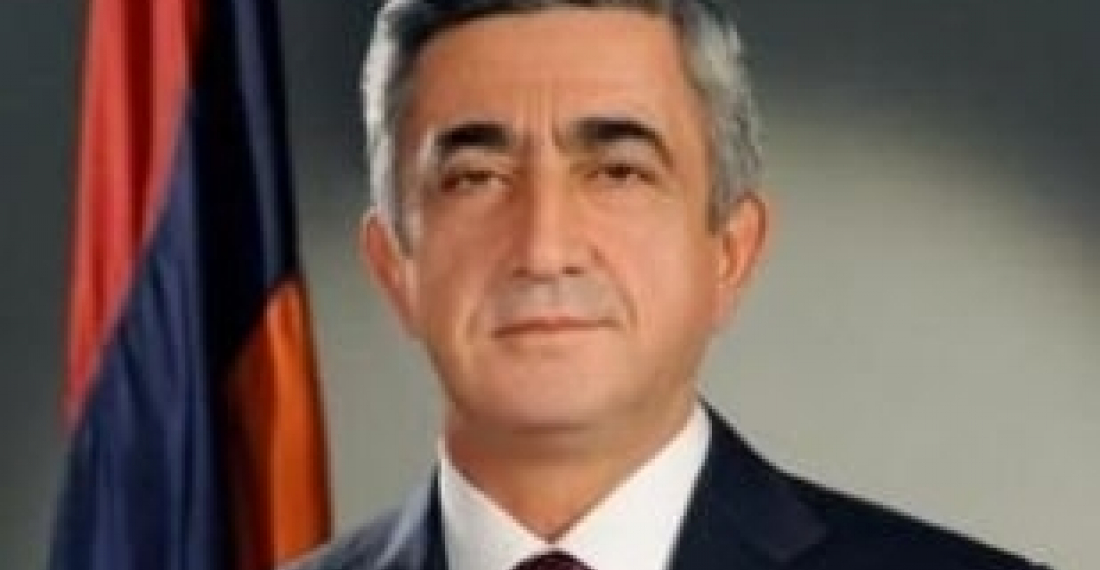
Serzh Sargsyan:

"The Nagorny Karabakh Republic 
is a full-fledged country with all its attributes. Even under the
threat of war, this country is much more democratic than those
speaking of democracy and national tolerance in the periods free from
threatening Armenians with war," President of Armenia Serzh Sargsyan
said at the ceremonial awarding at the residence of the NKR
President, ArmInfo's correspondent to Stepanakert reported.

The Head of Republic qualified Artsakh Republic's proclamation as an
important event for the whole Armenian nation, underlining that it is
a holiday of freedom and dignity of a human being and a nation,
restoration of violated rights and the victory of historical justice.
President Sargsyan called Artsakh the pride of the world spread
Armenians.

He said that Nagorny Karabakh's status cannot be lower than it is
now.

"The peace process is continued. Unlike the other party, we do not
conceal the truth from our people and do not indulge in wishful
thinking," the president said.


He said that the life and freedom of the Artsakh people cannot be
under jurisdiction of any other country.

"What happened in 1923 is impossible in the 21st century, especially
that we had paid too high a price for that," he said.

He highlighted that the vicious, long and terrible war unleashed by
Azerbaijan could drive to desperation anyone but not the Karabakh
people.

"Artsakh's self-defense groups drove to desperation and made to
escape those who turned our rich and beautiful region into the hell.
Massacres, destruction and robbery, ethnic purges and annihilation of
peaceful population were what the Armed Forces of the Azerbaijani
Republic were engaged in. For us that invasion of mercenaries and
robbers was historical testing that made us choose between death and
fight to live and become stronger. We chose life and today we
celebrate the victory of live over death," Serzh Sargsyan said.

The president said he is sure all the big and small problems will be
settled in the visible future and Artsakh will celebrate more and
more anniversaries.

The solemn ceremony of awarding took place at the residence of the
Artsakh Republic President on September 1. President Serzh Sargsyan
of Armenia who arrived in Artsakh yesterday to partake in the
independence celebrations was present at the event.

In connection with the 20th anniversary of the NKR proclamation a
group of Artsakh liberation movement activists, freedom fighters and
servicemen, distinguished public figures and politicians,
philanthropists, scientists, workers of culture, education and sports
spheres, journalists from Artsakh, the Republic of Armenia, Diaspora
and abroad were decorated with state awards.

Related articles

Editor's choice
News
Borrell tells the European Parliament that the situation in Afghanistan was critical, but the EU will remain engaged

Borrell tells the European Parliament that the situation in Afghanistan was critical, but the EU will remain engaged

Borrell underlined that the European Union will make every effort to support the peace process and to remain a committed partner to the Afghan people. "Of course, we will have to take into account the evolving situation, but disengagement is not an option.  We are clear on that: there is no alternative to a negotiated political settlement, through inclusive peace talks.
Editor's choice
News
Pope's visit to Türkiye and Lebanon has a strong ecumenical character, and places interreligious dialogue at its centre

Pope's visit to Türkiye and Lebanon has a strong ecumenical character, and places interreligious dialogue at its centre

Pope Leo XIV has begun the first overseas trip of his pontificate, a six-day visit to Türkiye and Lebanon, which started yesterday (27 November) and ends on Tuesday (2 December). According to Vatican Radio, the visit "carries a strong ecumenical character and places interreligious dialogue at its centre. It will also be a moment of closeness to Christian communities and local populations across the region".   During nearly a week in the region, Pope Leo XIV will meet civil and religious authorities, visit mosques and ancient churches, pray at Beirut’s port in memory of the victims of the 2020 explosion, and hold private meetings with Presidents Recep Tayyip Erdoğan and Joseph Aoun.   A highlight of the visit will be a visit to Nicaea, where the Pope will mark the anniversary of the Council of Nicaea. Christians of many traditions recognise the Council of Nicaea as a foundation of shared faith. One of the most anticipated moments will be the Pope’s encounter with Lebanese youth in Bkerké, at the Maronite Patriarchate, a meeting expected to carry strong messages of hope in the Jubilee Year. A central event will be the ecumenical celebration in İznik, where the Pope and Ecumenical Patriarch Bartholomew will walk together toward the ruins of the Basilica of St Neophytos. The prayer, held before icons of Christ and the Council, will conclude with the lighting of a candle—a symbolic gesture of unity. The journey will also highlight interreligious engagement.   Memorable moments are expected throughout the trip: a wreath at Atatürk’s mausoleum, prayer inside the Blue Mosque, Mass at Istanbul’s Volkswagen Arena, the planting of a cedar at the presidential palace in Beirut, and prayer at the tomb of St Charbel in Lebanon. The Vatican said that "Pope Leo XIV’s pilgrimage to Türkiye and Lebanon aims to offer a voice of peace, unity, and hope at the heart of the Middle East."

Popular

Editor's choice
News
Pope's visit to Türkiye and Lebanon has a strong ecumenical character, and places interreligious dialogue at its centre

Pope's visit to Türkiye and Lebanon has a strong ecumenical character, and places interreligious dialogue at its centre

Pope Leo XIV has begun the first overseas trip of his pontificate, a six-day visit to Türkiye and Lebanon, which started yesterday (27 November) and ends on Tuesday (2 December). According to Vatican Radio, the visit "carries a strong ecumenical character and places interreligious dialogue at its centre. It will also be a moment of closeness to Christian communities and local populations across the region".   During nearly a week in the region, Pope Leo XIV will meet civil and religious authorities, visit mosques and ancient churches, pray at Beirut’s port in memory of the victims of the 2020 explosion, and hold private meetings with Presidents Recep Tayyip Erdoğan and Joseph Aoun.   A highlight of the visit will be a visit to Nicaea, where the Pope will mark the anniversary of the Council of Nicaea. Christians of many traditions recognise the Council of Nicaea as a foundation of shared faith. One of the most anticipated moments will be the Pope’s encounter with Lebanese youth in Bkerké, at the Maronite Patriarchate, a meeting expected to carry strong messages of hope in the Jubilee Year. A central event will be the ecumenical celebration in İznik, where the Pope and Ecumenical Patriarch Bartholomew will walk together toward the ruins of the Basilica of St Neophytos. The prayer, held before icons of Christ and the Council, will conclude with the lighting of a candle—a symbolic gesture of unity. The journey will also highlight interreligious engagement.   Memorable moments are expected throughout the trip: a wreath at Atatürk’s mausoleum, prayer inside the Blue Mosque, Mass at Istanbul’s Volkswagen Arena, the planting of a cedar at the presidential palace in Beirut, and prayer at the tomb of St Charbel in Lebanon. The Vatican said that "Pope Leo XIV’s pilgrimage to Türkiye and Lebanon aims to offer a voice of peace, unity, and hope at the heart of the Middle East."