Region

South Caucasus

The South Caucasus – a region encompassing Armenia, Azerbaijan and Georgia - is one of strategic importance, not only for adjacent countries, such as Turkiye, Russia, Iran and the Central Asian states, but also for neighbours such as the European Union and the GCC states, and globally for the United States, India, China, Pakistan and Japan.

commonspace.eu team brings decades of experience of working in the South Caucasus and we are pleased to share our insights with our loyal readers through the website, and the sister newsletter, Caucasus Concise.

Editor's choice
Monday Commentary
Monday Commentary: 2025 was a momentous year for the South Caucasus

Monday Commentary: 2025 was a momentous year for the South Caucasus

The year 2025 has ended up being a momentous year for the South Caucasus, writes Dennis Sammut in his Monday Commentary. Armenia-Azerbaijan relations have been redefined, with consequences for the whole region and beyond. That huge development overshadowed key moments in the domestic trajectory of the two countries, which however have deep consequences for the two countries, and even beyond. It has also been a tumultuous year for Georgia too. The country has been gripped in a political crisis throughout 2025, with no obvious end in sight. Whatever the domestic arguments, on the international stage Georgia is today a shadow of what it used to be until recently. It not only has lost the chance of joining the European Union any time soon, but it has also lost its position as the leading South Caucasus country. Today, in the new reality of the region, it lags as a tired third. Important as 2025 was, it ended with a lot of unfinished business. So 2026 will also be crucial for the three countries. Since regaining its statehood in 1991 after the dissolution of the Soviet Union, Armenia-Azerbaijan relations have been defined by war. The two fought open wars, wars of attrition, and propaganda wars, incessantly. Tens of thousands of people lost their lives, and hundreds of thousands were displaced. Many had lost hope that the two could try the alternative – i.e. peaceful co-existence. Yet in 2025 they were proven wrong.
Editor's choice
Opinion
Opinion: A sustainable peace requires consistent long-term European involvement

Opinion: A sustainable peace requires consistent long-term European involvement

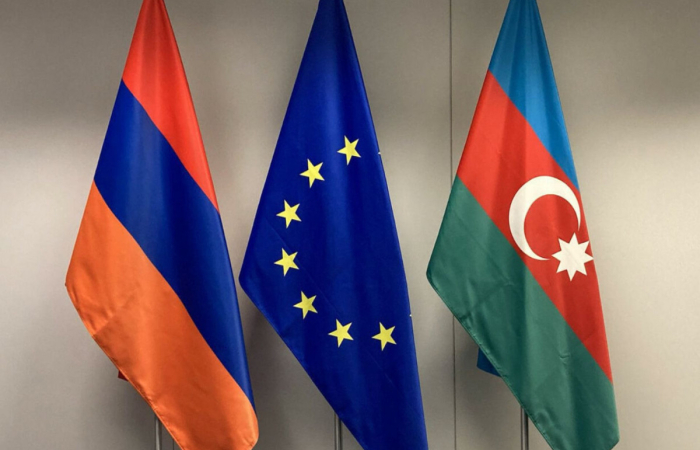
There is no denying that the EU, especially key member states acting in support, helped bring Baku and Yerevan closer to the Washington Declaration of August 8, 2025. But a declaration is not a treaty. Turning principles into a peace deal and eventually to a sustainable peace requires consistent long-term European involvement, writes Yalchin Mammadov in this-op-ed for commonspace.eu Before facilitating trust between Armenia and Azerbaijan, the EU is first expected to address its own credibility gap with Baku. A more balanced approach—such as including Azerbaijan, alongside Armenia, in the European Peace Facility—could be a useful first step. Diplomats can negotiate peace; societies must build peace. In this context, the EU can do what it does the best: long-term societal engagement. By expanding youth and academic exchange programmes, investing in cross-border civil society initiatives, and fostering people-to-people cooperation, Brussels can help shape a new generation equipped to sustain peace beyond political cycles. Such tools are slow and unglamorous, but if ignored, even the strongest treaty risks collapse. And obviously, these aspects require two-way engagement and genuine willingness by both governments to facilitate contact. If Brussels wants to remain influential, it needs to replace outdated one-size-fits-all policies with ambitious, interest-driven and differentiated approaches. Without a clear regional strategy, which appears to be the current situation, the South Caucasus will continue to sit at the margins of Europe’s security architecture—leaving space for other powers to take the lead. (You can read the op-ed in full by clicking the image.)

Filter archive

Publication date
Editor's choice
Armenian President: Armenia develops cooperation with both CSTO and NATO as they are not conflicting structures

Armenian President: Armenia develops cooperation with both CSTO and NATO as they are not conflicting structures

Armenia is successfully developing cooperation with both the Collective Security Treaty Organization (CSTO) and NATO as they are not conflicting structures, President of Armenia Serzh Sargsyan said during a joint press-conference with NATO Secretary General Anders Fogh Rasmussen on Thursday.
Editor's choice
Armenian President urges world community not to be too much "politically correct" with respect to Azerbaijan

Armenian President urges world community not to be too much "politically correct" with respect to Azerbaijan

President of Armenia Serzh Sargsyan has urged the world community not to be too much "politically correct" with respect to Azerbaijan as this encourages the Azeri authorities to act impudently and to take steps like the pardon of murderer Ramil Safarov.
Editor's choice
NATO Secretary General: Pardoning Safarov is a crime

NATO Secretary General: Pardoning Safarov is a crime

Extradition of Azerbaijani officer Ramil Safarov and Azerbaijani president's decision to pardon the murderer hinder confidence building between Armenia and Azerbaijan, NATO Secretary General Anders Fogh Rasmussen said in a joint press conference with President of Armenia Serzh Sargsyan, Thursday in Yerevan.
Editor's choice
Lithuanian FM: "We are interested in stability in South Caucasus"

Lithuanian FM: "We are interested in stability in South Caucasus"

Lithuania is interested in stability of the South Caucasus, Lithuanian Foreign Minister Audronis Azubalis said at the Ministerial Meeting of Nordic Baltic Eight, NBB in Vilnius, when commenting on extradition of Azerbaijani murderer Ramil Safarov and Yerevan's protests against that.
Editor's choice
Acting Foreign Minister of the Nagorno-Karabakh Republic addressed a letter to the OSCE Chairman-in-Office in connection with Safarov's extradition

Acting Foreign Minister of the Nagorno-Karabakh Republic addressed a letter to the OSCE Chairman-in-Office in connection with Safarov's extradition

In connection with the extradition and presidential pardon for Ramil Safarov, Acting Foreign Minister of the Nagorno-Karabakh Republic Vassily Atajanyan addressed a letter to the OSCE Chairman-in-Office, Ireland's Minister for Foreign Affairs Eamon Gilmore.
Editor's choice
Armenian community of Estonia demand apologies from Hungary

Armenian community of Estonia demand apologies from Hungary

Armenian public organizations of Estonia have appealed to Ambassador Extraordinary and Plenipotentiary of Hungary in Estonia Mr. Erik Haupt with an open letter demanding apologies by the Hungarian Government to the family of the murdered Armenian officer Gurgen Margaryan and the Armenian people.
Editor's choice
Budapest regrets the decision to trust Baku

Budapest regrets the decision to trust Baku

Justice Ministry of Hungary was surprised at pardon granted to Azerbaijani murderer Ramil Safarov after he was extradited from Hungary, says the statement by the Justice Ministry of Hungary.
Editor's choice
Opinion
OPINION: Safarov case: The wider implications.

OPINION: Safarov case: The wider implications.

The fact that Safarov.s crime was committed on European territory in the context of an event to which both victim and culprit were guests of NATO means this case cannot be seen in the context of Armenian-Azerbaijani relations alone.