In Sochi Putin threw a lifeline to Lukashenko, whilst buying time for the Kremlin so it can reorganize the Belarussian political landscape, argues Alexander Petrosyan in this op-ed.
The failure of the European Union so far, to agree sanctions against Belarus officials following the flawed elections in August and the suppression of popular protests, must be disappointing for the Belarusian people. The key to the future of Belarus however for the moment remains with Russia.
It is hardly a secret that since the collapse of the USSR Belarus has been in the Russian orbit, and Moscow's overarching task still remains securing its vital interests in this country, which is also the only reliable route left for Russian overland energy pipelines to Europe. Although Belarus long-time leader, Alexander Lukashenko, has always relied upon the Kremlin for political and economic support, even if relations between Minsk and Moscow have witnessed contradictions over the past years.
Related content: Opinion - The Swan song of Europe's last dictator
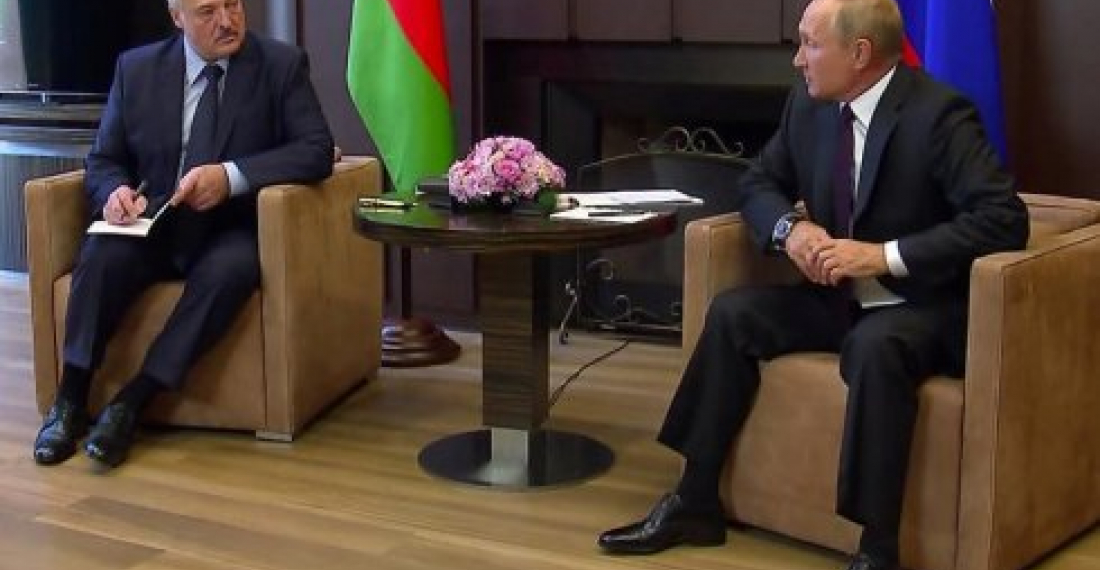
Since August, Lukashenko has appeared to be much more concerned with quickly fixing his relations with Moscow, then with appeasing Brussels. His efforts for rapprochement proved to be successful once he secured a face to face meeting with the Russian leader, Vladimir Putin, in Sochi on 14 September. During the marathon four hour meeting Putin appeared to legitimize Lukashenko's illegal election. During the meeting, Putin emphasized Russia's readiness to support Belarus under the CSTO commitments, but he also carefully highlighted, that Russian soldiers would return to their permanent deployment locations after the joint military drill in western Belarus ends.
Putin's Sochi performance
Both leaders arrived in Sochi with different agendas. Lukashenko headed to Sochi, first of all, to gain financial support, which the Belarusian economy needs very much these days. These expectations were met. Putin promised to provide a massive loan of about USD 1.5 billion to Belarus, and also offered to restructure Belarusian debt and to support the banking system. In essence this was a Russian bail-out of the Belarusian economy.
The Kremlin understands quite well, that Russia's continuing support to Lukashenko isn't in the Kremlin's interests in the long run. Russia's overt support to Lukashenko will eventually have irreversible negative effects on how Russia is perceived in Belarus, and some anti-Russian mood can already be noticed in the protests during the last days. Therefore, Putin pushed forward the idea of adopting a new constitution, and organizing new presidential and parliamentary elections, but on Russia's terms. This will allow Moscow to keep the prospects of the Union State integration alive. Lukashenko has always seen this integration as an opportunity to gain asymmetric economic, energy and financial gains at the expense of Russian interests, a fact which has always shaped his personal relations with Putin. Nevertheless, putting an end to the instability in a neighboring country, with which Russia has strong cultural and historical ties, is crucial for the Kremlin. Moscow fears that political turmoil in Belarus may have a 'spill over' effect in Russia itself. Current uproar around Navalny by the western media is partially linked to the Belarusian events, which increases pressure on Moscow, to avoid a possible repetition of the Ukrainian scenario.
Avoiding the Ukrainian mistakes
This does not mean that the Kremlin wants to keep Lukashenko in power at all costs and by any means, since it understands this may have unexpected consequences. On the other hand, Russia cannot allow, Belarus to follow the path of Ukraine, and become another anti-Russian bastion on its borders. Having lost direct control over Moldova, Ukraine and the Baltic states, traditional security concerns as regards Russia's western borders make Russian strategists paranoid about Belarus. Moscow views Western integration projects as a hostile threat for its security interests. Nor can the Kremlin allow chaos and bloodshed on its borders, with unknown outcomes. Yet, the possibility of a Russian military intervention, is not realistic at this moment. Although many commentators in the West have been warning about such a possibility since the very beginning of public protests, the background circumstances tell a totally different story.
First of all, the Ukrainian legacy has created enormous economic and political problems for Russia. Invading Belarus before solving the problems of Donbas and Crimea, will have a high cost for Putin. In economic terms, Russia isn't able to sustain another wave of sanctions which may push it further towards isolation and increasing dependence on China. Furthermore, unlike in Ukraine, in the case of the Belarusian protests an explicit western presence is missing, which makes the protests geo-politically neutral, and a domestic issue. Opposition leader Tikhanovskaya and the representatives of the coordination council have assured on a number of times, that regime change will not lead to a revision of relations with Russia. Given Belarus' dependence on Russian energy imports, investments, and the fact that the main trade partner for Belarusian companies are Russian counterparts, no rational Belarusian political leader will question relations with Moscow in the short run. Nevertheless, the Kremlin understands that a victory of the protestors will eventually see Belarus closer to the EU.
Russia's option
It seems that Moscow doesn't have a well-designed strategy to deal with Belarus, apart from not wanting to see an anti-Russian government in Minsk.
Although Putin congratulated Lukashenko on his re-election, Russia does not want to have a repeat of the Yanukovych case in Ukraine. The fact that Lukashenko has eliminated over these years all opponents, even those who were pro-Russian, limits Moscow's options. Russia needs time in order to reorganize the political landscape, and to promote Moscow-friendly candidates and parties within Belarus. In this effort the major Russian political parties represented in the State Duma, who have strong ties with Belarusian pro-government partners, will have an important role to play. One possible scenario might be an increased role of the parliament under a new constitution. This will allow the Kremlin to take control of the parliament, and will allow it to have a veto over a possible foreign possible U-turn by any future leader in Minsk. Moscow hopes that this scenario will satisfy the Belarusian people, empowering them to decide their future and to be engaged in a more active political life, but where Russia's privileged position in Belarus could be secured.
Source: Alexander Petrosyan, is an independent analyst, based in Yerevan, Armenia.
Photo: President Putin and President Lukashenko met in Sochi on 14 September 2020 (picture courtesy of the press service of the president of Russia)
The views expressed in opinion pieces and commentaries do not necessarily reflect the position of commonspace.eu or its partners