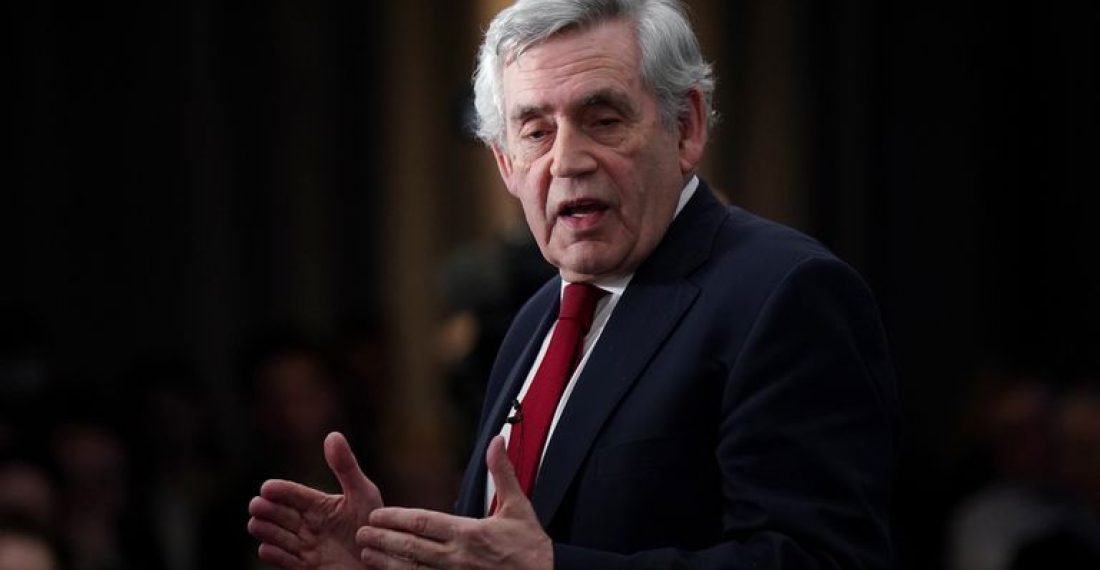
In an article for Project Syndicate, former British Prime Minister, Gordon Brown, says that multilateralism is not dead yet. Here is his article in full:
With conflicts raging in some 50 countries, tariff wars becoming the new (abnormal) norm and global economic growth falling to its slowest pace in generations, there seems to be little to cheer as we enter 2026. The only certainty is that we are living with mounting uncertainty. The sole realistic prediction might be continued unpredictability.
Underlying the tensions and turmoil of our times are three unmistakable shifts that are creating a new but still unsettled terrain: from a unipolar world to a multipolar one; from a rules-based order to a power-based one; and from a politics informed by economic openness to one that insists on protectionism, mercantilism and industrial policies that emphasize domestic security. Politics is now driving economics, rather than vice versa.
There are different views about how the world will change in 2026 and beyond. As we move away from the certainties of a unipolar world, will we see a return to great power competition and to spheres of influence, the emergence of a “one world, two systems” arrangement dominated by China and the US, or simply a period of chaotic disorder?
What is clear is that every pillar of the world order we have known since the Second World War’s end is crumbling. This includes adherence to the rule of law, human rights and democracy (there are now 91 autocracies in the world but only 88 democracies), as well as multilateral cooperation, humanitarian aid and environmental stewardship.
These seismic shifts have produced an aggressive, increasingly authoritarian form of nationalism that has replaced neoliberalism as the dominant ideology of our times. Ethnic chauvinism has given rise to increasingly flagrant violations of humanitarian and human rights law, not just in Russia’s war on Ukraine but also in the rising number of civil wars (in Sudan and Ethiopia, to name only two) and cross-border conflicts elsewhere.
So, from the perspective of the end of 2025, it looks as if this decade will be remembered for a global pandemic, the first war waged by a great power in Europe since the Second World War, Middle East carnage, a deepening climate crisis, and disorder.
But recall that, in 1941 — when the rise of fascism had plunged the world into even more widespread war and despair — something unexpected happened. America and Britain set out the principles that would guide a new postwar world order. More than two dozen other countries soon pledged support for the Atlantic Charter, which established the framework for the birth of the UN, the creation of the Bretton Woods institutions, the Universal Declaration of Human Rights and the Marshall Plan. Could something similar happen now?
In a fractured world, it is no surprise that electorates are growing more concerned about their day-to-day survival and security. But what is striking is that, despite this turn, they also understand that broader international dynamics are increasingly impinging on their lives. They are far more aware than ever of the connection between what is happening in their local communities and what is happening globally and a majority believe that, under the right conditions, helping others is a reliable way to help oneself.
These and other insights can be found in a recent Focaldata survey, which polled about 36,000 adults across 34 countries. Of course, given the daily headlines since January, particularly the ongoing coverage of trade wars, it is understandable that two-thirds of respondents recognize how their lives are being affected by decisions made elsewhere. Equally, since it has been only about three years since the COVID-19 pandemic ended, some 77 percent are still attuned to what is happening in global health. But clear majorities are also aware of the consequences for them of climate change (58 percent, rising to 63 percent among younger respondents) and disruptions to food supplies (55 percent).
These sentiments do not necessarily arise from some starry-eyed cosmopolitan idealism; rather, they reflect practical realities. What matters most to people is whether their fundamental needs are being met. They know that cooperation can offer security, such as in the provision of food and water (the top priority for 40 percent of respondents) or in mitigating poverty and inequality (selected by 38 percent, with majority support in sub-Saharan Africa). They also know that it is necessary to protect human rights (37 percent), support employment (36 percent) and promote health and effective responses to climate change (which are top priorities in the Global South, especially in Asia).
While some commentators have described today’s world as being divided between localists and globalists, between people attached to “Somewhere” and people attached to “Anywhere,” most of the public does not see it this way. The majority favors cooperation on global challenges, even if it means compromising on some strictly national interests.
Support for cooperation in pursuing mutual prosperity, peace and stability is strongest in sub-Saharan Africa (68 percent) and in East and South Asia (64 percent), where these objectives are most at risk. By contrast, in Northern Europe — where populist nationalism has taken far-right parties to the top of many opinion polls — only 57 percent report that they are prepared to sacrifice national interests to tap the benefits of global cooperation.
But even in President Donald Trump’s America, as in European countries where populist nationalist parties lead opinion polls, more people lean toward working with other countries than toward “going it alone.” Only hard-line nationalists hold the zero-sum view that success for them and their country must come at the expense of others. This cohort represents just 16 percent of the global population, though 25 percent of Americans.
Committed internationalists — the 21 percent who are what the philosopher Kwame Anthony Appiah calls “rooted cosmopolitans” — view cross-border cooperation through open trade as a positive-sum game. The vast majority are somewhere in between: neither narrow, inward-looking nationalists nor all-in cosmopolitans. They are patriotic but they do not see themselves as part of a never-ending struggle between “us” and “them.” So, how much support for international cooperation is there? Does the majority in the middle prefer a duty-free world or a dutiful one? What kind of obligations beyond their garden gate, city wall or national border are they willing to accept?
One cohort, representing 22 percent, supports humanitarian action to relieve suffering and is prepared to act out of altruism, supporting emergency aid in disaster zones. They are what we might call “good-cause” multilateralists who do feel others’ pain and believe in something bigger than themselves.
A second group, also representing 22 percent of the total, comprises pragmatic multilateralists who want to know that any taxes paid out for international development will be spent well. Leaders must show results; otherwise, cooperation will be deemed a failure and rejected.
A third group (representing 21 percent) comprises self-interested multilateralists who will endorse cooperation if they can see that it benefits them and their communities — whether it be through guaranteeing food or peace and security.
The implication is that cooperation must be rooted in everyday life. If political leaders demonstrate that global cooperation delivers for people on the ground, people will back multilateral efforts. But the process cannot begin at the global level and work down to the local. Rather, it must begin with people asking what global events mean for their everyday lives.
Day-to-day hardships — unaffordable essentials, at-risk jobs, poor health, food insecurity and threats to personal safety — are defining the public agenda everywhere. If international cooperation fails to ameliorate these burdens, support for it will evaporate.
Multilateral cooperation can be revived even without blanket endorsement of multilateral institutions. But contrary to the “America First” critique of multilateralism, trust in the World Health Organization stands at 60 percent globally (71 percent in Africa) and 58 percent trust the UN — a higher level than most national governments enjoy.
In our poll, no major power — not the US, the EU, China or Russia — has earned the trust of more than three in 10 people globally. That said, trust in international financial institutions, which have long championed globalization, is far lower, reflecting the rise of a populist nationalism in Europe, Britain and America that feels strongly that, while globalization has been a free-for-all, it has not been fair to all.
So, what should we conclude? First, there is a clear majority that can be mobilized not just for humanitarian aid (provided the money is well spent) but also for global action to address issues like climate change and pandemic prevention. The key is to frame policies in terms of enlightened self-interest — as a means of unlocking reciprocal and mutual benefits.
But, as stated above, the situation is fragile. Support for multilateral cooperation could fade overnight if people come to see such cooperation as a waste of scarce resources. We need visible “wins” that make everyday life better or safer. And if an overwhelming majority agree that no single country can tackle our greatest challenges, that should give current leaders a mandate to pursue collective action.
Underpinning this is the need for a new global, values-based order that, in the manner of the Atlantic Charter, sets out international and domestic goals. Even if “my tribe first” does not resonate with most people when it means isolation rather than cooperation, we still need to offer a powerful alternative by delivering on what matters most to people. We can then begin the process of rebuilding the world order on a foundation of rights (political, economic, civil), the rule of law, democracy, environmental sustainability and peace.
And as we search for a way through today’s turbulence, one signal from the latest polling stands out. Despite the noise of conflict and rivalry, people are not asking for withdrawal; they are asking for hope. Across 18 of the world’s largest economies, the clearest marker of effective international cooperation is not strength or self-interest, but vision: nearly four in 10 say cooperation means agreeing on a long-term plan for peace and progress. The same proportion wants cooperation to be guided by values based on trust-building and peace. Even in an age often identified with zero-sum politics, people still want their leaders to express a shared vision of what we can achieve together.
source: Gordon Brown, is a former prime minister of the United Kingdom. His article on Multilateralism was published on ©Project Syndicate
photo: Gordon Brown
The views expressed in opinion pieces and commentaries do not necessarily reflect the position of commonspace.eu or its partners