


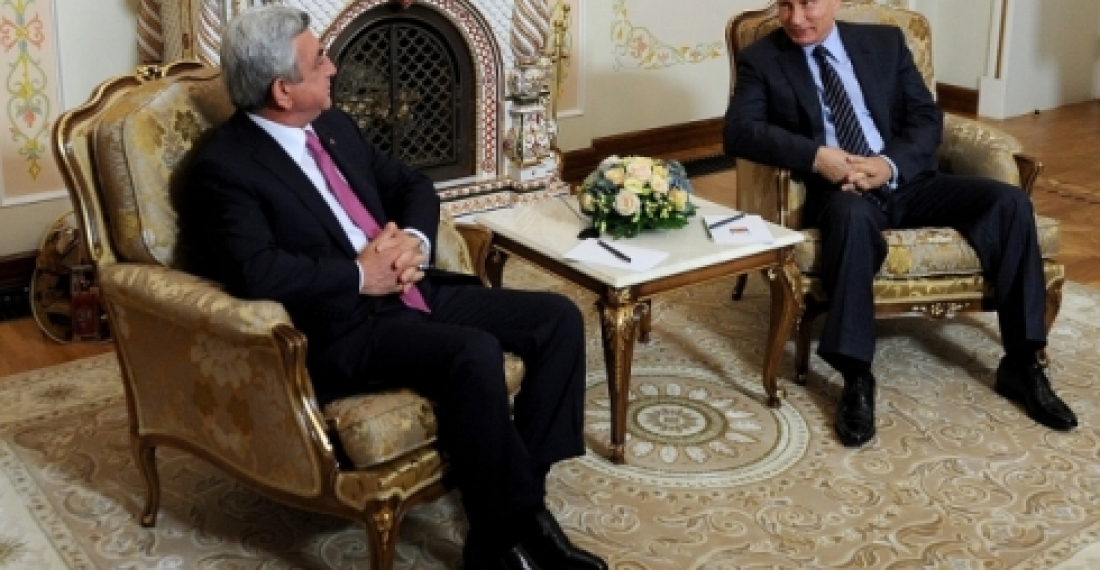
Putin and Sargsyan discuss Karabakh and economic relations in Moscow.

The situation around the Karabakh conflict and economic relations topped the agenda when Russia's President Vladimir Putin received his Armenian counterpart, Serzh Sargsyan at the Novo-Ogaryovo Presidential residence on the outskirts of Moscow, on Monday evening (7 September).

In a short exchange of views in the presence of the media, prior to the substantive talks, President Putin referred to "the special nature of the relations between Armenia and Russia". Putin hailed the strong economic relations between the two countries but noted that bilateral trade between the two countries had declined in the first half of 2015. He said that he did not have an explanation for that yet, but wanted to find the reason. 

In reply President Sargsyan said that Armenian-Russian relations were now developing within the new reality of the of the functioning of the Eurasian Economic Union. "We still have to work hard in order to give substance to this integration association, in order that it may deliver tangible results for our people. We are ready for this kind of work, we are interested in the speedy implementation of the principle of free movement of goods, capital, services and labor. For us this is very important", the President added. The Armenian President also thanked President Putin for his efforts to help resolve the Karabakh conflict. Sargsyan told Putin that in the last two weeks Azerbaijan had used heavy calibre weapons and artillery in the conflict zone and that Armenia had to respond in kind. He added that he will be raising this issue at the forthcoming summit of the Collective Security Treaty Organisation (CSTO) in Dushambe.

No statement was issued after the meeting but it was confirmed during the visit of the Armenian President to the Russian capital that Moscow will give Armenia a soft loan of US$ 200 million to enable it to replenish and modernise its military equipment. News about this loan had been circulating in Armenia for some time. It was also announced that Russia had reduced the price of its gas sales to Armenia by US$24 per cubic meter, from US$ 189 to US$ 165.

source: commonspace.eu with the press Service of the president of the Russian Federation

photo: President Putin of Russia and President Sargsyan of Armenia at their meeting on the outskirts of Moscow on Monday, 7 September 2015. (Picture courtesy of the Press Service of the President of Russia).
Related articles

Editor's choice
News
Borrell tells the European Parliament that the situation in Afghanistan was critical, but the EU will remain engaged

Borrell tells the European Parliament that the situation in Afghanistan was critical, but the EU will remain engaged

Borrell underlined that the European Union will make every effort to support the peace process and to remain a committed partner to the Afghan people. "Of course, we will have to take into account the evolving situation, but disengagement is not an option.  We are clear on that: there is no alternative to a negotiated political settlement, through inclusive peace talks.
Editor's choice
News
Pope's visit to Türkiye and Lebanon has a strong ecumenical character, and places interreligious dialogue at its centre

Pope's visit to Türkiye and Lebanon has a strong ecumenical character, and places interreligious dialogue at its centre

Pope Leo XIV has begun the first overseas trip of his pontificate, a six-day visit to Türkiye and Lebanon, which started yesterday (27 November) and ends on Tuesday (2 December). According to Vatican Radio, the visit "carries a strong ecumenical character and places interreligious dialogue at its centre. It will also be a moment of closeness to Christian communities and local populations across the region".   During nearly a week in the region, Pope Leo XIV will meet civil and religious authorities, visit mosques and ancient churches, pray at Beirut’s port in memory of the victims of the 2020 explosion, and hold private meetings with Presidents Recep Tayyip Erdoğan and Joseph Aoun.   A highlight of the visit will be a visit to Nicaea, where the Pope will mark the anniversary of the Council of Nicaea. Christians of many traditions recognise the Council of Nicaea as a foundation of shared faith. One of the most anticipated moments will be the Pope’s encounter with Lebanese youth in Bkerké, at the Maronite Patriarchate, a meeting expected to carry strong messages of hope in the Jubilee Year. A central event will be the ecumenical celebration in İznik, where the Pope and Ecumenical Patriarch Bartholomew will walk together toward the ruins of the Basilica of St Neophytos. The prayer, held before icons of Christ and the Council, will conclude with the lighting of a candle—a symbolic gesture of unity. The journey will also highlight interreligious engagement.   Memorable moments are expected throughout the trip: a wreath at Atatürk’s mausoleum, prayer inside the Blue Mosque, Mass at Istanbul’s Volkswagen Arena, the planting of a cedar at the presidential palace in Beirut, and prayer at the tomb of St Charbel in Lebanon. The Vatican said that "Pope Leo XIV’s pilgrimage to Türkiye and Lebanon aims to offer a voice of peace, unity, and hope at the heart of the Middle East."

Popular

Editor's choice
News
Pope's visit to Türkiye and Lebanon has a strong ecumenical character, and places interreligious dialogue at its centre

Pope's visit to Türkiye and Lebanon has a strong ecumenical character, and places interreligious dialogue at its centre

Pope Leo XIV has begun the first overseas trip of his pontificate, a six-day visit to Türkiye and Lebanon, which started yesterday (27 November) and ends on Tuesday (2 December). According to Vatican Radio, the visit "carries a strong ecumenical character and places interreligious dialogue at its centre. It will also be a moment of closeness to Christian communities and local populations across the region".   During nearly a week in the region, Pope Leo XIV will meet civil and religious authorities, visit mosques and ancient churches, pray at Beirut’s port in memory of the victims of the 2020 explosion, and hold private meetings with Presidents Recep Tayyip Erdoğan and Joseph Aoun.   A highlight of the visit will be a visit to Nicaea, where the Pope will mark the anniversary of the Council of Nicaea. Christians of many traditions recognise the Council of Nicaea as a foundation of shared faith. One of the most anticipated moments will be the Pope’s encounter with Lebanese youth in Bkerké, at the Maronite Patriarchate, a meeting expected to carry strong messages of hope in the Jubilee Year. A central event will be the ecumenical celebration in İznik, where the Pope and Ecumenical Patriarch Bartholomew will walk together toward the ruins of the Basilica of St Neophytos. The prayer, held before icons of Christ and the Council, will conclude with the lighting of a candle—a symbolic gesture of unity. The journey will also highlight interreligious engagement.   Memorable moments are expected throughout the trip: a wreath at Atatürk’s mausoleum, prayer inside the Blue Mosque, Mass at Istanbul’s Volkswagen Arena, the planting of a cedar at the presidential palace in Beirut, and prayer at the tomb of St Charbel in Lebanon. The Vatican said that "Pope Leo XIV’s pilgrimage to Türkiye and Lebanon aims to offer a voice of peace, unity, and hope at the heart of the Middle East."

