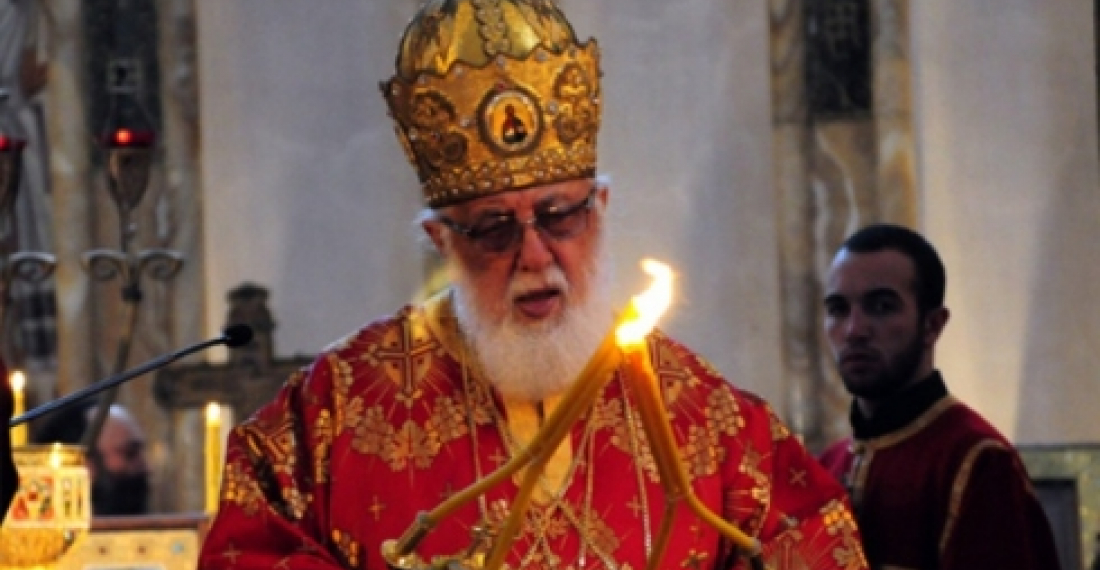
Orthodox leaders from around the world are gathering in Tbilisi to celebrate the 80th birthday of Illia II, the Catholicos Patriarch of All Georgia. The anniversary also coincides with the 35 anniversary of the Patriarch's enthronement. Amongst them will be the Patriarch of Constantinople, Bartholomeo II, the Patriarchs of Serbia and Bulgaria, as well as a high level delegation from the Russian Orthodox Church.
Ilia II was born on 4 January 1913 as Irakli Ghudushauri-Shiolashvili in Vladikavkaz, Russia's North Ossetia, although his family hails from Eastern Georgia. He graduated from the Moscow clerical seminary and was ordained a deacon in 1957 and a monk in 1959; he graduated from the Moscow clerical academy in 1960 and returned to Georgia, where he was assigned to the Batumi Cathedral Church as a priest. In 1963 he became the bishop of Batumi and Shemokmedi and appointed a patriarchal vicar. From 1963 to 1972 he was also the first rector of the Mtskheta Theological Seminary - the only clerical school in Georgia at that time. In 1967, he was consecrated as the bishop of Tskhumi and Abkhazeti and elevated to the rank of metropolitan in 1969.He was elected the new Catholicos-Patriarch of Georgia on December 25, 1977.
Commonspace.eu political editor said in a comment:
"Illia II has played an enormously important role as a symbol of Georgian unity throughout the last turbulent quarter century of Georgian history - from the time when Soviet power started crumbling in the 1980s, right through to the present times when Georgia's fragile democracy and statehood are tested through a period of political co-habitation. The Patriarch, whilst being above politics has never been afraid of expressing himself on issues. This was the case both during the Soviet times, as well as in modern independent Georgia. For this he has often come under attack from left and right, but he has never lost the trust of the Georgian people. Under Illia II the Orthodox Church features constantly as the most trusted institution in the land in opinion polls that have been conducted over the years.
The Patriarch's easter epistle last year focused on the situation in Georgia's prisons. The government of the time criticised his stance but he was completely vindicated a few months later when video footage of prisoner abuse was released. The Patriarch has also advocated dialogue with Russia and maintained good relations with the leadership of the Russian Orthodox Church in the difficult years following the 2008 Georgia-Russia War. During the tense 2012 elections the Patriarch tried to keep out of politics and urged his Bishops and priests to do the same. He constantly called for unity of the Georgian people.
Many Georgian's are concerned about the Patriarch's health, and about what will happen to the Georgian Orthodox Church when he dies. Some also feel that the Church needs to update its position on a number of social issues to remain relevant for the 21st century. For the moment however the Georgian people will over the next few days, join the leaders of the Orthodox community all over the world in celebrating with Illia II his 80th birthday and the 35th anniversary of his enthronement."
source: Commonspace.eu
photo: Illia II, Catholicos Patriarch of All Georgia (archive picture)