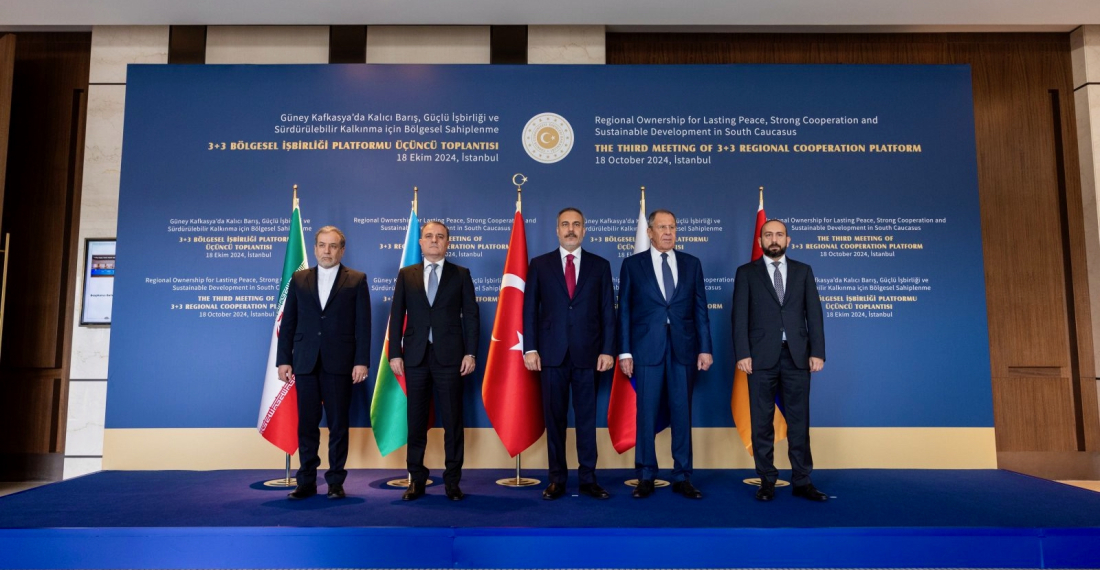
On 18 October, the 3+3 regional cooperation platform which hypothetically includes Armenia, Azerbaijan, and Georgia “plus” three surrounding powers (Türkiye, Iran, and Russia) convened the third meeting at the ministerial level, though again without the participation of Georgia. Hosted by Türkiye in Istanbul, the meeting took place amidst a sensitive security situation in the wider region due to the ramifications of the Russia-Ukraine war, the potential Iran-Israel war, the upcoming fateful parliamentary elections in Georgia, and certainly, the persisting challenges in the Armenia-Azerbaijan peace process.
Nothing new or big came out of the meeting. The very fact that it was possible to be held, and the messages given, however, is of notable significance. Above all, the meeting reaffirmed the consensus among the three surrounding powers, i.e., Russia, Türkiye and Iran, about the geopolitical order established in the South Caucasus after the Second Karabakh War (2020). This was clearly expressed by Hakan Fidan, Turkish Foreign Minister, during his inauguration speech at the event.
“Our perspective on the South Caucasus is… based on a sense of regional ownership. We believe that the states of the region know the regional problems best and are capable of solving them”, Fidan stated. This formula that promotes regional solutions to regional problems started to be clearly pronounced by the sides last year, particularly, prior to and during the second meeting of the 3+3 group in Tehran in October. While this approach is in the obvious interest of Russia and Iran, as they oppose the involvement of the Western players in the affairs of the South Caucasus, Azerbaijan and Georgia look also to agree on this position.
Azerbaijan, in particular, feels threatened by the growing military supplies by France and India to Armenia given the revanchist sentiments in Armenia and the calls by the opposition to reclaim the territories lost to Azerbaijan in 2020-2023. Over the past year since October 2023, when France agreed to provide various types of weapons to Armenia, relations between Azerbaijan and France further deteriorated.
These tensions between Azerbaijan and France have gradually started to be reflected also in the relations between Azerbaijan, on the one hand, and the European Union and the United States on the other. Azerbaijan protests also to the military assistance (10 million euros) provided by the European Peace Facility to the Armed Forces of Armenia. Baku criticizes the EU for double standards, since Brussels never supported Azerbaijan when its territories were under the illegal occupation of Armenia. The military assistance by the EU to Armenia is coordinated with the United States through a new platform to reduce Armenia’s dependency on Russia created as a result of the 5 April trilateral meeting of US Secretary of State Antony Blinken, European Commission President Ursula von der Leyen, and Armenia’s Prime Minister Nikol Pashinyan.
Baku criticises this approach of the Western actors and characterise them as attempts that create “geopolitical dividing lines” in the South Caucasus. Likewise, Baku rejects the calls for the instrumentalisation of the Zangezur corridor in the geopolitical games. This is particularly related to the proposal of the United States to open the corridor without Russia’s participation and use it to reduce the dependency of Central Asia on Russia and China.
Recent events over the past few months suggest a growing rift between Georgia and its Western allies as well. Initially sparked by backlash over the Georgian government’s decision to adopt and implement a contentious regulation known as “foreign agent” law, this tension has escalated into a broader reassessment of the country’s ties with Brussels and Washington. Tbilisi accuses the West of intervention in Georgia’s domestic affairs and attempts to draw the country into the war against Russia. The upcoming elections will therefore determine the future course of Georgia’s external orientation with critical consequences for the wider region. It can be expected that Georgia will expand its role in the regional platforms and likely join the 3+3 group, if the incumbent government succeeds to remain in power.
In this context, Yerevan's position is more ambiguous. Armenia's annual trade turnover with Russia has surged to a staggering $16 billion—nearly an eightfold increase from pre-Ukraine war levels. Armenia has been accused of helping Russia circumvent Western sanctions. Despite this, tensions and disputes continue to strain the Russia-Armenia relationship. Given the dynamics with Azerbaijan and Georgia, Armenia appears to be the West’s last hope for maintaining a presence in the South Caucasus security sphere. However, as the smallest country in the region, landlocked and surrounded by 3+3 members, Armenia lacks the capacity to serve as a stronghold for Western interests in this critical geostrategic area.
This geopolitical configuration in the South Caucasus suggests that regional dynamics are more favourable than ever for the implementation of 3+3 initiatives. While the three surrounding powers are not completely aligned on all issues – evident in the recent tensions between Russia and Iran over the Zangezur corridor – they share a strong common interest in opposing Western involvement in the region. This shared objective gives them considerable potential to resolve their differences and strengthen their collective influence over the South Caucasus.
source: Dr Vasif Huseynov, is a Senior Advisor at the Center of Analysis of International Relations (AIR Center) and Adjunct Lecturer at Khazar University in Baku, Azerbaijan.
The views expressed in opinion pieces and commentaries do not necessarily reflect the position of commonspace.eu or its partners