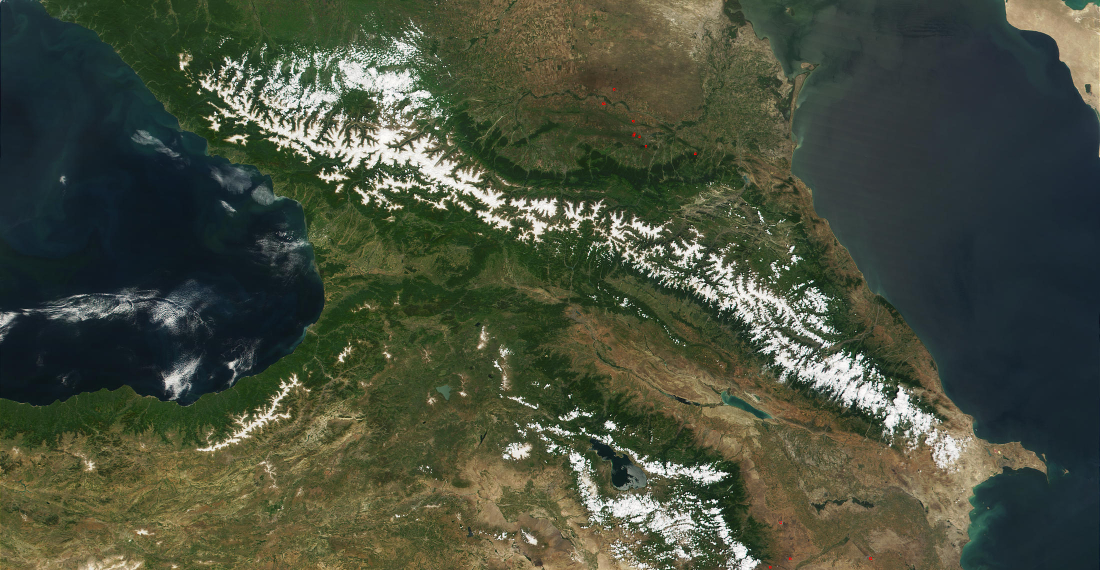
For decades, Russia has stood at the centre of the South Caucasus’ security order. No peace deal, no war settlement, no major infrastructure project could be imagined without Moscow’s involvement. Yet this year, for the first time in Azerbaijan’s modern history, that assumption has been openly challenged. A series of diplomatic clashes between Baku and Moscow, followed last week by the U.S.-mediated summit in Washington, show that Azerbaijan is willing to confront Russia more directly than ever before, and that the South Caucasus may now be shifting away from Moscow at an accelerated pace.
The cracks began to show on 25 December 2024, when an AZAL passenger jet bound for Grozny crashed near Aktau, Kazakhstan. Preliminary Azerbaijani investigations suggested it had been mistakenly struck by a Russian Pantsir-S1 missile system. Thirty-eight people died. Baku’s response was sharper than most experts would predict: Russian cultural institutions were shut down, state media turned critical, and Moscow’s traditional mantle of an ultimate “arbiter” in the Caucasus was openly challenged. From then on, the spiral of mistrust only deepened. Cyber attacks against Azerbaijani state web portals conducted in February were later attributed to Russian hackers, an Azerbaijani MP was refused entry to an official event in Russia without warning or explanation, and Aliyev skipped the 80th Anniversary of the WWII Victory celebrations in Moscow in May. Russian authorities arrested and tortured to death Azerbaijani citizens in late June, further exacerbating the crisis; Baku retaliated with its own arrests and expulsions. Russian media began hosting commentators speculating about military pressure on Azerbaijan, a sign of how hostile the rhetoric had become.
At the same time, Moscow sought to shore up ties with Armenia, but even here its grip was slipping. Armenian leadership, disillusioned by Russia’s lack of support in the 2020 and 2023 wars, took a resolute position on diversifying the country’s foreign policy. Pashinyan’s historic visit to Türkiye in June 2025 symbolised a pivot long considered unthinkable, while Russian border guards left Yerevan’s Zvartnots airport earlier that year. The old monopoly of Russian influence is thus weakening.
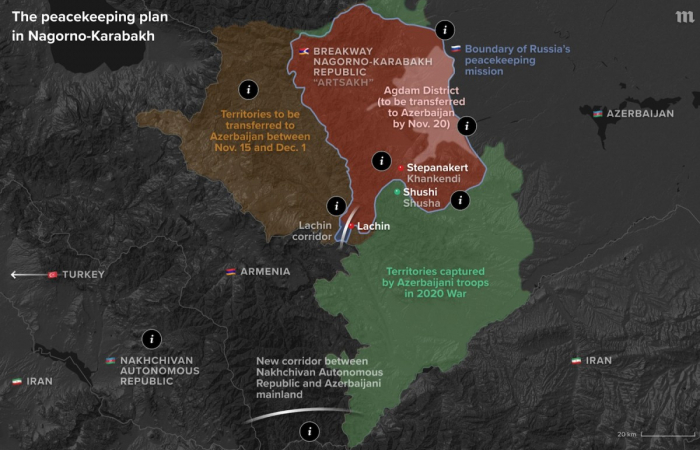
It was against this background that the Washington summit of 8 August unfolded. Hosted by Donald Trump, and bringing together Ilham Aliyev and Nikol Pashinyan, the meeting produced a string of breakthroughs: Baku and Yerevan initialled the peace agreement, which is reportedly to be signed once Armenia amends its constitution, both sides called for the dissolution of the defunct OSCE Minsk Group, and the long-contested Zangezur corridor was finally given a green light. What made this especially significant was not only the agreements themselves, but who guaranteed them. The corridor, once envisaged to be launched under the Russian security oversight, is now to function under the control of an American company, even carrying the label “Trump Route for International Peace and Prosperity” (TRIPP). In a nutshell, Washington has carved out a formal role for itself in the domain Russia once considered its preserve.
Russian reactions captured the unease. Maria Zakarova, the Russian Foreign Ministry’s spokesperson, claimed that “The Westerners aim to transfer the reconciliation process of Baku and Yerevan to their tracks”. Others went further, likening the TRIPP to the creation of a U.S. military base. These warnings illustrate how symbolically charged the corridor has become. However, it would be misleading to frame this moment as Russia’s “loss” of the South Caucasus. Moscow still holds decisive leverage: its troops remain in Abkhazia and South Ossetia; it retains deep economic and cultural ties across the region; and it has decades of institutional know-how in handling the local politics. What has changed is that Russia’s role is no longer accepted by default.
Three conditions have made this shift possible. First, Russia’s focus on the war in Ukraine has drained attention and resources from its southern flank. Second, the TRIPP corridor symbolises American economic and security presence in the region, something unimaginable until now. Third, Armenia itself has been edging towards a more pluralist foreign policy, reducing its reliance on Moscow and seeking closer ties with Western partners. Taken together, these factors create space for both Azerbaijan and Armenia to bring in more actors and reduce their dependency on any single external guarantor. So, in substance, it is less about Russia’s exit and more about the diversification of partnerships.
This pluralisation of the South Caucasus order has several implications. Türkiye, already Azerbaijan’s closest partner, emerges strengthened, as the TRIPP corridor enhances east–west connectivity. The U.S., for the first time, has a tangible stake in regional stability. The EU, though currently sidelined, remains a potential partner interested in enhancing its stake in the region’s energy resources. And Iran, watching uneasily from across its northern border, will scrutinise the corridor as an unwelcome sign of U.S. proximity. In fact, сontradictory statements from Tehran regarding the latest developments in the South Caucasus indicate that they are becoming one of the dividing lines in the struggle unfolding within Iranian elites, and have the potential for triggering profound foreign policy shifts there as well. As for Russia, the old practice of expecting Armenia and Azerbaijan to follow Moscow’s orbit without alternatives is increasingly outdated. To preserve its influence in the region, Russia will need to engage with them as more autonomous actors, ready to accommodate multiple partners, and avoid zero-sum scenarios.
For Azerbaijan, the new reality is double-edged. Aliyev can present himself as the leader who secured peace and safeguarded national interests without bowing to Moscow. Yet, managing relations with Russia remains a delicate matter. A misstep could provoke retaliation, whether economic pressure, covert disruption, or alignment with anti-Azerbaijani actors in the region. On the other hand, for Armenia, the Washington summit provides reassurance that its outreach to the West can deliver tangible results. Yet Yerevan must also guard against overdependence on any single patron and prioritise genuine regional cooperation. If U.S. involvement wanes, or Türkiye’s interests outweigh Armenia’s, the gains could quickly unravel.
The broader lesson is that the South Caucasus is no longer a single-power stage. Russia remains present and influential, but no longer uncontested, and the Washington summit has shown that space exists for others to shape outcomes.
source: Simona Scotti is an expert on EU-South Caucasus relations, security, and Turkey-South Caucasus relations.
The views expressed in opinion pieces and commentaries do not necessarily reflect the position of commonspace.eu or its partners