"Ironically, the outcome of last week’s events in Tbilisi might in fact positively contribute to the possibility of receiving EU candidate status, and may indicate a decline in Russia’s ability to bully its neighbors into pushing a Russian agenda in domestic politics," writes Giorgi Arziani for commonspace.eu. "The growing intolerance of the Georgian people and western partners towards events and developments that culminated in last week’s protests gives hope and renewed optimism that the stalled democracy building process in Georgia may start again," he adds.
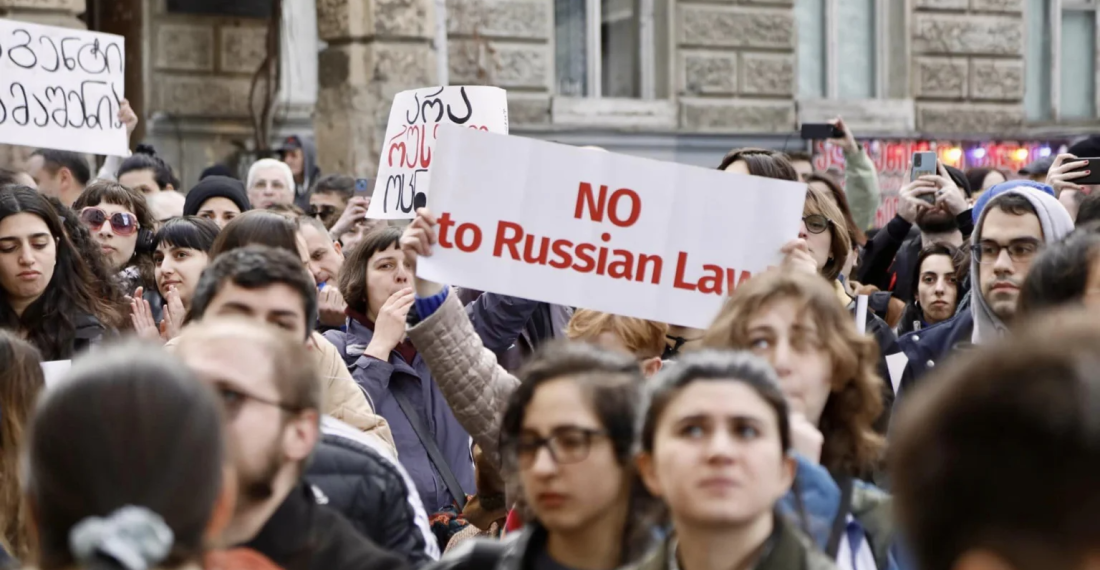
After last week’s three-day protest in Georgia against a law intended to brand media and NGOs that receive funding from abroad as “foreign agents”, the government backtracked, rejected the law in parliament, and released all those detained during the protests. It’s far from the first time that Georgians have protested, however each time the ruling party has managed to push forward with its agenda. But this time Georgians celebrated their first victory over the ever-growing autocratic tendencies of the ruling Georgian Dream party. Why was that?
It is hard to understand the rationale behind the proposed legislation. The ruling party has fully regained its political dominance after a prolonged political crisis followed by the disputed 2020 elections. The Georgian opposition is discredited, fragmented and is going through a hard time reinventing itself, while trying to survive growing pressure from the ruling party. The timing of the legislation was also particularly inexplicable given that Georgia is trying to implement reforms demanded by the EU as conditions for its candidacy for membership. The law would have been a backward step on at least two reforms demanded by Brussels concerning freedom of the media and civil society. To many it appeared to be political idiocy. But it was in fact a deliberate act of self-sabotage.
Russia's reaction suggests Moscow was a main stakeholder
The reaction of Russian officials can shed a light on understanding the circumstances. Russian officials and Kremlin propagandists have been widely commenting on the protests in Tbilisi against Georgia's proposed "foreign agents" bill and have threatened negative consequences. Russian State Duma Speaker Vyacheslav Volodin accused the US of preventing Georgia from becoming “sovereign” after the ruling Georgian Dream party withdrew the bill, while Russian Foreign Ministry spokeswoman Maria Zakharova mocked the EU for criticising the law.
Kremlin propagandist Margarita Simonyan made a thinly-veiled threat to destroy Tbilisi, claiming that protesters, by calling for the de-occupation of Georgian territories, indicated that they wanted to open a “second front” against Russia. Russian Minister of Foreign Affairs, Sergey Lavrov, drew parallels between the events in Georgia and the Euromaidan protests in Kyiv during 2013-2014; the pro-democracy Euromaidan movement led to the removal from power of the corrupt, pro-Russian Ukrainian president, Viktor Yanukovych. This resulted in Moscow's fury, culminating in the illegal annexation of Crimea and the instigation of separatist conflict in the east of Ukraine.
Such a wide-scale reaction to the events which unfolded in Georgia might suggest that the main stakeholder of the Russian-style law, which was meant to curb civil society in Georgia, is in fact Russia itself. Indeed the events surrounding the proposed legislation are somehow similar to the bullying of Ukraine in 2013. Back then, the Ukrainian government was forced to announce its decision to suspend preparations for signing the Association Agreement with the EU - which Russia feared would have taken Ukraine further away from Russian influence - in favour of striking a similar agreement with Russia. It appears that the “foreign agents” legislation was aimed at creating a stalemate in Georgia’s increasingly complicated European integration process. After all, Georgia’s compliance with the EU's 12-point “to-do list” will be evaluated this autumn.
The events of last week may indicate a decline in Russia's ability to bully its neighbors
Ironically, the outcome of last week’s events might in fact positively contribute to the possibility of Georgia receiving EU candidate status, and may indicate a decline in Russia’s ability to bully its neighbors into pushing a Russian agenda in domestic politics. It might also signify that the times of governments receiving western development money while at the same time undermining democratic institutions, are coming to an end. The growing intolerance of the Georgian people and western partners towards events and developments that culminated in last week’s protests gives hope and renewed optimism that the stalled democracy building process in Georgia may start again.