In the negotiations between Armenia and Azerbaijan the future of Nagorno Karabakh has always been the elephant in the room, writes Benyamin Poghosyan in this op-ed for commonspace.eu. "The complete absence of trust, the 35 years of conflict with vigorous anti-Armenian propaganda in Azerbaijan, and the nature of the Azerbaijani state - which according to all credible international assessments is far away from fully protecting and securing the rights of its citizens, both ethnic Azerbaijanis and representatives of ethnic minorities - makes the prospect of Nagorno Karabakh Armenians happily living as Azerbaijani citizens under Azerbaijani jurisdiction a very distant possibility. Decades are needed to create conditions for such an outcome to become a reality. Any attempt to artificially accelerate this process will result in new tensions and armed clashes, and may force many, if not all, Armenians out of Nagorno Karabakh. It is not a desirable outcome and will not contribute to lasting peace and stability in the region", he says. Poghosyan argues that "the only reliable way to avoid this is a long-term international presence in Nagorno Karabakh."
Since the end of the 2020 Nagorno Karabakh war, negotiations have been underway to sign a peace agreement between Armenia and Azerbaijan. The process became active after the June 2021 early parliamentary elections in Armenia, which resulted in the surprising victory for Prime Minister Pashinyan’s Civil Contract party. Armenia and Azerbaijan negotiated on different platforms and different issues. Meetings took place in Moscow, Sochi, Brussels, Washington, and Prague and were focused on the restoration of communications, border delimitation and demarcation, and the signature of a peace treaty. Armenia and Azerbaijan formed two commissions; one focused on communications and the second on border delimitation and demarcation. Sometimes it seemed that sides were very close to inking an agreement, but successful negotiations alternated with large-scale escalations, such as Azerbaijani aggression against Armenia in September 2022.
Armenia and Azerbaijan negotiated on several issues, but the elephant in the room was always Nagorno Karabakh's future. Azerbaijan sought to bypass this issue, claiming that the 2020 war has finished the conflict, and no Nagorno Karabakh exists anymore. President Aliyev even signed a decree establishing the “Karabakh economic region”, seeking to convince Azerbaijani and international society that Nagorno Karabakh was transformed into Karabakh. However, despite these actions, everyone involved in the negotiation process clearly understands that the conflict is there, and no lasting peace and stability is achievable without finding a mutually acceptable solution for the future of Nagorno Karabakh.
Azerbaijan seeks to articulate a vision whereby the viable option to move forward is through negotiations and contacts between the Azerbaijani government and the Armenian community of Karabakh. During these negotiations, Azerbaijani citizens of Armenian origin may raise their concerns, while the government will seek solutions. In Azerbaijan's vision, no international presence or guarantee is needed to facilitate the process, and the two sides will reach a common ground very soon.
Trust between Armenia and Azerbaijan is zero or even below zero
This idealistic picture may sound attractive to anyone unfamiliar with the 35 years history of the conflict. However, it looks wholly detached from reality for those who are part of the conflict, or who followed the conflict, either as an expert, a diplomat, or track 1.5 or track 2 diplomacy participant. Azerbaijan is not Norway or Finland, and its actions and policy before, during, and after the 2020 Nagorno Karabakh war, including the blockade of the Lachin corridor, which continues for more than 100 days, has destroyed any possibility of starting the trust-building process between Nagorno Karabakh and Azerbaijan. The trust between the sides is zero or even below zero, while trust is the most instrumental ingredient for any conflict settlement process.
The complete absence of trust, the 35 years of conflict with vigorous anti-Armenian propaganda in Azerbaijan, and the nature of the Azerbaijani state - which according to all credible international assessments is far away from fully protecting and securing the rights of its citizens, both ethnic Azerbaijanis and representatives of ethnic minorities - makes the prospect of Nagorno Karabakh Armenians happily living as Azerbaijani citizens under Azerbaijani jurisdiction a very distant possibility. Decades are needed to create conditions for such an outcome to become a reality. Any attempt to artificially accelerate this process will result in new tensions and armed clashes and may force many, if not all, Armenians out of Nagorno Karabakh. It is not a desirable outcome and will not contribute to lasting peace and stability in the region.
The only reliable way to avoid this is a long-term international presence in Nagorno Karabakh. Meanwhile, in these types of situations, the devil is always in the details. Currently, the international presence in Nagorno Karabakh is secured through the deployment of Russian peacekeepers. However, they do not have a mandate, as Azerbaijan refused to sign it, and their presence depends on the decisions of the Russian leadership. At any moment, and for any reason, Russia may decide to withdraw its peacekeepers. According to November 10, 2020, trilateral statement, Azerbaijan or Armenia may demand the withdrawal of the Russian peacekeepers every five years, which makes this issue a captive of regional geopolitics and complicated nexus of Russia – Azerbaijan – Turkey – Armenia relations.
Russian peacekeepers cannot provide a lasting solution
The presence of Russian peacekeepers is definitely better than the absence of any international involvement, but within its current modalities, it cannot provide a lasting solution. Usually, international presence in conflict zones is regulated by the UN Security Council resolutions or OSCE decisions. However, given the Russia – West confrontation due to the war in Ukraine, both options do not seem likely. The US and the UK will not agree to provide an international peacekeeping mandate to the Russian troops, and Russia will not completely pull out its troops from Nagorno Karabakh and let in other forces. It may result in a stalemate in UN Security Council and OSCE, as different options can be vetoed either by Russia or the US and the UK.
Currently, the only viable alternative to the geopolitical battles accompanying every extension of the Russian peacekeepers' mandate in Nagorno Karabakh is the possible deployment of an EU mission in Nagorno Karabakh. The EU mission does not require UN SC or OSCE approval. It needs only agreement from Armenia and Azerbaijan and the decision of the European Council. Meanwhile, the EU has more chances to find a common ground with Russia about potential cooperation between the EU mission and Russian peacekeepers. In the long run, if the mission successfully builds trust and confidence between Nagorno Karabakh Armenians and Azerbaijan, the presence of the Russian peacekeepers may be gradually reduced.
There will be many challenges in elaborating the mandate and modalities of a potential EU mission. However, the EU should take the initiative and start initial talks with Armenia and Azerbaijan, while also consulting with Russia. This option could facilitate the peace negotiations between Armenia and Azerbaijan and finally bring peace, stability, and prosperity to the South Caucasus.
Source: Benyamin Poghosyan is a Senior research fellow, APRI – Armenia, and the founder and Chairman of the Centre for Political and Economic Strategic Studies in Yerevan.
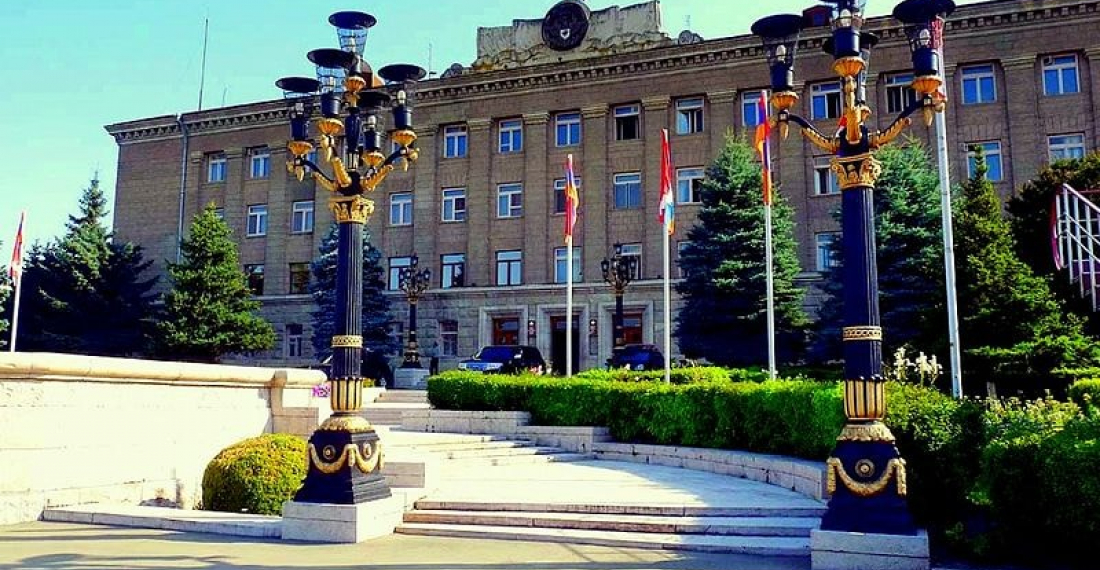
Photo: Government building in Stepanakert
The views expressed in opinion pieces and commentaries do not necessarily reflect the position of commonspace.eu or its partners