Ukraine protests continue as Zelenskyy offers new anti-corruption bill after European pressure

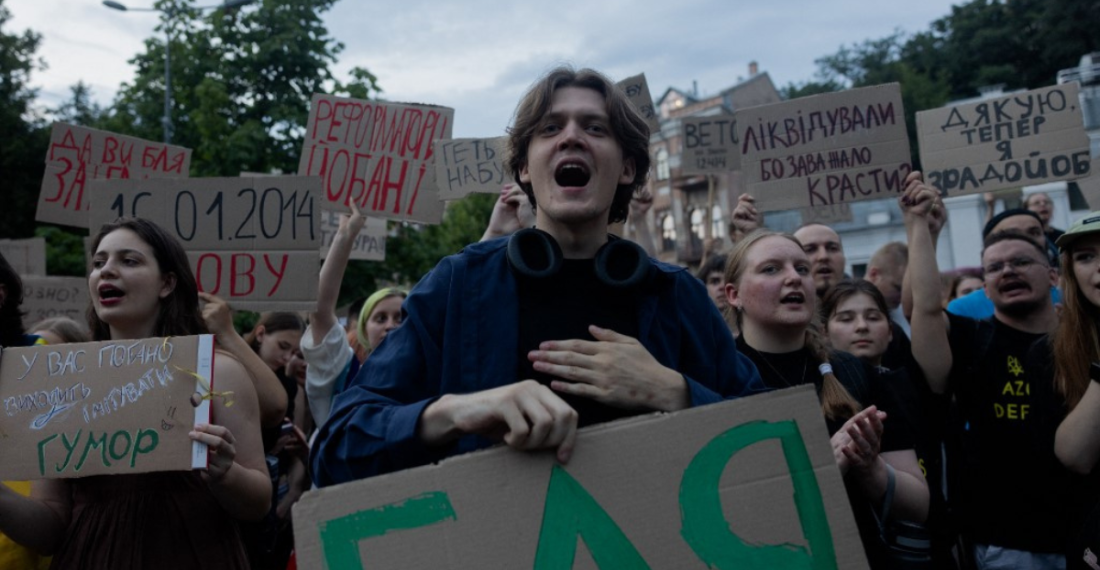
Ukrainians are taking to the streets to protest a new law they worry will undermine the work of two key anti-corruption agencies and erode the independence of bodies meant to provide a check on power. Protests are growing and spreading around the country even as President Volodymyr Zelenskyy offered a vague new bill to alleviate demonstrators’ concerns. After a day of pressure from Ukrainian citizens, the European Commission and many European governments, Zelenskyy said he “heard the public opinion” and promised to fix the situation with a new bill that he pledged would preserve the independence of corruption agencies.

Discontent over the law led to the first major demonstration against the government in more than three years of war, marking the most serious fracture yet in the national unity that has helped Ukraine resist Russia’s invasion.  President Zelenskyy defended the law as necessary to remove “Russian influence” from the fight against corruption, though he didn’t provide examples of such interference, according to AP.

Thousands of people showed up in Kyiv, Lviv, Dnipro and Odesa, and even the frontline city of Kharkiv near the Russian border, a day after Zelenskyy signed the original bill that critics said undermined the independence of the National Anti-Corruption Bureau (NABU) and the Special Anti-Corruption Prosecutor’s Office (SAP).

“We heard what people are saying these days, what people are saying on social networks, to each other, on the streets. All this is not in vain. We have analyzed all the concerns, all the aspects of what should be changed,” Zelenskyy said in a video address on Wednesday evening, as protesters chanted on the streets outside his office.

Zelenskyy said that after a day of talks with affected parties, he will soon propose a bill to the Ukrainian parliament that will be “a response to the situation, and will provide strength to the law enforcement system. All the norms for the independence of anti-corruption institutions will be there,” Zelenskyy said. “This will be a presidential bill, and we will implement it within the framework of our strategy for transforming the state,” Zelenskyy added, providing few specifics and no deadline for the new bill.

The NABU and SAP supported Zelenskyy’s pivot, saying they are ready to join the discussion and preparation of a legislative solution that will eliminate legal risks, meet rule-of-law standards and provide greater potential for guaranteeing justice in Ukraine. 

But Zelenskyy’s sudden concession did not calm the streets, as protesters demanded to see the law first. “Until we see the text, it’s hard to assess it, or even whether it will happen. There’s no faith in Zelenskyy! We need to keep pushing,” Ukrainian war veteran Oleh Symoroz said on social media.

Some opposition lawmakers called on protesters to demand an urgent parliament meeting to reverse the controversial law that drove Ukrainians to their first anti-government protests since Russia launched its all-out war in 2022.

Top EU leadership had urged Zelenskyy on Wednesday to prove he is still committed to European democratic values after signing the inflammatory law, which European allies including Germany said threatens to fatally undermine Ukraine’s ongoing bid to join the bloc.

The Ukrainian branch of Transparency International also criticized the law, saying it undermines one of the most significant reforms since the 2014 uprising and that it damages trust with international partners.

Fighting entrenched corruption is crucial to Ukraine’s bid to join the European Union and maintain access to billions of dollars in Western aid. In a post on X, EU Enlargement Commissioner Marta Kos called the new law “a serious step back.”

The action against the agencies comes only a month after the NABU launched a criminal investigation into then Deputy Prime Minister Oleksii Chernyshov, one of the highest-profile corruption cases since Zelenskyy took office. Chernyshov has denied the allegations but was removed from his post during last week’s government reshuffle.

It also follows the arrest of two NABU officials on suspicion of having ties to Russia by Ukraine’s Security Service.
Source: commonspace.eu with AP, Politico and agencies. Photo: Ukrainians protesting the new anti-corruption bill/AFP

Related articles

Editor's choice
News
Borrell tells the European Parliament that the situation in Afghanistan was critical, but the EU will remain engaged

Borrell tells the European Parliament that the situation in Afghanistan was critical, but the EU will remain engaged

Borrell underlined that the European Union will make every effort to support the peace process and to remain a committed partner to the Afghan people. "Of course, we will have to take into account the evolving situation, but disengagement is not an option.  We are clear on that: there is no alternative to a negotiated political settlement, through inclusive peace talks.
Editor's choice
News
Pope's visit to Türkiye and Lebanon has a strong ecumenical character, and places interreligious dialogue at its centre

Pope's visit to Türkiye and Lebanon has a strong ecumenical character, and places interreligious dialogue at its centre

Pope Leo XIV has begun the first overseas trip of his pontificate, a six-day visit to Türkiye and Lebanon, which started yesterday (27 November) and ends on Tuesday (2 December). According to Vatican Radio, the visit "carries a strong ecumenical character and places interreligious dialogue at its centre. It will also be a moment of closeness to Christian communities and local populations across the region".   During nearly a week in the region, Pope Leo XIV will meet civil and religious authorities, visit mosques and ancient churches, pray at Beirut’s port in memory of the victims of the 2020 explosion, and hold private meetings with Presidents Recep Tayyip Erdoğan and Joseph Aoun.   A highlight of the visit will be a visit to Nicaea, where the Pope will mark the anniversary of the Council of Nicaea. Christians of many traditions recognise the Council of Nicaea as a foundation of shared faith. One of the most anticipated moments will be the Pope’s encounter with Lebanese youth in Bkerké, at the Maronite Patriarchate, a meeting expected to carry strong messages of hope in the Jubilee Year. A central event will be the ecumenical celebration in İznik, where the Pope and Ecumenical Patriarch Bartholomew will walk together toward the ruins of the Basilica of St Neophytos. The prayer, held before icons of Christ and the Council, will conclude with the lighting of a candle—a symbolic gesture of unity. The journey will also highlight interreligious engagement.   Memorable moments are expected throughout the trip: a wreath at Atatürk’s mausoleum, prayer inside the Blue Mosque, Mass at Istanbul’s Volkswagen Arena, the planting of a cedar at the presidential palace in Beirut, and prayer at the tomb of St Charbel in Lebanon. The Vatican said that "Pope Leo XIV’s pilgrimage to Türkiye and Lebanon aims to offer a voice of peace, unity, and hope at the heart of the Middle East."

Popular

Editor's choice
News
Pope's visit to Türkiye and Lebanon has a strong ecumenical character, and places interreligious dialogue at its centre

Pope's visit to Türkiye and Lebanon has a strong ecumenical character, and places interreligious dialogue at its centre

Pope Leo XIV has begun the first overseas trip of his pontificate, a six-day visit to Türkiye and Lebanon, which started yesterday (27 November) and ends on Tuesday (2 December). According to Vatican Radio, the visit "carries a strong ecumenical character and places interreligious dialogue at its centre. It will also be a moment of closeness to Christian communities and local populations across the region".   During nearly a week in the region, Pope Leo XIV will meet civil and religious authorities, visit mosques and ancient churches, pray at Beirut’s port in memory of the victims of the 2020 explosion, and hold private meetings with Presidents Recep Tayyip Erdoğan and Joseph Aoun.   A highlight of the visit will be a visit to Nicaea, where the Pope will mark the anniversary of the Council of Nicaea. Christians of many traditions recognise the Council of Nicaea as a foundation of shared faith. One of the most anticipated moments will be the Pope’s encounter with Lebanese youth in Bkerké, at the Maronite Patriarchate, a meeting expected to carry strong messages of hope in the Jubilee Year. A central event will be the ecumenical celebration in İznik, where the Pope and Ecumenical Patriarch Bartholomew will walk together toward the ruins of the Basilica of St Neophytos. The prayer, held before icons of Christ and the Council, will conclude with the lighting of a candle—a symbolic gesture of unity. The journey will also highlight interreligious engagement.   Memorable moments are expected throughout the trip: a wreath at Atatürk’s mausoleum, prayer inside the Blue Mosque, Mass at Istanbul’s Volkswagen Arena, the planting of a cedar at the presidential palace in Beirut, and prayer at the tomb of St Charbel in Lebanon. The Vatican said that "Pope Leo XIV’s pilgrimage to Türkiye and Lebanon aims to offer a voice of peace, unity, and hope at the heart of the Middle East."