Opinion: French politicians lured to the east ahead of presidential poll

Armenia has become a "must visit" destination for those contesting next spring's French presidential elections. Alexandre Petrosyan discusses why, in this oped for commonspace.eu

After announcing his candidacy in the 2022 French presidential election, Eric Zemmour, a  controversial, far-right politician, referred to as a French Donald Trump, started his campaign. His first foreign destination was Armenia, where he arrived as he mentions ‘to support the first Christian nation who is today harassed by its two neighbours: Turkey and Azerbaijan’.  Despite his expectations, Zemmour was welcomed by a small group of protestors calling him ‘racist, fascist’ and his visit did  not receive much attention within Armenia.

Zemmour, who is known for his islamophobia, right-wing populism and anti-immigration views, leads the newly established political party called Reconquête,  a reference to the Reconquista period in the Iberian peninsula.  During his trip to Armenia, Zemmour visited the Khor Virap monastery, close to the Turkish border, where he explained the Armenian-Turkish relations through an Islamophobic lens. Neither Zemmour, nor his companions realise that   Armenian-Turkish and Armenian-Azerbaijani problems  are merely political ones and there is no religious ground in any of them. Armenia can’t be regarded as an Islamophobic country, simply because it has very good relations with  the neighbouring Islamic Republic of Iran, and her Muslim countries of the Middle East, where hundreds of thousands Armenians live.

Zemmour’s arrival to Armenia  had the purpose to attract  the votes of the Armenians living in France, and at the same time play to the sensibilities of the Catholics of France, who are particularly interested in the destiny of the Eastern Christians. However, he also causes problems  to the long-time leader of the right-wing, Marine Le Pen, who promotes almost the same ideas, but with other labelling. The most important thing which continues to bring other presidential candidates to Armenia is that no one of the candidates has a chance to secure necessary victory in the first round and most probably there will be the second round between the two candidates who will receive the most votes. And the second round is scheduled on 24 April 2022, which is the Armenian Genocide remembrance day. Given the fact that the Armenians are mostly concentrated in Paris, Marseille, Lyon and Valence and their number  is estimated to be around 800 000,  half of whom have the right to vote, such attention towards Armenia is quite understandable.  

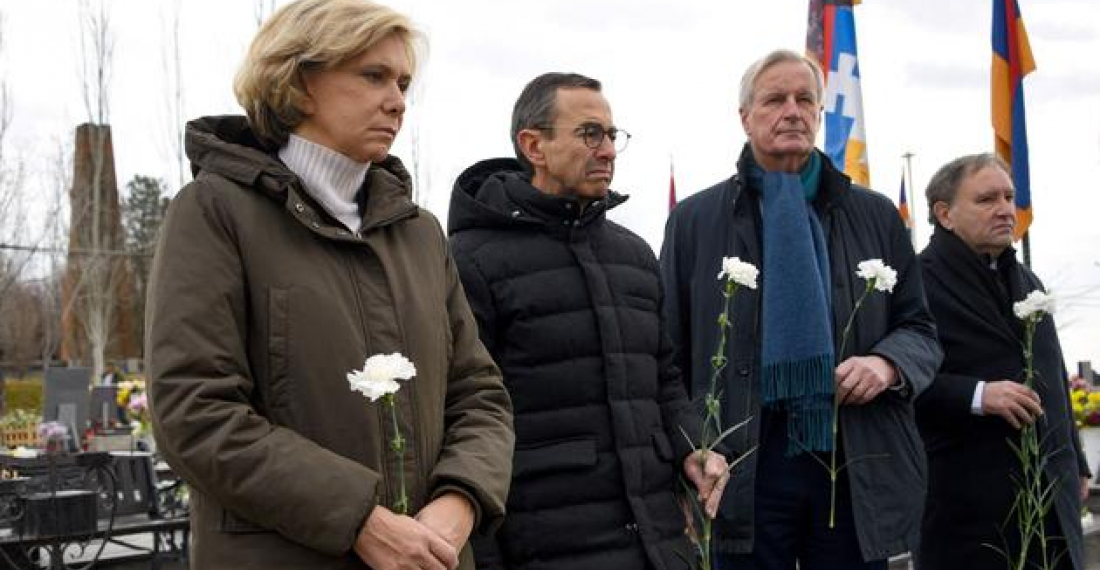
A week  after Zemmour’s departure, another prominent candidate for the presidency, Valerie Pecresse, former Minister of Budget and incumbent head of the regional council of Ile-de-France, paid a visit to Armenia. According to  recent polls, Pecresse has the highest chances of presidential victory, after Macron. Compared with Zemmour, she was warmly welcomed in ‘brotherly Armenia’, where she met with the President, the Speaker of the Parliament and the Minister of Foreign Affairs. Pecresse’s delegation was very representative.  Apart from some representatives of the Armenian diaspora, there were Michel Barnier, until recently the EU’s chief Brexit negotiator and Bruno Retailleau, president of the Republicans faction in the French Senate. Besides visiting the Armenian Genocide Memorial Complex and Yerablur Military Pantheon, Pecresse went far beyond established formalities and visited Nagorno-Karabakh, meeting with the president and the minister of foreign affairs, criticising France’s inactivity in the OSCE, and the inability to deliver more humanitarian aid for the post-war restoration process. This immediately triggered an Azerbaijani condemnation and  the visitors’ names were added to the long list of that country’s personae non gratae. Pecresse  left Armenia with the promise to organise an international conference in Paris in support of Armenia and Arstakh/Karabakh and to activate  French foreign policy in the South Caucasus, in case of being elected, as according to her, ‘French security is connected with Armenia as well’.

The next outstanding candidate who tries to convince Armenians and to unite the French Left is Anne Hidalgo, current mayor of Paris. Back in June, during his visit to Paris Pashinyan met with Hidalgo, inviting her to visit Yerevan in autumn.  Autumn came and went, and her visit didn’t take place. Instead, she pledges ‘to promote the recognition of the Nagorno-Karabakh Republic’ and also to pursue the criminalization of the Armenian Genocide denial. She has recently initiated the opening ceremony of the ‘Esplanade of Armenia’, when  the delegation led by Armenia’s Foreign Affairs Minister was in Paris at the beginning of December.

The final candidate who has the sympathy of the Armenians and right now has the highest chances to be elected is the current president Emanuel Macron. His activity during the Second Karabakh war, the attempts to restore the OSCE Minsk group and to raise the issue of the status of Nagorno-Karabakh, found warm acceptance among Armenians both at home and abroad. Macron’s activity in the OSCE Minsk Group and also in other European affairs are mostly related with his ambitions to replace Merkel at the helm of the EU, and at the same time to silence the voices in opposition who blame him in declining prestige and influence of France. After his visit to Paris in June, Pashinyan stated that Macron’s scheduled visit to Armenia, which was cancelled because of the COVID, would be organised in  the autumn. So far, the visit hasn’t taken place. Most probably Macron would visit the region, including Armenia, next year prior to the elections, in order to win the hearts of Armenians.

Any possible outcome of the French presidential elections wouldn’t challenge the current level of relations with Yerevan. France is an important partner for Armenia within the EU as well. Armenia should convert the existing nature of relations with France into more tangible achievements, viewing it as a channel for modernisation, the enhancement of democratic institutions and also an essential source for foreign policy diversification. 
source: Alexander Petrosyan is an independent Brussels based analyst focusing on the South Caucasus and Eastern Europe. 
photo: French presidential candidate Vaslerie Precresse, and her delegation, visited Armenia, as well as the Armenian controlled part of Nagorno-Karabakh ahead of next April's poll.
The views expressed in opinion pieces and commentaries do not necessarily reflect the position of commonspace.eu or its partners

Related articles

Editor's choice
News
Council of Europe launches new International Claims Commission for Ukraine

Council of Europe launches new International Claims Commission for Ukraine

Thirty-four countries and the European Union have signed a new convention establishing an International Claims Commission for Ukraine at a diplomatic conference co-hosted by the 46-nation Council of Europe and the Netherlands in the Hague. The diplomatic conference was attended by leaders and high-level representatives from over 50 states, including the President of Ukraine, Volodymyr Zelenskyy, the President of the Republic of Moldova, Maia Sandu, and the Prime Minister of the Netherlands, Dick Schoof.  “Today marks a major step forward in ensuring accountability for Ukraine. The International Claims Commission represents justice and hope for tens of thousands of victims—our determination that those who have suffered will not be forgotten. I call for quick ratifications so we can get the commission rapidly up and running for the people of Ukraine,” said Council of Europe Secretary General Alain Berset. Ukrainian President Volodymyr Zelenskyy said: “We expect that every mechanism for compensation from the Register of Damage and Claims Commission to the actual payments – will start working and receive strong and sufficient international support, so that people can truly feel that any kind of damage caused by the war can be compensated. This war, and Russia’s responsibility for it, MUST become a clear example – so that others learn not to choose aggression.” “Accountability is about creating the conditions for peace that endures. And therefore, accountability is a condition of security – today and for the future. But accountability is not only about Ukraine. And it is not only about one aggressor and one victim. Accountability is about Europe. About every country in Europe. It is about whether Europe, as a whole, is willing to defend its peace,” said Maia Sandu, President of the Republic of Moldova, which currently holds the Presidency of the Council of Europe’s Committee of Ministers. The Prime Minister of the Netherlands, Dick Schoof, said: “Every day Russia is deliberately bombarding homes, destroying businesses and damaging infrastructure in Ukraine. Russia must compensate Ukraine for the damage caused. That is why we have launched the International Claims Commission for Ukraine and we are honoured to host it.” The International Claims Commission will be the second part of a comprehensive compensation mechanism related to Russia’s war of aggression, building on the existing Register of Damage for Ukraine. The claims commission will be established within the framework of the Council of Europe and will also be open to other countries. The Register of Damage for Ukraine, created in 2023, collects and records compensation claims submitted by individuals, organisations and public bodies in Ukraine. Forty-four states and the European Union have so far joined the Register, which has already received 86,000 claims. The International Claims Commission will review, assess and decide upon claims submitted to the Register of Damage for Ukraine and determine the amount of compensation, if any, which is due in each case. The convention establishing the commission will enter into force once it has been ratified by 25 signatories, as long as sufficient funds have been secured to support its initial work.

Popular

Editor's choice
News
Council of Europe launches new International Claims Commission for Ukraine

Council of Europe launches new International Claims Commission for Ukraine

Thirty-four countries and the European Union have signed a new convention establishing an International Claims Commission for Ukraine at a diplomatic conference co-hosted by the 46-nation Council of Europe and the Netherlands in the Hague. The diplomatic conference was attended by leaders and high-level representatives from over 50 states, including the President of Ukraine, Volodymyr Zelenskyy, the President of the Republic of Moldova, Maia Sandu, and the Prime Minister of the Netherlands, Dick Schoof.  “Today marks a major step forward in ensuring accountability for Ukraine. The International Claims Commission represents justice and hope for tens of thousands of victims—our determination that those who have suffered will not be forgotten. I call for quick ratifications so we can get the commission rapidly up and running for the people of Ukraine,” said Council of Europe Secretary General Alain Berset. Ukrainian President Volodymyr Zelenskyy said: “We expect that every mechanism for compensation from the Register of Damage and Claims Commission to the actual payments – will start working and receive strong and sufficient international support, so that people can truly feel that any kind of damage caused by the war can be compensated. This war, and Russia’s responsibility for it, MUST become a clear example – so that others learn not to choose aggression.” “Accountability is about creating the conditions for peace that endures. And therefore, accountability is a condition of security – today and for the future. But accountability is not only about Ukraine. And it is not only about one aggressor and one victim. Accountability is about Europe. About every country in Europe. It is about whether Europe, as a whole, is willing to defend its peace,” said Maia Sandu, President of the Republic of Moldova, which currently holds the Presidency of the Council of Europe’s Committee of Ministers. The Prime Minister of the Netherlands, Dick Schoof, said: “Every day Russia is deliberately bombarding homes, destroying businesses and damaging infrastructure in Ukraine. Russia must compensate Ukraine for the damage caused. That is why we have launched the International Claims Commission for Ukraine and we are honoured to host it.” The International Claims Commission will be the second part of a comprehensive compensation mechanism related to Russia’s war of aggression, building on the existing Register of Damage for Ukraine. The claims commission will be established within the framework of the Council of Europe and will also be open to other countries. The Register of Damage for Ukraine, created in 2023, collects and records compensation claims submitted by individuals, organisations and public bodies in Ukraine. Forty-four states and the European Union have so far joined the Register, which has already received 86,000 claims. The International Claims Commission will review, assess and decide upon claims submitted to the Register of Damage for Ukraine and determine the amount of compensation, if any, which is due in each case. The convention establishing the commission will enter into force once it has been ratified by 25 signatories, as long as sufficient funds have been secured to support its initial work.