"Azerbaijan and Ukraine officially consider each other “strategic partners” and have consistently supported each other’s territorial integrity and inviolability of their internationally-recognized borders," writes Vasif Huseynov in this op-ed for commonspace.eu. "Azerbaijan’s support to Ukraine’s territorial integrity and sovereignty within its internationally recognized borders exemplifies the country’s broader foreign policy principles. Having itself experienced invasion and ethnic cleansing by neighboring Armenia, Azerbaijan possesses a clear understanding and empathy for Ukraine’s current challenges," he writes.
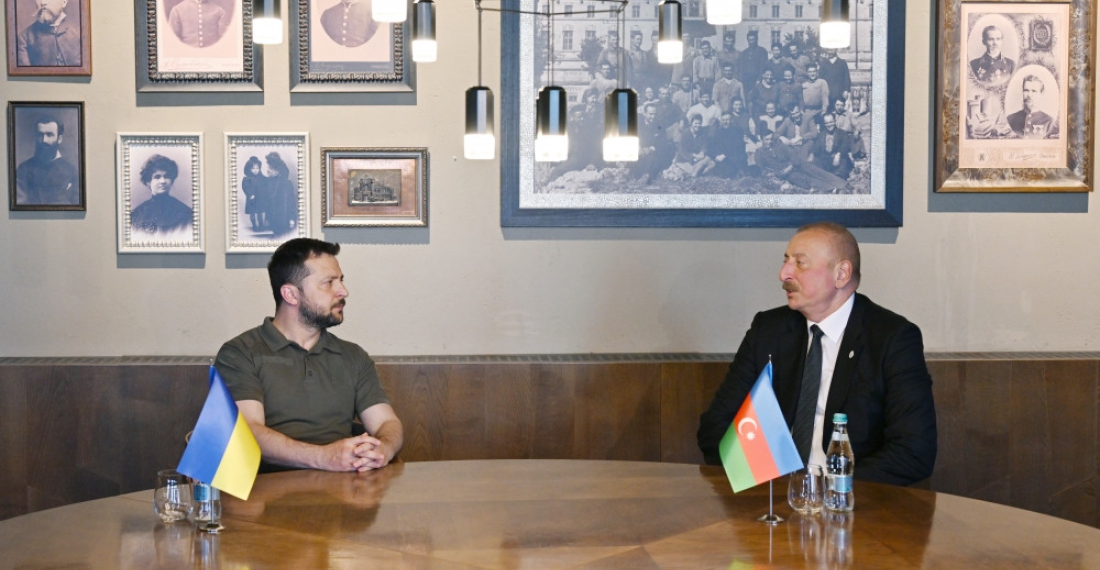
On 1 June, President Ilham Aliyev of Azerbaijan had a meeting with Ukrainian President Volodymyr Zelensky during the second gathering of the European Political Community in Chișinău, Moldova. It is noteworthy that President Aliyev was the only leader from the South Caucasus to meet with the Ukrainian President, which holds particular political significance in the context of Ukraine’s ongoing struggle against Russian invasion.
During their meeting, both leaders expressed mutual support for the territorial integrity and sovereignty of their respective countries within their internationally recognized borders. One intriguing and quite symbolic aspect that drew observers’ attention was the use of English as the language of the meeting, despite the fact that both leaders are more comfortable speaking in Russian.
Azerbaijan and Ukraine officially consider each other “strategic partners” and have consistently supported each other’s territorial integrity and inviolability of their internationally-recognized borders. In January 2022, just a month before the full-scale invasion, and amidst the escalation of hostilities, President Aliyev was conspicuously the only leader from the post-Soviet space (excluding the Baltic States) who travelled to Kyiv, where he signed a number of agreements on deepening bilateral cooperation and declared his support for Ukraine’s territorial integrity and sovereignty.
Hence, the latest meeting between the two leaders demonstrated Azerbaijan’s consistency in its support to Ukraine, despite all the pressure from the Russian side. According to the Azerbaijani government, Baku has provided around €20 million in humanitarian aid to Ukraine since the beginning of the full-scale war. Azerbaijan’s state energy company, SOCAR, has been providing free fuel at its gas filling stations in Ukraine specifically for ambulances and vehicles operated by the State Emergency Service of Ukraine (DSNS). Considering that there are more than 50 such stations of SOCAR in Ukraine, this assistance may have been important for the DSNS.
Azerbaijani humanitarian aid for Ukraine draws "bewilderment" from Moscow
Furthermore, Azerbaijan has extended its humanitarian support to Ukraine by sending various forms of aid, including medical supplies and clothing. Azerbaijan dispatched 45 power transformers and 50 generators to regions in Ukraine that were experiencing power shortages and lacked heating. Interestingly, the Russian Foreign Ministry expressed “bewilderment” over Azerbaijan’s provision of transformers and generators, portraying them as military assistance to Ukraine.
“Such a step on the part of Baku is puzzling. As part of a special military operation, the Armed Forces of the Russian Federation are destroying the critical infrastructure of Ukraine used by the Kyiv regime for military needs. Azerbaijani supplies, which are unlikely to fundamentally change the situation, do not amount to humanitarian aid,” a representative of the Russian Foreign Ministry said to local media in December 2022.
This reaction has, however, not stopped Azerbaijan from providing this support. In a recent act of solidarity, Azerbaijan provided humanitarian aid consisting of pumps, boats, protective suits and uniforms to mitigate the consequences of the collapse of the dam at the Kakhovka hydroelectric plant on 6 June.
In the course of the 1 June meeting, President Zelensky thanked the Azerbaijani leader for Baku’s assistance provided for the reconstruction of Ukraine’s infrastructure. “We highly appreciate Azerbaijan's participation in the restoration of infrastructure facilities in Kyiv Oblast. We hope for assistance in the further reconstruction of Ukraine. In the post-war period, we look forward to Azerbaijan's active participation in investment projects in Ukraine,” the country’s president said.
Increasing speculation that Armenia is helping Russia evade sanctions
Along with providing humanitarian support to Ukraine, Azerbaijan has been one of the few countries in the entire post-Soviet space that has refused to help Russia evade Western sanctions. This approach by the Azerbaijani government, which is in line with the country’s overall support to Ukraine, appears in a stark contrast to that of some other former Soviet countries, including Armenia.
For example, a latest international report reveals that “Armenia’s exports to Russia surged in 2022, at a staggering growth rate of 187% compared to the previous year. Moreover, over half of these exports were re-exports originating from third countries, adding fuel to speculation that Armenia is playing a key role in the rerouting of Western imports to Russia to avoid sanctions”. This is presented as the reason why the US has also identified Armenia as one of five countries that pose challenges in terms of evading sanctions.
This situation forms a contradiction to the statement of the Armenian Prime Minister Nikol Pashinyan who tries to convince the Western public that “Armenia is not Russia’s ally in its war against Ukraine”. Some commentators explain Azerbaijan’s more independent standing in this present geopolitical context due to the country’s resources and geographical position as a necessary link on both the Middle Corridor and on the international North-South Transportation Corridor.
Baku has never aligned its foreign policy with Russia, or joined Moscow-led integration projects
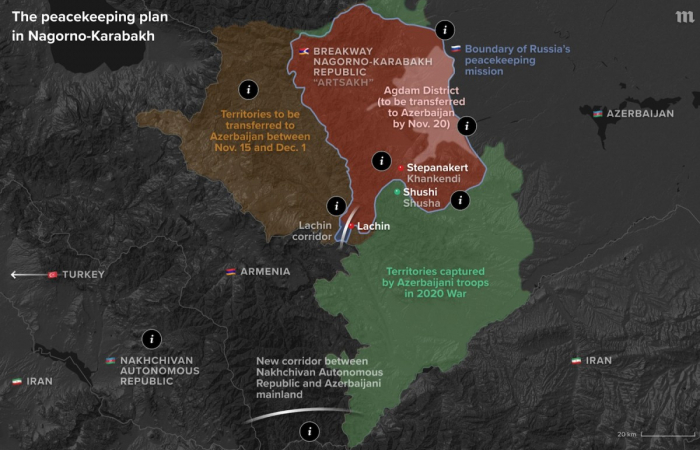
This analysis disregards the fact that Azerbaijan’s balanced approach in foreign policy and independent stance against Russia’s regional ambitions date back to the mid-1990s. As opposed to Armenia, who joined Russia’s military and economic blocks decades ago and benefitted from the Russian support to maintain a some three-decade long occupation of 20% of Azerbaijan’s territory, Baku never aligned its foreign policy with that of Russia and avoided Moscow-led integration projects despite the Kremlin’s insistence and pressure.
That said, Azerbaijan’s support to Ukraine’s territorial integrity and sovereignty within its internationally recognized borders exemplifies the country’s broader foreign policy principles. Having itself experienced invasion and ethnic cleansing by neighboring Armenia, Azerbaijan possesses a clear understanding and empathy for Ukraine’s current challenges.
source: Dr Vasif Huseynov, is a Senior Advisor at the Center of Analysis of International Relations (AIR Center) and Adjunct Lecturer at Khazar University in Baku, Azerbaijan.
photo: AzTV
The views expressed in opinion pieces and commentaries do not necessarily reflect the position of commonspace.eu or its partners