


"Long term economic development may play a key role in defining the balance of power between Armenia and Azerbaijan" says Dr Benyamin Poghosyan in this op-ed
The last month has seen Armenia engaging in high level contacts with Iran and Turkmenistan. Armenian President Serzh Sargsyan participated in Iranian President Rouhani's inauguration. During a bilateral meeting between the two presidents perspectives for developing Armenian - Iranian relations were discussed including the possibility to expand the cooperation in the energy sphere. Currently Armenia imports Iranian gas, turns it into electricity in its gas power plants, and exports electricity back to Iran. The project is based on 3 kilowatt hour electricity for one cubic meter gas scheme. The third Armenia-Iran high voltage electricity transmission line is under construction which will allow for a significant increase in electricity exports to Iran. The Presidents discussed also the possibility of additional gas imports from Iran for Armenia's domestic consumption which may shake the monopoly that Russia's Gazprom has over the Armenian gas market.
Another opportunity for moving further bilateral cooperation in the energy sphere is the long discussed possibility of Iranian gas transit through Armenia into Georgia and further on to the European Union markets via Black Sea pipelines connecting Georgia to Ukraine, or as a liquefied natural gas (LNG) if Georgia manages to construct a LNG terminal in its Black Sea coast. If implemented, the project can transform Armenia into a key transit country, playing an important role in strengthening EU energy security. Of course, this is a long-term project facing both technical and political obstacles. Iran needs investments to boost its gas infrastructure to bring necessary volumes of gas from southern fields to the Armenian-Iranian border. Russia definitely will oppose projects which may endanger Gazprom's position in Europe, and taking into account the Crimean crisis any pipeline construction connecting Georgian and Ukrainian Black sea coasts will face both political and technical difficulties.
Armenia and Iran are also closely cooperating in launching a new "Persian Gulf-Black Sea" transportation corridor, which will connect Iranian Persian Gulf Ports with the Georgian Black Sea coast via Armenia. The possibility to include this project into China's "One Belt, One Road" initiative may significantly increase the geopolitical importance of this corridor.
Armenia and Iran are actively discussing the deepening of bilateral cooperation by connecting their free economic zones. The Iranian Aras free economic zone is functioning near the Armenian - Iranian border, and Armenia is planning to launch "Meghri" free economic zone in autumn 2017. Iranian President's Advisor and secretary of Iran's Free Trade, Industrial and Special Economic Zones Akbar Torkan recently visited Armenia and held negotiations with Armenian Minister of Economic Development and Investments Suren Karayan discussing the expansion of cooperation between two states. Armenia is positioning itself as a bridge for Iran towards both Eurasian Economic Union (EAEU) and EU markets. As an EAEU member state Armenia exports to the Union member states with zero tariffs, and due to its GSP+ agreement with the EU, thousands of Armenian products can be exported into EU markets with zero tariffs too. Armenia is offering Iran to establish production lines in Meghri free economic zone, and export the products both to EAEU and EU markets. Simultaneously, the 80 million strong Iranian market can play a significant role in Armenian efforts to boost its export capacities. Negotiations are underway to sign a free trade agreement between Iran and EAEU. If that happens, Armenia, as the only EAEU member state having land border with Iran may become a launch pad for European and Chinese companies wanting to enter the Iranian market.
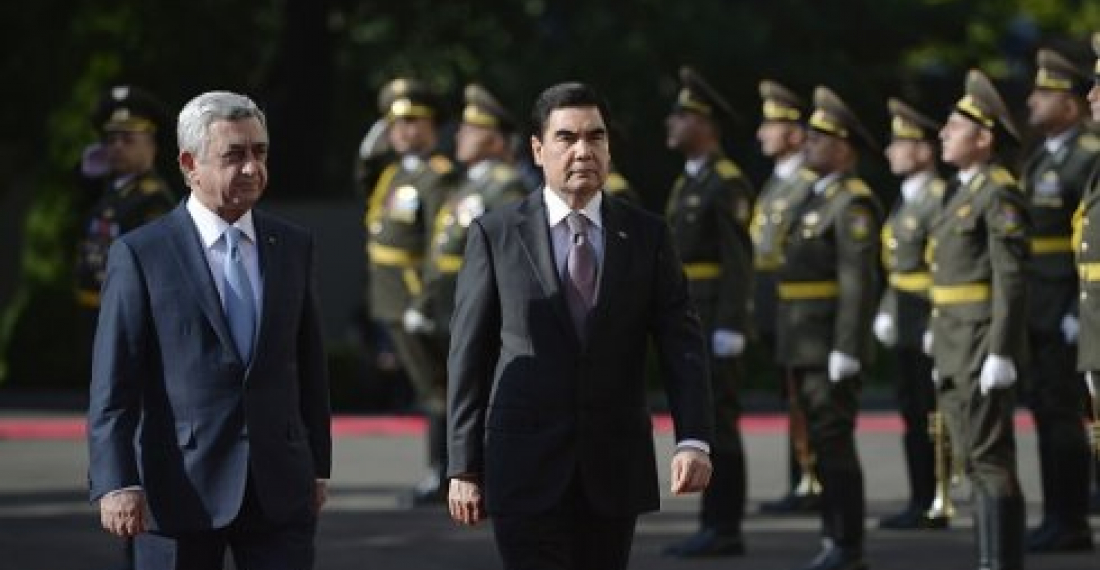
On August 24, 2017 the Armenian President received in Yerevan his Turkmenistan counterpart Gurbanguly Berdimuhamedov. The bilateral talks were focused on deepening economic relations including in the energy sphere. The possibility of Armenia-Iran-Turkmenistan trilateral cooperation, including the import of gas from Turkmenistan via Iran was discussed. Although many technical details need to be clarified, this is another example of Armenia trying to use every opportunity to increase its involvement in regional cooperation projects.
Armenian recent moves to boost regional cooperation are based on its desire to overcome its isolation from energy and transportation projects being implemented in the South Caucasus. Due to the coordinated policy of Azerbaijan and Turkey Armenia is excluded from oil and gas pipelines bringing Azerbaijani resources via Georgia to Turkey and Europe. The Baku-Akhalkalaki-Kars railway connecting Azerbaijan and Turkey which is going to be launched later this year is another move to deepen the isolation of Armenia. Azerbaijan is actively working with Iran and Russia to connect railroads, and put into operation a North-South transportation corridor to connect India with Europe via Iran, Azerbaijan and Russia.
Given the little hope of any breakthrough in the Karabakh negotiation process, Armenian-Azerbaijani rivalry is likely to continue for the foreseeable future. In this "war of attrition" scenario long term economic development may play a key role in defining the balance of power between Armenia and Azerbaijan. The efforts to expand regional cooperation and involve Armenia in transit projects is critical for Yerevan in its quest for balancing Azerbaijan, and for simultaneously increasing its foreign and security policy flexibility, lessening its overdependence over Russia.
source: Dr Benyamin Poghosyan is the Executive Director of the Political Science Association of Armenia. He contributed this op-ed to commonspace.eu
photo: Armenian President Serzh Sargsyan welcoming the president of Turkmenistan Gurbanguly Berdimuhamedov in Yerevan on 24 August 2017 (picture courtesy of the press service of the president of Armenia)



