"Azerbaijan’s non-participation in the military parade in Moscow demonstrates a changing political landscape in the region that profoundly challenges conventional perceptions," writes Farid Mirzali in this op-ed for commonspace.eu. "In fact, the cooling down of relations between Azerbaijan and Russia has been gradually gathering pace since last December when the protests along the Lachin road were launched and Baku started to blame the Russian peacekeeping mission for its failure to fulfill their duties and prevent armed men and weapons from entering Karabakh."
The victory of the USSR over Nazi Germany on 9 May 1945 is a day that has gone down in history, with grand military parades honoring Soviet soldiers becoming a staple of the Russian holiday calendar. In 1995 in Moscow, a big parade was organized to commemorate the 50th anniversary of the victory. Along with a number of leaders from around the world, leaders of the post-Soviet countries also attended the parade as guests for the first time.
In subsequent years, these parades were held annually, and leaders of post-Soviet countries and most major states were invited there as guests. Since 2016, there has been a decrease in the number of leaders attending due to the annexation of Crimea and the war in Ukraine. For subsequent military parades, invitations were only sent to post-Soviet leaders on anniversary dates.
The President of Azerbaijan, Ilham Aliyev, last attended the 9 May parade as a guest in 2015. Although Russian President Vladimir Putin sent an official invitation to Mr. Aliyev for the military parade held in 2020, he expressed regret that his pre-planned participation in the military parade dedicated to the 75th anniversary of the Victory in Moscow was not possible due to the implementation of quarantine measures in Azerbaijan. Instead, Azerbaijan was represented by the Minister of Defense and 75 servicemen of the Azerbaijani Army. For the same reason, the Prime Minister of Armenia, Nikol Pashinyan, did not attend the military parade and instead sent the Minister of Defense to Moscow as a guest.
Azerbaijan's absense in Moscow caused widespread media speculation
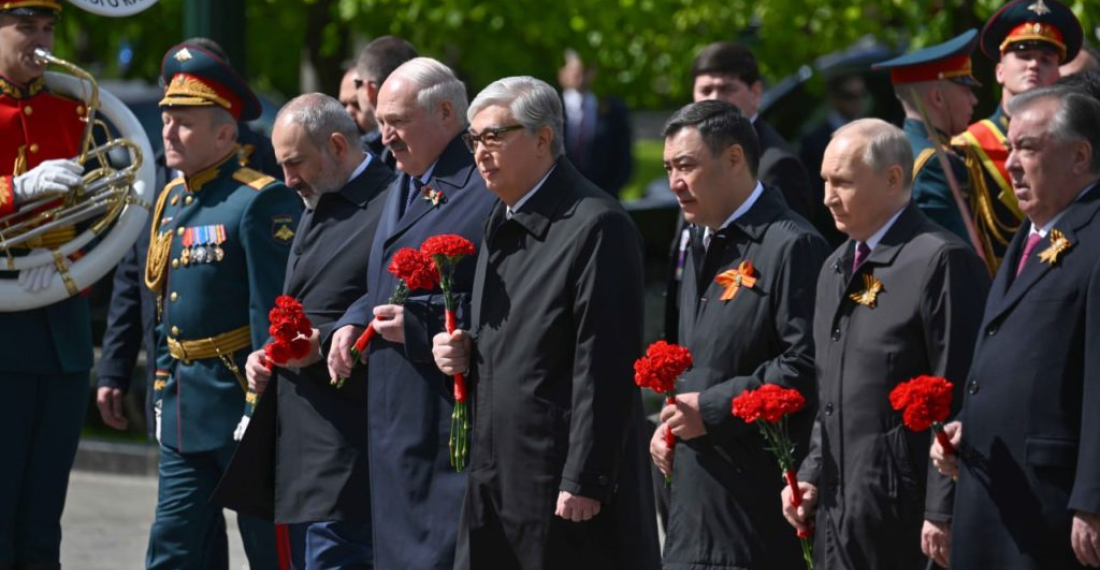
After the start of the full-scale Russo-Ukrainian war, no post-Soviet leader participated in the parade held in 2022. The press secretary of the Kremlin, Dmitry Peskov, said that since the parade held in 2023 was not an anniversary date, no special invitations were sent to the leaders of post-Soviet countries. However, the leaders of Kazakhstan, Kyrgyzstan, Tajikistan, Uzbekistan, Belarus and Armenia rather unexpectedly visited Moscow on this occasion, comfirming their attendence at the last minute. The absence of Azerbaijan among these countries caused widespread speculation in the media.
“President Ilham Aliyev informed the Kremlin that he would not be able to attend the event in Moscow, due to his participation in the celebrations of the 100th anniversary of former president Heydar Aliyev. As a result, Azerbaijan was not represented in the parade,” reported Russian “Channel One”.
This year, unlike previous years, President Aliyev congratulated Soviet war veterans not from the capital Baku, but from the liberated city of Shusha. This gesture, on one hand, served to emphasize symbolic priorities of the Azerbaijani leadership, and moreover, cannot be unrelated to the rather ugly context surrounding parades in Moscow since recently. Russia’s invasion and occupation of Ukraine made the Kremlin’s narrative of the “sacred war” against Nazism null and void.
Azerbaijan has repeatedly stated that it doesn’t recognize Russia’s attack on Ukraine and occupation of its territories. As a matter of principle, official Baku offered mediation missions to the parties before and at the beginning of the war. However, this does not mean that Azerbaijan equates the occupying country with the occupied one. Speaking with the Ukrainian expert Aliona Hlyvko at the ADA Conference in 2022, President Aliyev openly declared that he recognizes the territorial integrity of Ukraine and recommended Kyiv to continue fighting until justice is restored. Analysts believe that Baku is thereby demonstrating that Azerbaijan is not under the influence of Russia, that it is conducting an independent policy, and that it has become the main voice in the region after the Second Karabakh War.
This, in turn, suggests that Russia is gradually losing its dominance in the South Caucasus, which has been lately symbolized by its reluctant acceptance of the installation of an Azerbaijani checkpoint on the Lachin road. Unlike President Aliyev though, Armenian Prime Minister Nikol Pashinyan travelled to Moscow one day earlier and was seated in the front to watch the military parade.
Azerbaijan's absense in the 9 May parade demonstrates a changing political landscape in the region
Following the parade, Aliyev met with the President of the European Union, Charles Michel, in Brussels on 14 May, where he conducted negotiations with Nikol Pashinyan mediated by Mr. Michel. Emphasizing that Armenia and Azerbaijan had agreed on recognising each other’s territorial integrity, Charles Michel also stated that the leaders would soon hold another informal one in Chisinau. In parallel with this meeting, there were further ceasefire violations reported on the Azerbaijan-Armenia border, in which the positions of the Azerbaijani Army were fired upon with artillery shells, and one Azerbaijani soldier was killed.
It should also be noted that during the meetings between the leaders and foreign ministers of Azerbaijan and Armenia held in Europe and the United States without a Russian mediation, the ceasefire is regularly violated on the border between the two countries, often resulting in casualties and triggering yet another crisis in the peace process. Despite the statements of support for meetings held to contribute to the peace process from the Western world, official Moscow emphasizes the importance of these meetings being mediated by Russia and accuses the EU and US of escalating the conflict.
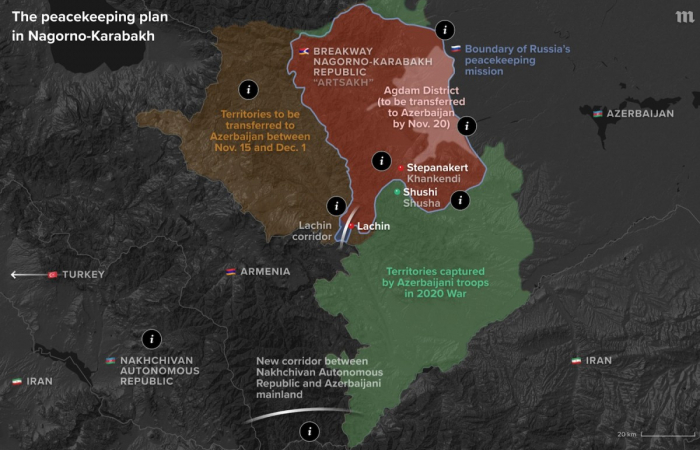
Azerbaijan’s non-participation in the military parade in Moscow demonstrates a changing political landscape in the region that profoundly challenges conventional perceptions. In fact, the cooling down of relations between Azerbaijan and Russia has been gradually gathering pace since last December when the protests along the Lachin road were launched and Baku started to blame the Russian peacekeeping mission for its failure to fulfill their duties and prevent armed men and weapons from entering Karabakh.
Meanwhile, the Azerbaijani side also claimed that the road is blocked not by protesters but by the peacekeepers themselves. Moreover, the installation of a proper checkpoint on 23 April by the Azerbaijani side exposed Moscow’s failure on the ground and its growing alienation from both Baku and Yerevan. Indeed, according to some reports, the peacekeepers’ vehicles are now also subject to being checked by Azerbaijani border controllers at the Lachin сheckpoint.
Finally, it should be noted that the Declaration of Allied Interaction signed by Presidents Aliyev and Putin on 22 February, 2022, in the run-up to the invasion,, has never been ratified by the Azerbaijani Parliament and hence remains little more than a piece of paper. Most probably, by taking part in the military parade on the highest level, Armenia tried to play both sides in the peace process with Azerbaijan, attempting to strengthen its commitment to Russia in the hope that the latter would “punish” Baku for its unwillingness to align with Moscow.