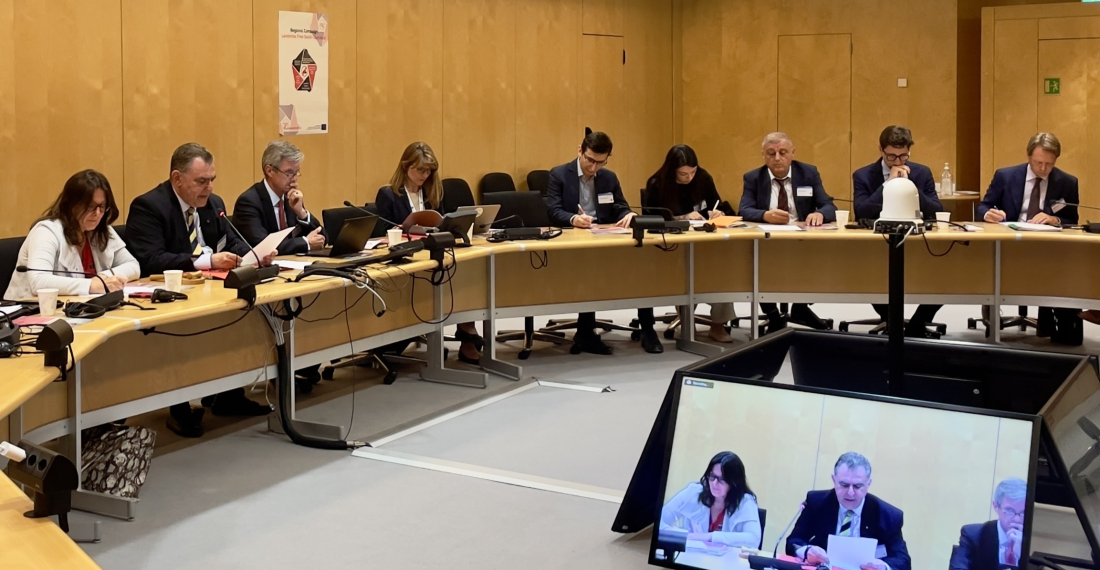
The challenges ahead to achieve a landmine free South Caucasus by 2030 were discussed in a report presented by the Director of LINKS Europe, Dr Dennis Sammut, at an event held in Geneva on Monday (19 June 2023), on the margins of this year’s Intersessional Meetings of the Anti-Personnel Mine Ban Convention, popularly known as “The Ottawa Convention”. At the meeting, representatives of governments and international organisations reiterated their willingness to work for a landmine free South Caucasus by 2030. The event was also attended by representatives of civil society organisations from Armenia, Azerbaijan and Georgia. In his report, Dr Dennis Sammut called on Armenia, Azerbaijan and Georgia to join the Ottawa Convention, but said that on its part the international community needed also to step up its efforts. He proposed that the first steps should be taken before the end of the year for the convening of an international donors conference where a plan for a landmine free South Caucasus by 2030 could be agreed. He proposed that the European Union, as the biggest donor for humanitarian demining in the South Caucasus, should take the initiative by hosting in the Autumn bilateral Round Tables with the three countries, focused on the issue of landmines and their consequences, to prepare for such an International Conference.
The following is the full text of the report
Your Excellencies,
Ladies and Gentlemen
I am delighted to welcome you to this side event on the margins of this year’s intersessional meetings of the Anti-personnel Mine Ban convention. This event is being organised by LINKS Europe in its capacity as co-ordinator of the regional campaign, Landmine Free South Caucasus. I want to thank the German Presidency of the 21st Meeting of the State Parties of the Convention and the Implementation Support Unit of the Anti- Personnel Mine Ban Convention for making this event possible.
War and conflict have ravaged the region of the South Caucasus for more than three decades. Remnants of war, and particularly anti-personnel landmines continue to contaminate large swathes of territory across the region. On top of this, Soviet era landmines, planted to protect the Soviet borders and military facilities remain, decades after the dissolution of the Soviet Union, a serious threat. The level of contamination in the region is so high it puts it at the top three most contaminated areas in world. It is true that the level of contamination is not even in all three countries.
In Georgia a lot of work has been done and most contaminated areas have been cleared, although problems remain in some specific areas
In Azerbaijan, particularly after the changed situation on the ground following the 2020 Karabakh War, the authorities face an acute situation.
In Armenia, the problem is somewhere in between.
But make no mistake about it, no country in the South Caucasus can say that it has solved the problem completely.
There are serious challenges ahead for achieving the objective of a landmine free South Caucasus by 2030, and they are political as much as technical
There is then the humanitarian dimension of the problem. Thousands of people have been killed or injured across the region over the last three decades. The impact of the tragedies on families and communities is high, the mechanism to alleviate the suffering, very weak. This is not yesterday’s problem. Last year once again saw hundreds killed or injured. The impact on communities is huge and affecting tens of thousands.
It is now time to take resolute action to eradicate the problem of landmines and other unexploded remnants of war from the South Caucasus once and for all. This will require the political will of the three governments, and the support of the international community.
There is already political will, but it is not enough; and there is already international support, but it is not enough either.
We are here to day to share information on the problem, and to ask both the governments of the region and the international community to step up their work. We welcome the presence of representatives of governments and international organisations who have joined us for this meeting
We welcome also to our meeting participants from civil society in Armenia, Azerbaijan and Georgia. They are essential to keep the issues on the agenda; to keep decisionmakers focused; to make populations aware, and to spread educational messages, especially among vulnerable communities.
The regional campaign Landmine Free South Caucasus is an initiative of organisations in Armenia, Azerbaijan and Georgia, working together with international partners, launched in October 2018 after a meeting in Tbilisi attended by the leading demining organisations from Armenia, Azerbaijan and Georgia, and others. We are grateful to the European Union for their support of the campaign, to other institutions, such as UNDP, and to the governments of Armenia, Azerbaijan and Georgia, with who we maintain an active dialogue on the issue.
Activities in the framework of the campaign have been successfully held since, and included policy discussions with the participation of senior government representatives held in Baku, Tbilisi and Yerevan, presentations by the leading demining organisations in the region, and outreach campaigns to raise awareness. Campaign material is usually available in five languages: Armenian, Azerbaijan, Georgian, Russian and English.
To conclude, I want to raise five action points, which I hope will also be supported by others in this meeting, and beyond:
We need a flexible regional approach to the issue of demining in the South Caucasus
The last five years have not been easy for the region. The 2nd Karabakh War in 2020 heavily impacted the situation and a changed situation on the ground exposed the extent of current landmine contamination. From the dust of the war, prospects for peace in the South Caucasus have emerged. Demining issues can also, with the right approach, contribute towards the quest for peace, and the process of building trust and confidence. It is not by coincidence that the “Joint Armenian-Azerbaijani Expert Liaison Group on Confidence building measures in support of lasting peace in the South Caucasus”, in its report published in April 2022, identified demining as one area where the sides could work together, and urged them to establish a mechanism for doing so
We join this call, and hope that Armenia, Azerbaijan and Georgia find ways of working together to address the very serious challenge of contamination from landmines and other remnants of war across the region; such a regional approach is not only helpful, but is also in some circumstances and situations absolutely necessary. At the same time we must ensure that a regional approach does not, because of the current political complexities in the region, become a hindrance to the objective of eradicating all landmines from the South Caucasus, and this means a regional approach has also to be flexible.
Armenia, Azerbaijan and Georgia should take steps in the direction of joining the Ottawa Convention
We call on the governments of Armenia, Azerbaijan and Georgia to revisit the issue of acceding to the Anti Personnel Mine Ban Convention. It is regretful that there are still those in the three countries who think that landmines are necessary; whilst the three governments are considering the issue they should also already be sending positive signs of engagement with the convention and its provisions, by, for example, the sharing of information, and voluntary reporting under the provisions of the Convention. It is clear that if the three countries were to take the decision to adhere to the Convention together, this decision would be easier to reach. This is yet another reason why a regional approach to the landmine issue in the South Caucasus is desirable. There can be no clearer sign that the governments of the region are committed to a landmine free South Caucasus than their adherence to the Ottawa convention.
The Humanitarian aspects of demining need to be de-politicised
We call on all the three governments of the region to take the humanitarian dimension of the problem of landmine contamination and its consequences out of the political controversy and points scoring; more needs to be done to alleviate the suffering of landmine victims and we call for tangible action in this direction. We welcome the fact that 30 November was marked in 2022 for the first time as “Day of solidarity with the victims of landmines and other remnants of war in the South Caucasus”, and we call on the governments of Armenia, Azerbaijan and Georgia to embrace this initiative.
The Campaign Landmine Free South Caucasus will be relaunched in 2024
We recognise the need to widen awareness of the problem of landmines among decision makers, opinion shapers, and the wider public in the region. Since 2018 the campaign landmine free South Caucasus has contributed to this, but more work is needed. We are therefore taking steps to relaunch the Landmine Free South Caucasus Campaign in 2024, with a view to bringing in more stakeholders especially from the region, and widening the scope of its remit;
The international community needs to step-up
We call for a more active engagement on the part of the international community to address the issue of landmine contamination in the South Caucasus. In this regard we propose that the first steps be taken before the end of the year for convening an international donors conference, with the active participation of the governments of the region and other stakeholders where a master plan for a landmine free South Caucasus by 2030 or soon after can be agreed.
The European Union, as the largest external donor for mine action in the South Caucasus is well placed to take the lead on this endeavour, but others should join too. A first step in preparation to a larger regional meeting can be the holding of bilateral round tables with the three countries focusing solely on the issue of landmines and other remnants of war sometime this Autumn.
The problem of contamination from landmines and other remanants of war in the South Caucasus is enormous. We now need a response that is adequate to respond to the challenge.
I thank you for your attention.