Xi Jinping arrives in Moscow to meet with Vladimir Putin

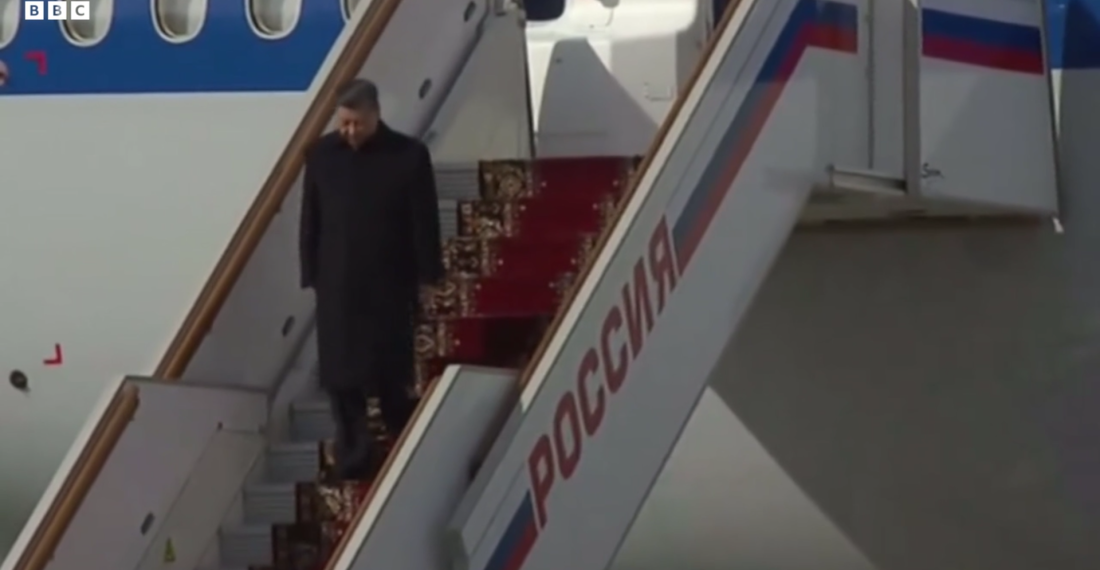
The Chinese President Xi Jinping has arrived in Moscow for face-to-face talks with Russian President Vladimir Putin on Monday (20 March).

Both the Kremlin and China's foreign ministry have been tight-lipped about the purpose of the trip, revealing only that Xi and Putin will discuss a "comprehensive partnership and strategic co-operation", adding that Xi will be in Moscow until Wednesday.

The visit comes only days after the International Criminal Court in The Hague issued Vladimir Putin with an international arrest warrant for alleged war crimes, namely the unlawful deportation of people, including children, from Ukraine to Russia.

Xi Jinping is scheduled to have lunch with the Russian President before an informal one-to-one meeting this afternoon, while formal talks with delegations are planned for tomorrow.

China's stance on the Russian invasion of Ukraine has been ambiguous

Ever since 24 February 2022, China's stance over the full-scale Russian invasion of Ukraine has been somewhat ambiguous. China has neither openly welcomed the war, nor openly criticised Russia. 

Less than a month ago China also published its own 12-point peace plan to bring the war in Ukraine to an end, calling for peace talks and respect for national sovereignty.

However the document does not call for Russian troops to completely leave Ukraine, and it condemned "unilateral sanctions" in what what seen as a veiled criticism of the West's increasing isolation of Russia over the last year. 

There has recently also been concern among world leaders that China may consider supplying Russia weapons following a "no limits" partnership that was agreed between the two countries shortly before Russia's February 2022 invasion. Beijing has denied considering sending Russia weapons.

The Chinese Foreign Ministry's spokesperson Wang Wenbin has said that Xi's visit was a "trip for friendship, cooperation and peace".
source: commonspace.eu with BBC
photo: BBC

Related articles

Editor's choice
News
Situation in South Yemen strains relations between Saudi Arabia and UAE

Situation in South Yemen strains relations between Saudi Arabia and UAE

The relations between Saudi Arabia and the United Arab Emirates (UAE) are increasingly strained as a result of the different approach of the two countries towards Yemen. Whilst both countries were initially together in resisting the Houthi take over in Yemen, the UAE subsequently focused on the South of the country, backing the Southern Movement (STC), which seeks to restore the independence of South Yemen. South Yemen became an independent country in 1967, at the end of British rule, and only unified with the north in 1990. The Saudi-led “Coalition to Support Legitimacy in Yemen” on Tuesday, 30 December, said it conducted a “limited” airstrike targeting two ships “that smuggled weapons and other military hardware into Mukalla in southern Yemen”. The ships originated in the UAE port of Furjeirah. In a statement carried by the Saudi Press Agency (SPA), the Coalition Forces spokesman, Major General Turki Al-Maliki, said that two ships coming from the port of Fujairah in the United Arab Emirates entered the Port of Mukalla in Hadramaut without obtaining official permits from the Joint Forces Command of the Coalition. He stressed the Coalition's "continued commitment to de-escalation and enforcing calm in the governorates of Hadramawt and Al-Mahra, and to prevent any military support from any country to any Yemeni faction without coordination with the legitimate Yemeni government and the Coalition. The Southern Transitional Council (STC), launched a sweeping military campaign early in December, seizing the governorates of Hadramaut along the Saudi border and the eastern governorate of Al-Mahra in Yemen’s border with Oman. The UAE-backed STC forces captured the city of Seiyun, including its international airport and the presidential palace. They also took control of the strategic PetroMasila oilfields, which account for a massive portion of Yemen’s remaining oil wealth. (click the image to read the article in full).

Popular