


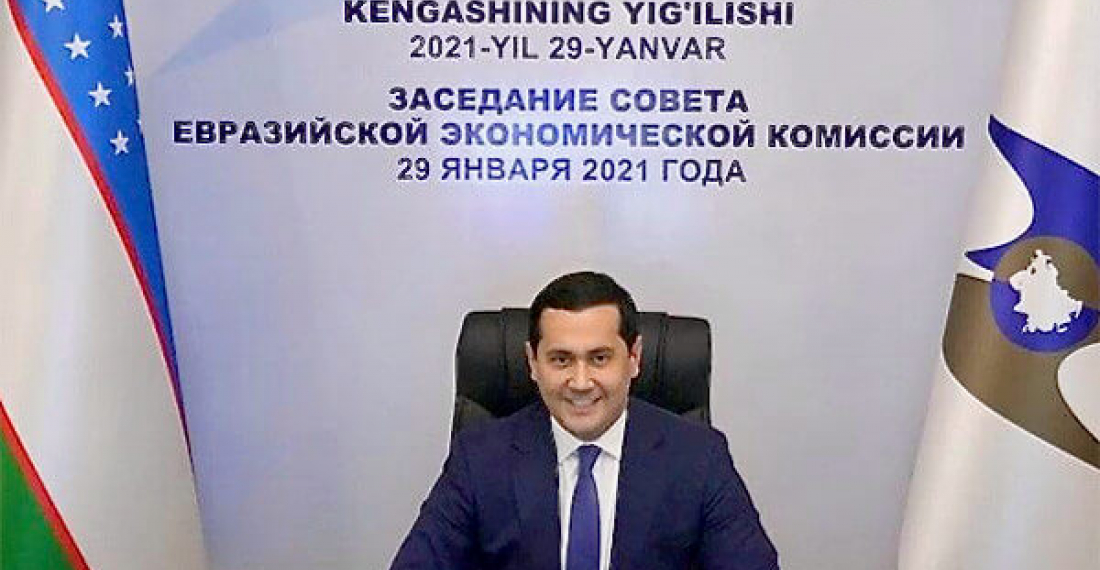
Uzbekistan participates for the first time in the Council of the Eurasian Economic Commission

The Central Asian nation of Uzbekistan has participated for the first time in a session of the Eurasian Economic Union (EAEU). The country was granted observer status in the Union at an EAEU meeting on 11 December 2020. The meeting on Friday (29 January) was held in the form of a video conference. The meeting discussed issues related to the expansion of trade and economic cooperation and the removal of obstacles to the internal market's functioning. 

The meeting was attended by the Minister of Finance of the Republic of Kazakhstan Yerulan Zhamaubayev, the Chairman of the Eurasian Economic Council Alikhan Smailov, Deputy Prime Minister of the Russian Federation Alexei Overchuk, Acting Prime Minister of the Kyrgyz Republic Artem Novikov, Deputy Prime Minister of the Republic of Belarus Igor Petrishenko, Deputy Prime Minister of the Republic of Armenia Mher Grigoryan, and Chairman of the EAEU Board Mikhail Myasnikovich.

Uzbekistan was represented by Deputy Prime Minister and Minister of Investment and Foreign Trade of the Republic of Uzbekistan Shukhrat Umurzakov.

At the meeting the Uzbek delegation outlined the main areas of interaction between Uzbekistan and the EAEU in its capacity as an observer country.  The importance of building constructive cooperation based on the principles of equality, mutual benefit and respect for each other's interests was highlighted, Uzbek government sources said.

The meeting agenda covered a wide range of topics in the areas of trade, economy, investment, and industrial cooperation. Particular attention was paid to the importance of strengthening industrial cooperation in priority areas such as mechanical engineering, energy, electrical engineering, textile and pharmaceutical industries, and agriculture.

It should be noted that the volume of trade between Uzbekistan and the countries of the European Economic Area has increased by 75% in the last four years and that the countries of the European Economic Area now account for more than 30% of Uzbekistan's foreign trade turnover.

Source: commonspace.eu with UzDaily
Photo: Deputy Prime Minister/Minister of Investment and Foreign Trade of the Republic of Uzbekistan Shukhrat. Umurzakov

Related articles

Editor's choice
News
Situation in South Yemen strains relations between Saudi Arabia and UAE

Situation in South Yemen strains relations between Saudi Arabia and UAE

The relations between Saudi Arabia and the United Arab Emirates (UAE) are increasingly strained as a result of the different approach of the two countries towards Yemen. Whilst both countries were initially together in resisting the Houthi take over in Yemen, the UAE subsequently focused on the South of the country, backing the Southern Movement (STC), which seeks to restore the independence of South Yemen. South Yemen became an independent country in 1967, at the end of British rule, and only unified with the north in 1990. The Saudi-led “Coalition to Support Legitimacy in Yemen” on Tuesday, 30 December, said it conducted a “limited” airstrike targeting two ships “that smuggled weapons and other military hardware into Mukalla in southern Yemen”. The ships originated in the UAE port of Furjeirah. In a statement carried by the Saudi Press Agency (SPA), the Coalition Forces spokesman, Major General Turki Al-Maliki, said that two ships coming from the port of Fujairah in the United Arab Emirates entered the Port of Mukalla in Hadramaut without obtaining official permits from the Joint Forces Command of the Coalition. He stressed the Coalition's "continued commitment to de-escalation and enforcing calm in the governorates of Hadramawt and Al-Mahra, and to prevent any military support from any country to any Yemeni faction without coordination with the legitimate Yemeni government and the Coalition. The Southern Transitional Council (STC), launched a sweeping military campaign early in December, seizing the governorates of Hadramaut along the Saudi border and the eastern governorate of Al-Mahra in Yemen’s border with Oman. The UAE-backed STC forces captured the city of Seiyun, including its international airport and the presidential palace. They also took control of the strategic PetroMasila oilfields, which account for a massive portion of Yemen’s remaining oil wealth. (click the image to read the article in full).

Popular

