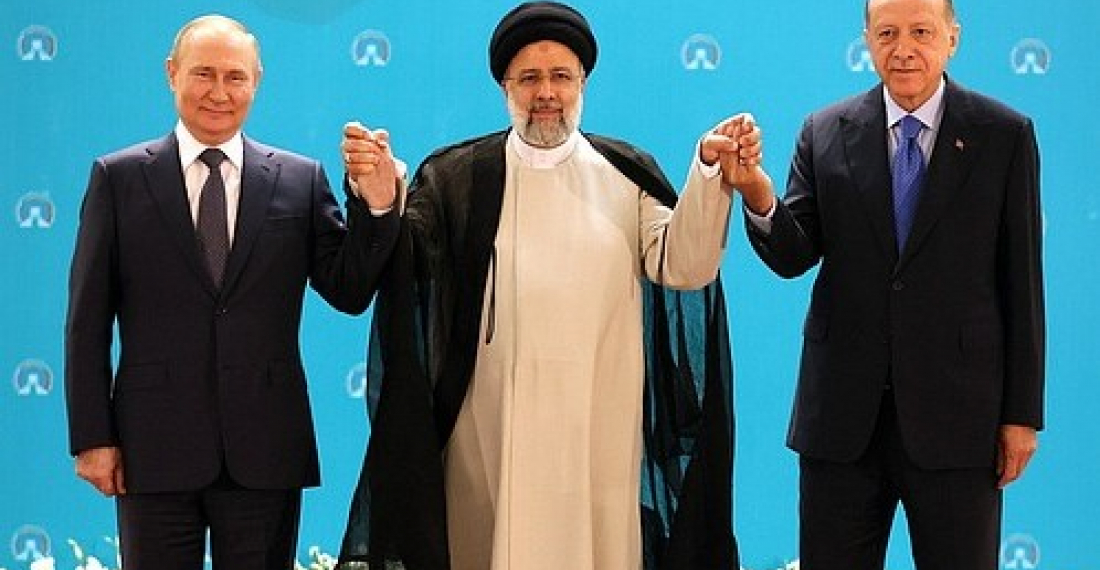
A summit meeting of the leaders of Turkey, Russia and Iran took place in Tehran on Tuesday 19 July.
This is an unlikely trio, three ambitious regional powers who have been brought together by circumstances. The event itself was a set-piece affair, and most of the serious work was done in the bilateral Iran-Russia, Iran-Turkey and Turkey-Russia meetings.
Top of the agenda was Syria, and Turkey's determination not to allow Syria to be a springboard for Kurdish militant activity against it. Turkey has for weeks been preparing for a military operation into Syria. Turkish president, Recip Tayip Erdogan, told his Russian and Iranian counterparts that he expected their full support in Ankara’s fight against “terrorists” in Syria.
Both Russia and Iran have a military presence in parts of Syria mentioned as possible targets of Turkey’s new assault.
“What we expect from Russia and Iran is their support for Turkey in its fight against terrorism,” Erdogan said.
Erdogan noted that Turkey had struck an agreement with Moscow and Washington in 2019 under which both countries were supposed to help push outlawed Kurdish militants 30 km away from the Syria-Turkey border.
“This still has not happened,” said Erdogan. “It is a long overdue.”
Washington and Moscow have also urged Turkey to exercise restraint.
In a meeting with Erdogan on Monday (18 July), Iran’s supreme leader Ali Khamenei told Erdogan such an offensive would be “detrimental” for the region and called for the issue to be resolved through dialogue between Ankara, Damascus, Moscow and Tehran.
Khamenei also on Tuesday urged strengthened energy cooperation with Moscow in a meeting with Putin. Putin has not been travelling very often since the outbreak of the Covid pandemic, and his arrival in Tehran signified the importance Moscow attaches with the Islamic Republic at this point. The bilateral meetings between Putin and the Iranian leadership were hailed as a big success and opening a new chapter in relations. In Tehran Putin also spoke about the proposed transportation link from St Petersburg to the shores of the Gulf, through Azerbaijan and Iran.
Putin and Erdogan also held a bilateral meeting where the Russian president said he wanted to “thank” his Turkish counterpart for progress on talks over Ukraine’s grain, according to the Kremlin. Erdogan has for months been offering to meet Putin in a bid to help resolve heightened global tensions.
“I want to thank you for your mediation efforts,” Putin told Erdogan during the bilateral meeting, according to comments released by the Kremlin.
“We have moved forward,” Putin said, while adding “not all issues have yet been resolved.”
Trilateral Statement - Full text of the trilateral statement issued by the three countries at the end of the meeting:
The President of the Islamic Republic of Iran, His Excellency Seyyed Ebrahim Raisi, the President of the Russian Federation, His Excellency Vladimir Vladimirovich Putin, and the President of the Republic of Turkey, His Excellency Recep Tayyip Erdogan, met on July 19, 2022 in Tehran and held a trilateral summit within the framework of the Astana format.
The Presidents,
1. Discussed the current situation on the ground in Syria, considered the evolution of the situation since the last virtual summit on July 1, 2020, and reaffirmed our determination to increase trilateral coordination in the light of existing agreements, as well as concurring views following the meetings of foreign ministers and representatives. In addition, they studied the latest international and regional developments and emphasized the leading role of the Astana process in the peaceful and long-term settlement of the Syrian crisis.
2. Noted their unwavering commitment to the sovereignty, independence, unity and territorial integrity of the Syrian Arab Republic, as well as to the purposes and principles of the UN Charter. Stressed that these principles must be respected by all and that no action, by whomsoever taken, should undermine them.
3. Expressed their determination to continue the joint fight against terrorism in all its forms and manifestations. They condemned the increased presence and activity of terrorist groups and their affiliates, regardless of their names, in various parts of Syria, including attacks on civilian targets that result in the death of innocent people. We noted the need for the full implementation of all agreements on northern Syria.
4. Rejected all attempts to create new realities on the ground under the pretext of combating terrorism, including illegal self-government initiatives, and expressed their determination to resist separatist plans aimed at undermining the sovereignty and territorial integrity of Syria and threatening the national security of neighboring countries, including cross-border attacks and infiltration.
5. Discussed the situation in northern Syria, stressed that the achievement of stability and security in this region is possible only on the basis of respect for the sovereignty and territorial integrity of the country, and decided to coordinate their efforts to this end. They expressed their opposition to the illegal seizure and transfer of oil revenues that should belong to Syria.
6. Reaffirmed their determination to continue ongoing cooperation for the ultimate elimination of all terrorists, terrorist groups, enterprises and organizations, while ensuring the protection of civilians and civilian infrastructure in accordance with international humanitarian law.
7. Examined in detail the situation in the Idlib de-escalation zone (IDZ) and stressed the need to maintain calm on the ground through the full implementation of all existing agreements on Idlib. Expressed grave concern about the presence and activity of terrorist groups that threaten civilians inside and outside the IZD. We agreed to make further efforts to ensure sustainable normalization of the situation in and around the Idlib de-escalation zone, including the humanitarian situation.
8. Expressed grave concern over the humanitarian situation in Syria and rejected all unilateral sanctions that violate international law, international humanitarian law and the UN Charter, including any discriminatory measures through region-specific exemptions that could promote separatist plans. In this regard, they called on the international community, in particular the UN and its humanitarian agencies and other governmental / non-governmental international agencies, to increase assistance to the Syrians without discrimination, politicization and preconditioning, and in a more transparent manner.
9. Reaffirmed the belief that the Syrian conflict has no military solution and can only be resolved through a political process led and carried out by the Syrians themselves with the assistance of the UN in accordance with UNSCR 2254. In this regard, they emphasized the important role of the Constitutional Committee, which was created with the decisive contribution of the guarantor countries of the Astana format to the implementation of the decisions of the Syrian National Dialogue Congress in Sochi. We reaffirmed our readiness to maintain continuous interaction with its members and the Special Envoy of the UN Secretary-General for Syria G. Pedersen, as a mediator, to ensure the sustainable and efficient work of subsequent sessions of the Constitutional Committee. Expressed the conviction that in its work the Committee must respect the conditions and the Rules of Conduct in order to fulfill its mandate to prepare for the popular approval of the constitutional reform, as well as to make progress in its work, which must take place in an atmosphere of constructive interaction, search for compromises without foreign interference and artificially imposed time limits reach an agreement among its members. Emphasized the need for the Constitutional Committee to carry out its activities without any bureaucratic and logistical obstacles.
10. Reaffirmed their determination to continue operations for the mutual release of detainees/abducted persons within the relevant Working Group of the Astana format. Stressed that the Working Group is a unique mechanism that has proven its relevance and effectiveness in building confidence between the Syrian parties, and decided to continue work on the release of detainees/abductees, and expand operations in accordance with the existing mandate to transfer the bodies of the dead and search for missing persons .
11. Emphasized the need to facilitate the safe and voluntary return of refugees and internally displaced persons (IDPs) to their places of residence in Syria, ensuring their right to return and their right to support. In this regard, they called on the international community to make the necessary contribution for their resettlement and return to normal life, as well as to assume greater responsibility and increase their assistance to Syria, among other things, by launching early recovery projects, including the restoration of basic infrastructure - water and electricity, health and education, schools, hospitals, and humanitarian demining projects in accordance with international humanitarian law.
12. Condemned the ongoing Israeli military attacks in Syria, including on civilian targets. They considered these actions to be in violation of international law, international humanitarian law, the sovereignty and territorial integrity of Syria, and also recognized them as destabilizing and increasing tension in the region. We reaffirmed the need to respect universally recognized international legal decisions, including the provisions of the relevant UN resolutions rejecting the occupation of the Syrian Golan, primarily UN Security Council resolutions 242 and 497, according to which all decisions and steps taken by Israel in this regard are considered invalid and unenforceable.
13. In addition to the Syrian issue, we reaffirmed our intention to strengthen trilateral coordination in various fields in order to promote joint political and economic cooperation.
14. Agreed to instruct their representatives to hold the 19th International Meeting on Syria in the Astana format by the end of 2022.
15. Decided to hold the next trilateral summit in the Russian Federation at the invitation of the President of the Russian Federation, His Excellency Vladimir Putin.
16. The Presidents of the Russian Federation and the Republic of Turkey expressed their sincere gratitude to the President of the Islamic Republic of Iran, His Excellency SE Raisi, for the warm welcome during the trilateral summit in the Astana format in Tehran.
source: commonspace.eu with agencies, and Arab News (Riyadh) and the press service of the president of Russia.
photo: The President of the Islamic Republic of Iran, Seyyed Ebrahim Raisi, the President of the Russian Federation, Vladimir Vladimirovich Putin, and the President of the Republic of Turkey, Recep Tayyip Erdogan, met on July 19, 2022 in Tehran and held a trilateral summit within the framework of the Astana format. (picture courtesy of the press service of the president of Russia).