


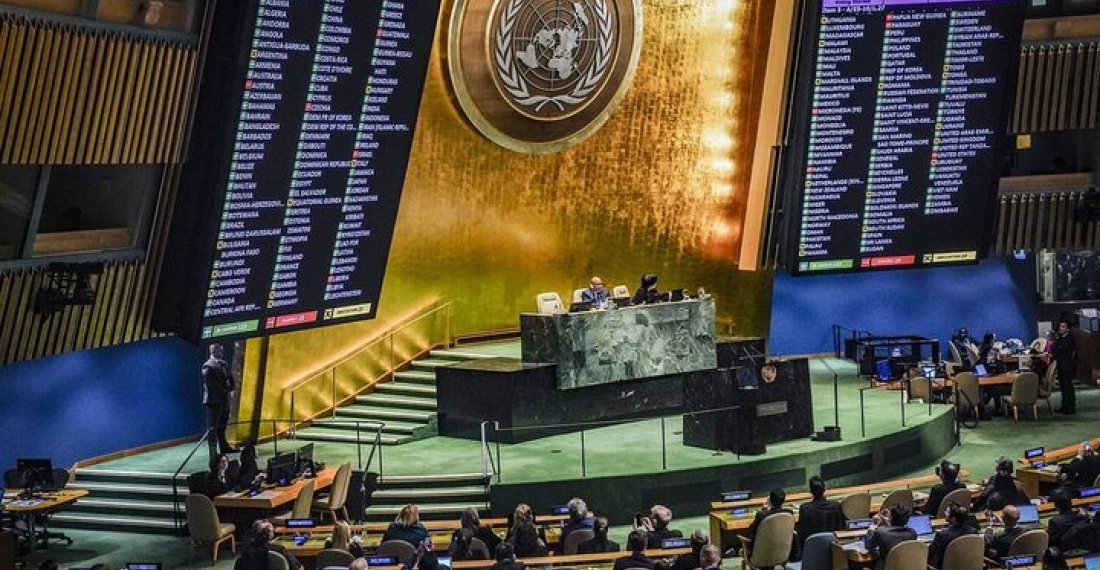
UN General Assembly - 79th session in New York

The UN General Assembly has begun its 79th session in New York. World leaders gathered to underline their goals, although many voices against the UN structure could not be overheard. Amid ongoing conflicts in Gaza, Ukraine, Sudan and most recently Lebanon, the session focused largely on the UN's ineffectiveness in its primary role - peacekeeping.

Richard Gowan, UN director of the International Crisis Group, stressed the need for change in the Security Council. Paralysed by vetoes, the Council has been unable to agree on key decisions that could ease the conflicts in Gaza and Ukraine. Charles Michele pointed to the historical responsibility of the permanent members of the Council. The EU President called for reform to make the Security Council more inclusive, legitimate and effective.

The 79th session marked a historic milestone for Palestine. Despite its status as a Permanent Observer State, Palestinian representatives were seated in the General Assembly chamber for the first time. Palestine's envoy, Riyad Mansour, was seated at a table marked 'State of Palestine' between UN members Sri Lanka and Sudan.

Despite the focus on ongoing conflicts, some leaders sought to shift attention to other important issues. Brazil's President Lula highlighted the recent devastating effects of climate change, with hurricanes, floods and droughts causing massive destruction around the world. Lula stressed the importance of redirecting resources, which are often used to wage war, when they could instead be used in a large-scale effort to combat climate change.

President Biden made his last appearance as leader of the United States. He stressed the importance of listening to citizens and admitted that 'some things are more important than staying in power'. He did briefly mention the recent escalation of the crisis in the Middle East, but only to reiterate that 'a diplomatic solution is still possible'. Without any substantive solutions, many were left wondering if there was any way forward with the great powers locked in a never-ending rivalry.
Source commonspace.eu with agencies

Related articles

Editor's choice
News
Situation in South Yemen strains relations between Saudi Arabia and UAE

Situation in South Yemen strains relations between Saudi Arabia and UAE

The relations between Saudi Arabia and the United Arab Emirates (UAE) are increasingly strained as a result of the different approach of the two countries towards Yemen. Whilst both countries were initially together in resisting the Houthi take over in Yemen, the UAE subsequently focused on the South of the country, backing the Southern Movement (STC), which seeks to restore the independence of South Yemen. South Yemen became an independent country in 1967, at the end of British rule, and only unified with the north in 1990. The Saudi-led “Coalition to Support Legitimacy in Yemen” on Tuesday, 30 December, said it conducted a “limited” airstrike targeting two ships “that smuggled weapons and other military hardware into Mukalla in southern Yemen”. The ships originated in the UAE port of Furjeirah. In a statement carried by the Saudi Press Agency (SPA), the Coalition Forces spokesman, Major General Turki Al-Maliki, said that two ships coming from the port of Fujairah in the United Arab Emirates entered the Port of Mukalla in Hadramaut without obtaining official permits from the Joint Forces Command of the Coalition. He stressed the Coalition's "continued commitment to de-escalation and enforcing calm in the governorates of Hadramawt and Al-Mahra, and to prevent any military support from any country to any Yemeni faction without coordination with the legitimate Yemeni government and the Coalition. The Southern Transitional Council (STC), launched a sweeping military campaign early in December, seizing the governorates of Hadramaut along the Saudi border and the eastern governorate of Al-Mahra in Yemen’s border with Oman. The UAE-backed STC forces captured the city of Seiyun, including its international airport and the presidential palace. They also took control of the strategic PetroMasila oilfields, which account for a massive portion of Yemen’s remaining oil wealth. (click the image to read the article in full).

Popular

