Trump optimistic about Russia - Ukraine Peace Talks in Istanbul

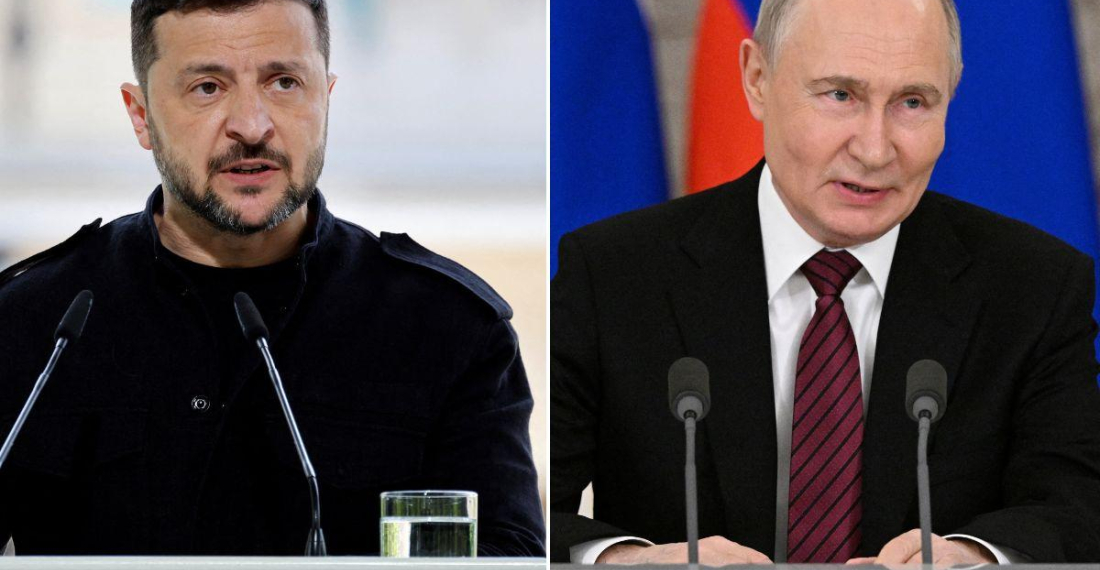
Russia launched more than 100 Shahed and decoy drones at Ukraine in nighttime attacks, the Ukrainian air force said after the Kremlin effectively rejected an unconditional 30-day ceasefire in the war that is now in its fourth year, but reiterated it would take part in possible peace talks later this week without preconditions. U.S. President Donald Trump said he’s optimistic about the Istanbul talks. There is “the potential for a good meeting” between Putin and Zelensky, Trump said in Washington, adding that he was “thinking about flying over” to the talks from his visit to Qatar and the United Arab Emirates that day.

There was no direct response from the Kremlin, however, to Ukrainian President Volodymyr Zelensky’s challenge for Russian leader Vladimir Putin to meet him for face-to-face peace talks in Turkey on Thursday. Kremlin spokesman Dmitry Peskov refused to say who might travel to Istanbul from the Russian side. “Overall, we’re determined to seriously look for ways to achieve a long-term peaceful settlement. That is all,” Peskov said.

The United States and European governments are making a concerted push to stop the fighting, which has killed tens of thousands of soldiers on both sides, as well as more than 10,000 Ukrainian civilians. Russia’s invading forces have taken around one-fifth of Ukraine in Europe’s biggest conflict since World War II.

Zelenskyy supported the prospect of Trump attending the negotiations. “I supported President Trump with the idea of direct talks with Putin. I have openly expressed my readiness to meet,” he said. “And of course, all of us in Ukraine would appreciate it if President Trump could be there with us at this meeting in Turkey.”

In a flurry of diplomatic developments over the weekend, Russia shunned the ceasefire proposal tabled by the U.S. and European leaders, but offered direct talks with Ukraine on Thursday. Ukraine, along with European allies, had demanded that Russia accept a ceasefire starting Monday before holding peace talks. Moscow effectively rejected that proposal and instead called for direct negotiations in Istanbul.

Turkish President Recep Tayyip Erdogan said he had discussed Russian-Ukrainian peace efforts in separate calls with Zelenskyy, Putin and Trump. Erdogan said “a new window of opportunity has emerged for peace,” and claimed that previous talks hosted by Turkey in 2022 came close to success but were derailed by “war barons.” “We support my dear friend Trump’s determination to resolve active conflicts through dialogue and diplomacy,” he said.

Trump insisted that Ukraine accept the Russian offer of talks. Zelenskyy went a step further Sunday and put pressure on Putin by offering a personal meeting. France added its voice to that offer Monday, with Foreign Minister Jean-Noël Barrot urging Putin to accept, though Barrot repeated the European position that a truce must be in place before the talks.

Russia’s failure to join the ceasefire offered by Ukraine would bring further sanctions on Moscow, European leaders say. Germany on Monday reminded Russia of that intention.Swedish Prime Minister Ulf Kristersson, who met with British Prime Minister Keir Starmer on Monday, said the pressure on Russia was increasing.

On Monday, U.K. Foreign Secretary David Lammy was hosting in London senior diplomatic officials from France, Italy, Germany, Spain, Poland and the European Union to discuss how best to fight back against Russian aggression.

Turkish Foreign Minister Hakan Fidan said he expected the two sides to reach a compromise in the coming days that might break the deadlock over whether talks could begin without a truce in place.

The Ukrainian leader said that he told Pope Leo XIV about peace efforts during his first phone conversation with the new pontiff. Ukraine is counting on the Vatican’s help in securing the return of thousands of children that the government says have been deported by Russia, Zelenskyy said, adding that he had invited the pope to visit Ukraine.
Source: commonspace.eu with agencies. Photo: Zelensky and Putin. Reuters

Related articles

Editor's choice
News
Borrell tells the European Parliament that the situation in Afghanistan was critical, but the EU will remain engaged

Borrell tells the European Parliament that the situation in Afghanistan was critical, but the EU will remain engaged

Borrell underlined that the European Union will make every effort to support the peace process and to remain a committed partner to the Afghan people. "Of course, we will have to take into account the evolving situation, but disengagement is not an option.  We are clear on that: there is no alternative to a negotiated political settlement, through inclusive peace talks.
Editor's choice
News
Pope's visit to Türkiye and Lebanon has a strong ecumenical character, and places interreligious dialogue at its centre

Pope's visit to Türkiye and Lebanon has a strong ecumenical character, and places interreligious dialogue at its centre

Pope Leo XIV has begun the first overseas trip of his pontificate, a six-day visit to Türkiye and Lebanon, which started yesterday (27 November) and ends on Tuesday (2 December). According to Vatican Radio, the visit "carries a strong ecumenical character and places interreligious dialogue at its centre. It will also be a moment of closeness to Christian communities and local populations across the region".   During nearly a week in the region, Pope Leo XIV will meet civil and religious authorities, visit mosques and ancient churches, pray at Beirut’s port in memory of the victims of the 2020 explosion, and hold private meetings with Presidents Recep Tayyip Erdoğan and Joseph Aoun.   A highlight of the visit will be a visit to Nicaea, where the Pope will mark the anniversary of the Council of Nicaea. Christians of many traditions recognise the Council of Nicaea as a foundation of shared faith. One of the most anticipated moments will be the Pope’s encounter with Lebanese youth in Bkerké, at the Maronite Patriarchate, a meeting expected to carry strong messages of hope in the Jubilee Year. A central event will be the ecumenical celebration in İznik, where the Pope and Ecumenical Patriarch Bartholomew will walk together toward the ruins of the Basilica of St Neophytos. The prayer, held before icons of Christ and the Council, will conclude with the lighting of a candle—a symbolic gesture of unity. The journey will also highlight interreligious engagement.   Memorable moments are expected throughout the trip: a wreath at Atatürk’s mausoleum, prayer inside the Blue Mosque, Mass at Istanbul’s Volkswagen Arena, the planting of a cedar at the presidential palace in Beirut, and prayer at the tomb of St Charbel in Lebanon. The Vatican said that "Pope Leo XIV’s pilgrimage to Türkiye and Lebanon aims to offer a voice of peace, unity, and hope at the heart of the Middle East."

Popular

Editor's choice
News
Pope's visit to Türkiye and Lebanon has a strong ecumenical character, and places interreligious dialogue at its centre

Pope's visit to Türkiye and Lebanon has a strong ecumenical character, and places interreligious dialogue at its centre

Pope Leo XIV has begun the first overseas trip of his pontificate, a six-day visit to Türkiye and Lebanon, which started yesterday (27 November) and ends on Tuesday (2 December). According to Vatican Radio, the visit "carries a strong ecumenical character and places interreligious dialogue at its centre. It will also be a moment of closeness to Christian communities and local populations across the region".   During nearly a week in the region, Pope Leo XIV will meet civil and religious authorities, visit mosques and ancient churches, pray at Beirut’s port in memory of the victims of the 2020 explosion, and hold private meetings with Presidents Recep Tayyip Erdoğan and Joseph Aoun.   A highlight of the visit will be a visit to Nicaea, where the Pope will mark the anniversary of the Council of Nicaea. Christians of many traditions recognise the Council of Nicaea as a foundation of shared faith. One of the most anticipated moments will be the Pope’s encounter with Lebanese youth in Bkerké, at the Maronite Patriarchate, a meeting expected to carry strong messages of hope in the Jubilee Year. A central event will be the ecumenical celebration in İznik, where the Pope and Ecumenical Patriarch Bartholomew will walk together toward the ruins of the Basilica of St Neophytos. The prayer, held before icons of Christ and the Council, will conclude with the lighting of a candle—a symbolic gesture of unity. The journey will also highlight interreligious engagement.   Memorable moments are expected throughout the trip: a wreath at Atatürk’s mausoleum, prayer inside the Blue Mosque, Mass at Istanbul’s Volkswagen Arena, the planting of a cedar at the presidential palace in Beirut, and prayer at the tomb of St Charbel in Lebanon. The Vatican said that "Pope Leo XIV’s pilgrimage to Türkiye and Lebanon aims to offer a voice of peace, unity, and hope at the heart of the Middle East."