


Tokayev calls for an increased state of readiness in Kazakhstan armed forces

The president of Kazakhstan, Kassym-Zhomart Tokayev, has called for an increased state of readiness in the country's armed forces, whilst addressing an enlarged board meeting of the Ministry of Defense in Nur Sultan.

The president said that a lot of work has been done, since independence nearly thirty years ago, to increase the defense capabilities of the country and he praised the  the hard work of the First President, Nursultan Nazarbayev

Kassym-Zhomart Tokayev called on the leadership of the Ministry of Defense to closely monitor the rapidly changing situation in the world, both globally and in some regions. According to him, the current security architecture is in crisis. Tokayev said he  believes that internal unrest and revolutions will inevitably affect the integrity of the country. This is evidenced by the new pages of history, from the Brest Treaty to the last events in the Kap Mountains, adding that

In this case, the only guarantee of the sovereignty and integrity of the state is the Armed Forces. The state always supports the servicemen who protect our country from external threats. As President and Commander-in-Chief, I consider the focus on defense to be a priority in my work.

 The Kazakh leader said it was important to improve the moral and psychological situation in the army and the fighting spirit of the soldiers and ordered the military command to develop a concept of ideological work in the Armed Forces, other troops and military structures until November 1, 2021.

He also touched upon the issue of social and legal protection of servicemen. The President said that starting next year, the amount of money allocated for food for law enforcement agencies will increase, and it was decided to increase financial payments to servicemen by an average of 30% over the next 3 years. He stressed the need to constantly improve the military skills of the army. Kassym-Zhomart Tokayev noted that during this year's military exercises, the Kazakh military showed high readiness and readiness to participate in peacekeeping missions. In this regard, the Ministry of Defense was instructed to develop a roadmap for expanding the participation of the Armed Forces of Kazakhstan in UN peacekeeping operations until August 1, 2021.

The President thanked the military doctors of the Armed Forces for their assistance to the Lebanese people in dealing with the aftermath of the explosion in the port of Beirut. Kassym-Zhomart Tokayev also thanked all servicemen who honorably performed their duties in the fight against the coronavirus. 

The President stressed the importance of equipping the Kazakh army with the most advanced digital technologies and tools. To address this issue, the President decided to introduce the position of Deputy Minister of Defense for Digitization. In addition, Kassym-Zhomart Tokayev instructed to create a single military information and communication infrastructure operator by November 1, 2021.

He noted a number of priorities in equipping military structures with modern weapons, taking into account the current challenges. The President gave priority to strengthening the air defense, development of elements of radio-electronic combat of types and types of troops, increasing the fleet of military transport aircraft in order to increase the operational capacity of the army.

source: commonspace.eu with the press service of the president of Kazakhstan

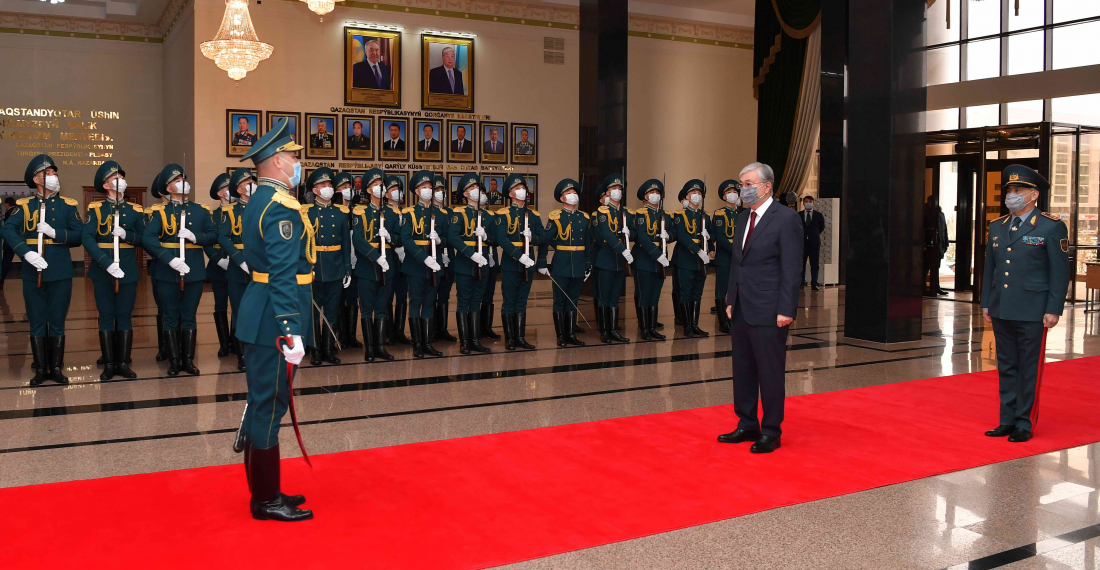
photo: President Kassym-Zhomart Tokayev  arriving for a meeting of the Board of the Armed Forces of Kazakhstan on 19 November 2020. (picture courtesy of the press service of the president of Kazakhstan
Related articles

Editor's choice
News
Finland hosts European Arctic Summit

Finland hosts European Arctic Summit

The Arctic summit of European leaders will be held in Rovaniemi, a municipality in Northern Finland on 13–14 September. Prime Minister Petteri Orpo has invited a group of EU leaders to the summit. The aim of the summit is to strengthen the EU’s common strategic approach to the Arctic region as its geopolitical significance continues to grow rapidly. “The Arctic region is an increasingly important part of Europe's security environment. The European Union has direct interests in its stability, security and sustainable development. It is very valuable to be able to discuss these issues together with a comprehensive group of EU leaders,” said Orpo. The summit will be attended by German Chancellor Friedrich Merz, Prime Minister of Poland Donald Tusk, Prime Minister of Denmark Mette Frederiksen, Prime Minister of Estonia Kristen Michal, Prime Minister of Latvia Andris Kulbergs, President of Lithuania Gitanas Nausėda and President of Romania Nicușor Dan. President of the European Council António Costa and High Representative of the Union for Foreign Affairs and Security Policy Kaja Kallas will also take part in the summit. The summit is taking place against an extremely dynamic backdrop. In the face of accelerating climate change and geopolitical tensions in the Strait of Hormuz, the economic importance of the northeast passage is growing. For 2026, more than forty million tonnes of freight are expected to pass through the Northern Sea Route for the first time, primarily due to expanded trade between Russia and China. Furthermore, in August, China launched its first regular container service through the Arctic. Finally, the EU’s Arctic policy itself is set for a reorientation: the Commission intends to present an updated Arctic strategy this autumn, in which security is to play a central role for the first time. Kaja Kallas had already advocated for this at the Arctic Frontiers conference in Tromsø earlier this year, stating that the Arctic needed more attention, more resources, and more hard power. The summit in Rovaniemi can therefore also be seen as a dress rehearsal for the new strategy. Finland brings a unique perspective to this debate: over 95 per cent of Finland’s foreign trade in goods is conducted by sea, and its ports freeze over almost every winter. This structural peculiarity has given rise to a strong export sector in the field of icebreakers: Finnish companies have designed around 80 per cent of all icebreakers worldwide and built around 60 per cent; even the US Coast Guard is having the first vessels of its new Arctic Security Cutter class built in Finland because the domestic alternative could not meet the schedule. The fact that this leverage can also be utilised geopolitically has already been successfully demonstrated. At the end of September 2022, the Finnish Ministry of Foreign Affairs refused to grant an export licence for an LNG icebreaker ordered by the Russian mining group Norilsk Nickel, thereby bringing to an end a project that would have created around 2,100 person-years of employment. (click the image to read more).

Popular

Editor's choice
Interview
Thursday Interview: Murad Muradov

Thursday Interview: Murad Muradov

Today, commonspace.eu starts a new regular weekly series. THURSDAY INTERVIEW, conducted by Lauri Nikulainen, will host  persons who are thinkers, opinion shapers, and implementors in their countries and spheres. We start the series with an interview with Murad Muradov, a leading person in Azerbaijan's think tank community. He is also the first co-chair of the Action Committee for a new Armenian-Azerbaijani Dialogue. Last September he made history by being the first Azerbaijani civil society activist to visit Armenia after the 44 day war, and the start of the peace process. Speaking about this visit Murad Muradov said: "My experience was largely positive. My negative expectations luckily didn’t play out. The discussions were respectful, the panel format bringing together experts from Armenia, Azerbaijan, and Turkey was particularly valuable during the NATO Rose-Roth Seminar in Yerevan, and media coverage, while varied in tone, remained largely constructive. Some media outlets though attempted to represent me as more of a government mouthpiece than an independent expert, which was totally misleading.  Overall, I see these initiatives as important steps in rebuilding trust and normalising professional engagement. The fact that soon a larger Azerbaijani civil society visits to Armenia followed, reinforces the sense that this process is moving in the right direction." (click the image to read the interview in full)

