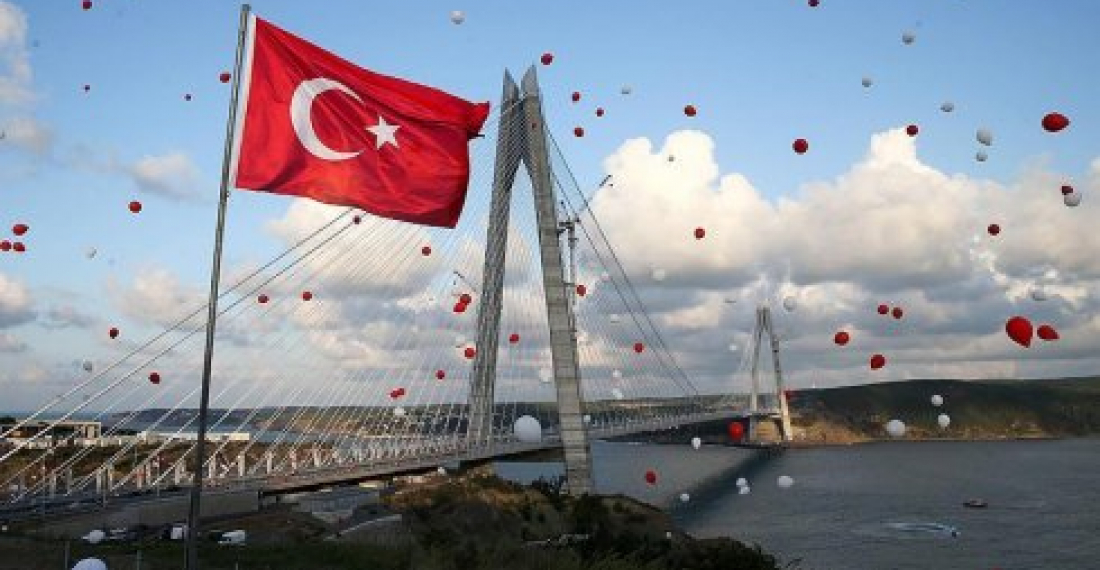
Third bridge now connects Europe and Asia

A third bridge spanning Istanbul's Bosphorus waterway opened Friday with a ceremony attended by President Recep Tayyip Erdogan and Prime Minister Binali Yildirim.

"We are connecting continents," Erdogan said. "We are celebrating together and we are very proud of it. The nation deserves this. With God's permission, this nation will get what it deserves.This is great day and joyful day."

The Yavuz Sultan Selim Bridge was described as a new necklace for the city by Prime Minister Binali Yildirim. "It will not only serve to Istanbul but also serve to every journey in the historic Silk Road, starting from the Far East, ending in Europe and bringing civilizations together by connecting people," he told a crowd of dignitaries.

The bridge, which cost nearly $3 billion to construct, is the latest in a raft of infrastructure "mega-projects" unveiled by the government.

Named after Selim I, the 16th century sultan known for his expansion of the Ottoman empire, the bridge accompanies the July 15 Matryrs' Bridge -- previously the Bosphorus Bridge -- and the Fatih Sultan Mehmet Bridge in crossing the Bosphorus.

It is the world's longest suspension rail bridge and will lead to $1.75 billion-a-year in savings through reduced travel times and energy costs. The 1.4 kilometer (0.9 mile) bridge will carry eight lanes of traffic and two rail lines between Europe and Asia at the entrance of the Bosphorus to the Black Sea.

All trucks and heavy-duty vehicles will be directed to the bridge to ease traffic on the other bridges, as well as cut congestion and pollution in Istanbul.

source: commonspace.eu with anadolu news agency

photo: The new Yavuz Sultan Selim bridge across the Bosphorus (picture courtesy of Anadolu news Agency, Turkey).
 

Related articles

Editor's choice
News
Pope on Christmas Day: "Peace is a shared responsibility"

Pope on Christmas Day: "Peace is a shared responsibility"

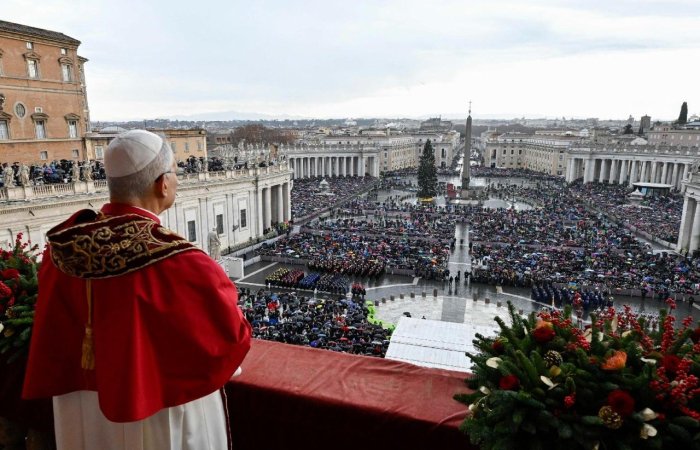
In his Christmas address on St Peter's Square, Pope Leo XIV renewed his plea for peace, reminding the world that it is both God’s gift and humanity’s shared responsibility. Pope Leo XIV renewed his appeal for peace, dialogue, and responsibility, turning to those regions where violence and instability continue to claim innocent lives. The Pope prayed for “justice, peace, and stability for Lebanon, Palestine, Israel, and Syria,” and urged that the promise of peace rooted in righteousness be renewed. He appealed in a particular way for Ukraine, asking that “the clamor of weapons cease,” and that all those involved, with the support of the international community, find the courage to engage in “sincere, direct, and respectful dialogue.” Remembering conflicts that risk being forgotten, Pope Leo XIV expressed closeness to the victims of war and violence in Sudan, South Sudan, Mali, Burkina Faso, and the Democratic Republic of Congo, as well as to all those who suffer as a result of injustice, political instability, religious persecution, and terrorism. The Pope also prayed for Haiti, calling for an end to violence and progress along the path of peace and reconciliation. He also invoked peace for Myanmar, asking that the country be guided towards reconciliation and hope, especially for its younger generations. Turning to Latin America, he encouraged those with political responsibilities to give space to dialogue for the common good, rather than to ideological and partisan divisions. The Pope also prayed for the restoration of the "ancient friendship" between Thailand and Cambodia, and entrusted to God the peoples of South Asia and Oceania, who have been severely affected by recent natural disasters, calling for renewed commitment to assisting those who suffer.

Popular

Editor's choice
News
Pope on Christmas Day: "Peace is a shared responsibility"

Pope on Christmas Day: "Peace is a shared responsibility"

In his Christmas address on St Peter's Square, Pope Leo XIV renewed his plea for peace, reminding the world that it is both God’s gift and humanity’s shared responsibility. Pope Leo XIV renewed his appeal for peace, dialogue, and responsibility, turning to those regions where violence and instability continue to claim innocent lives. The Pope prayed for “justice, peace, and stability for Lebanon, Palestine, Israel, and Syria,” and urged that the promise of peace rooted in righteousness be renewed. He appealed in a particular way for Ukraine, asking that “the clamor of weapons cease,” and that all those involved, with the support of the international community, find the courage to engage in “sincere, direct, and respectful dialogue.” Remembering conflicts that risk being forgotten, Pope Leo XIV expressed closeness to the victims of war and violence in Sudan, South Sudan, Mali, Burkina Faso, and the Democratic Republic of Congo, as well as to all those who suffer as a result of injustice, political instability, religious persecution, and terrorism. The Pope also prayed for Haiti, calling for an end to violence and progress along the path of peace and reconciliation. He also invoked peace for Myanmar, asking that the country be guided towards reconciliation and hope, especially for its younger generations. Turning to Latin America, he encouraged those with political responsibilities to give space to dialogue for the common good, rather than to ideological and partisan divisions. The Pope also prayed for the restoration of the "ancient friendship" between Thailand and Cambodia, and entrusted to God the peoples of South Asia and Oceania, who have been severely affected by recent natural disasters, calling for renewed commitment to assisting those who suffer.