Russia deploys two thousand troops to Karabakh

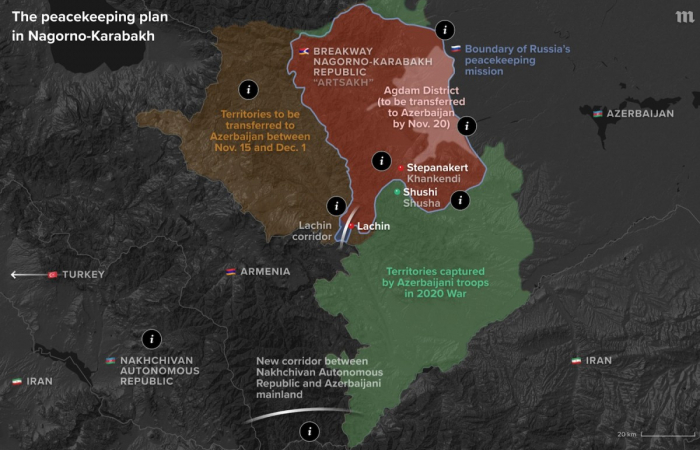
Russia has deployed swiftly two thousand peacekeepers to oversee an agreement to end the current hostilities between Armenia and Azerbaijan.

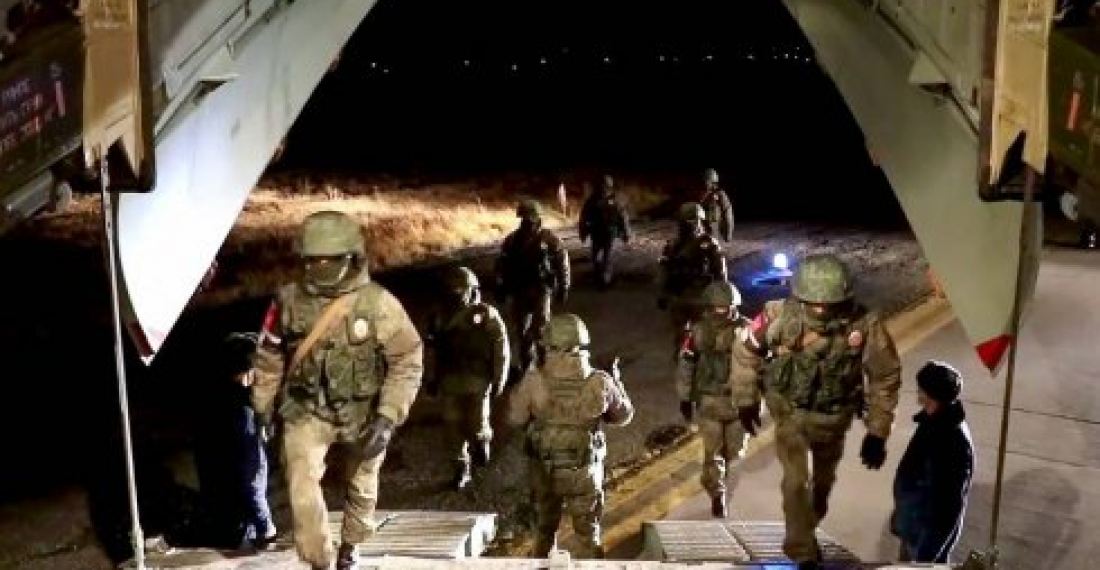
Ten planes deployed the peacekeeping force to Nagorno-Karabakh within hours of the agreement being signed. Three of the nine articles of the agreement relate to the peacekeeping force. They state:

  • Along the line of contact in Nagorno-Karabakh and along the Lachin corridor, a peacekeeping contingent of the Russian Federation is deployed in the amount of 1,960 servicemen with small arms, 90 armored personnel carriers, 380 units of automobile and special equipment.
  • The peacekeeping contingent of the Russian Federation is being deployed in parallel with the withdrawal of the Armenian armed forces. The duration of the stay of the peacekeeping contingent of the Russian Federation is 5 years, with automatic extension for the next 5-year periods, if none of the Parties declares 6 months before the expiration of the period of intention to terminate the application of this provision
  • In order to increase the effectiveness of control over the implementation of the agreements by the Parties to the conflict, a peacekeeping center is being deployed to control the ceasefire.

source: commonspace.eu with agencies

photo: Russian peacekeepers were flown overnight in ten flights to Nagorno-Karabakh (picture courtesy of TASS news agency, Moscow)
Related articles

Editor's choice
News
Pope on Christmas Day: "Peace is a shared responsibility"

Pope on Christmas Day: "Peace is a shared responsibility"

In his Christmas address on St Peter's Square, Pope Leo XIV renewed his plea for peace, reminding the world that it is both God’s gift and humanity’s shared responsibility. Pope Leo XIV renewed his appeal for peace, dialogue, and responsibility, turning to those regions where violence and instability continue to claim innocent lives. The Pope prayed for “justice, peace, and stability for Lebanon, Palestine, Israel, and Syria,” and urged that the promise of peace rooted in righteousness be renewed. He appealed in a particular way for Ukraine, asking that “the clamor of weapons cease,” and that all those involved, with the support of the international community, find the courage to engage in “sincere, direct, and respectful dialogue.” Remembering conflicts that risk being forgotten, Pope Leo XIV expressed closeness to the victims of war and violence in Sudan, South Sudan, Mali, Burkina Faso, and the Democratic Republic of Congo, as well as to all those who suffer as a result of injustice, political instability, religious persecution, and terrorism. The Pope also prayed for Haiti, calling for an end to violence and progress along the path of peace and reconciliation. He also invoked peace for Myanmar, asking that the country be guided towards reconciliation and hope, especially for its younger generations. Turning to Latin America, he encouraged those with political responsibilities to give space to dialogue for the common good, rather than to ideological and partisan divisions. The Pope also prayed for the restoration of the "ancient friendship" between Thailand and Cambodia, and entrusted to God the peoples of South Asia and Oceania, who have been severely affected by recent natural disasters, calling for renewed commitment to assisting those who suffer.

Popular

Editor's choice
News
Pope on Christmas Day: "Peace is a shared responsibility"

Pope on Christmas Day: "Peace is a shared responsibility"

In his Christmas address on St Peter's Square, Pope Leo XIV renewed his plea for peace, reminding the world that it is both God’s gift and humanity’s shared responsibility. Pope Leo XIV renewed his appeal for peace, dialogue, and responsibility, turning to those regions where violence and instability continue to claim innocent lives. The Pope prayed for “justice, peace, and stability for Lebanon, Palestine, Israel, and Syria,” and urged that the promise of peace rooted in righteousness be renewed. He appealed in a particular way for Ukraine, asking that “the clamor of weapons cease,” and that all those involved, with the support of the international community, find the courage to engage in “sincere, direct, and respectful dialogue.” Remembering conflicts that risk being forgotten, Pope Leo XIV expressed closeness to the victims of war and violence in Sudan, South Sudan, Mali, Burkina Faso, and the Democratic Republic of Congo, as well as to all those who suffer as a result of injustice, political instability, religious persecution, and terrorism. The Pope also prayed for Haiti, calling for an end to violence and progress along the path of peace and reconciliation. He also invoked peace for Myanmar, asking that the country be guided towards reconciliation and hope, especially for its younger generations. Turning to Latin America, he encouraged those with political responsibilities to give space to dialogue for the common good, rather than to ideological and partisan divisions. The Pope also prayed for the restoration of the "ancient friendship" between Thailand and Cambodia, and entrusted to God the peoples of South Asia and Oceania, who have been severely affected by recent natural disasters, calling for renewed commitment to assisting those who suffer.