Russia and US agree without Ukraine to press ahead on path to peace

The United States and Russia agreed in Riyadh on Tuesday to press ahead with efforts to end the war in Ukraine, a US official said, as Kyiv and its European allies watched anxiously from the sidelines and Moscow raised a major new demand. US State Department spokesperson Tammy Bruce said the two sides agreed to appoint "respective high-level teams to begin working on a path to ending the conflict in Ukraine as soon as possible in a way that is enduring, sustainable, and acceptable to all sides".

Russian negotiator Yuri Ushakov told reporters after more than four hours of talks: "It was a very serious conversation on all the questions we wanted to touch upon." Ukraine and European leaders are worried that president Donald Trump could cut a hasty deal with Russian president Vladimir Putin that ignores their security interests, rewards Moscow for its invasion and leaves Putin free to threaten Ukraine or other countries in the future.

Even while the meeting in the Saudi capital was under way, Russia signalled a hardening of its demands. Foreign Ministry spokeswoman Maria Zakharova told reporters in Moscow it was "not enough" for Nato not to admit Ukraine as a member. She said the alliance must go further by disavowing a promise it made at a summit in Bucharest in 2008 that Kyiv would join at a future, unspecified date.

"Otherwise, this problem will continue to poison the atmosphere on the European continent," she said. There was no immediate response from Ukraine, Nato members or the United States.  Ukrainian president Volodymyr Zelenskyy has consistently demanded Nato membership as the only way to guarantee Kyiv's sovereignty and independence from its nuclear-armed neighbour.

US spokesperson Bruce said in a statement: "President Trump wants to stop the killing; the United States wants peace and is using its strength in the world to bring countries together. president Trump is the only leader in the world who can get Ukraine and Russia to agree to that." She said the two sides had also agreed to consult in order to address "irritants" in their bilateral relations, which the Kremlin described as "below zero" during the previous US administration of Joe Biden.

Ushakov was quoted by Interfax news agency as saying conditions were discussed for a meeting between Trump and Putin, although he said it was unlikely to happen next week.

The talks in Saudi Arabia, which has friendly ties with both countries, underscored the rapid pace of US efforts to halt the war, less than a month after Trump took office and six days after he spoke by phone to Putin. Critics say that Trump's team, by ruling out Nato membership for Ukraine and saying that Kyiv's desire to win back all its lost territory is an illusion, has made major concessions in advance. US officials say they are simply recognising reality.

Ukraine says no peace deal can be done on its behalf. "We, as a sovereign country, simply will not be able to accept any agreements without us," Zelenskyy said.
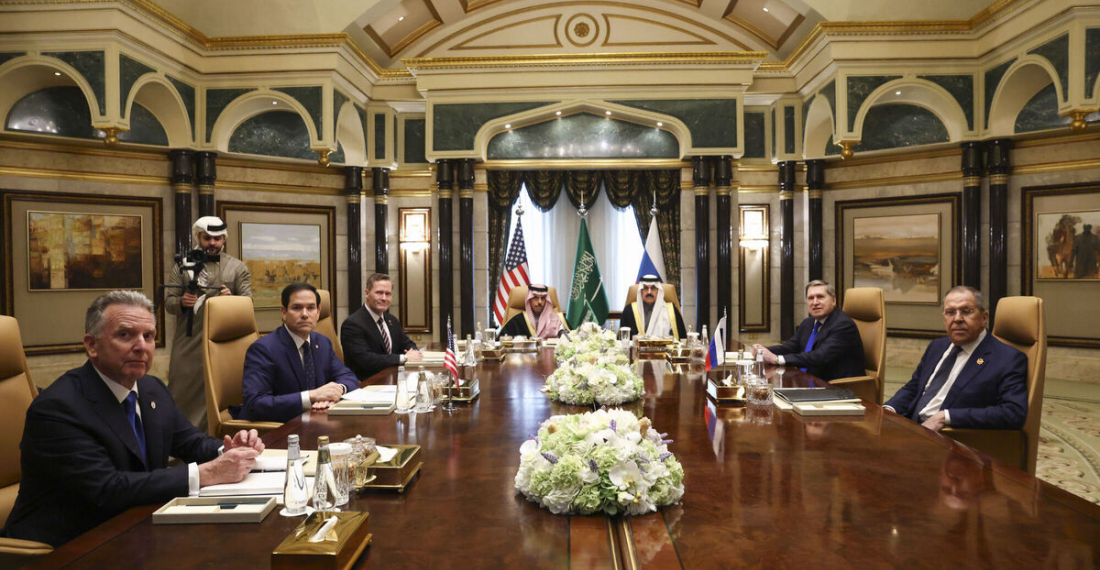
Source: commonspace.eu with agencies. Photo: US secretary of state Marco Rubio, second left, meets with Saudi foreign minister Prince Faisal bin Farhan Al Saud, Saudi national security advisor Mosaad bin Mohammad Al-Aiban, US national security advisor Mike Waltz, US Middle East envoy Steve Witkoff, Russian foreign minister Sergei Lavrov, right, and Russian president Vladimir Putin's foreign policy advisor Yuri Ushakov, at Diriyah Palace, in Riyadh, Saudi Arabia. Picture: Evelyn Hockstein/Pool Photo via AP

Related articles

Editor's choice
News
Borrell tells the European Parliament that the situation in Afghanistan was critical, but the EU will remain engaged

Borrell tells the European Parliament that the situation in Afghanistan was critical, but the EU will remain engaged

Borrell underlined that the European Union will make every effort to support the peace process and to remain a committed partner to the Afghan people. "Of course, we will have to take into account the evolving situation, but disengagement is not an option.  We are clear on that: there is no alternative to a negotiated political settlement, through inclusive peace talks.
Editor's choice
News
Egypt rejects Israeli "offer" for an exit only Rafah checkpoint in Gaza

Egypt rejects Israeli "offer" for an exit only Rafah checkpoint in Gaza

Egypt has rejected an Israeli "offer" for opening for exit only the Rafah checkpoint in Gaza. According to the Egyptian State Information Service, Egyptian authorities refuted on Wednesday afternoon reports that Israel claims it will open the Rafah crossing, the only lifeline for Gaza to the outside world, but only for those wishing to leave the besieged coastal enclave.  Citing an Egyptian official, the service stated that ''any agreement to open the crossing will cover both entry and exit, in line with US President Donald Trump's plan for humanitarian and political arrangements following the ceasefire.'' Cairo reaffirmed its adherence to the plan and UN Security Council Resolution 2803, including the right of return for Palestinians and maintaining two-way operations at the crossing. Earlier in the day, Israel's Coordinator of Government Activities in the Territories (COGAT) announced that the Rafah crossing would reopen ''within the next few days,'' marking the first such move since February 2025. According to the statement, departures would require prior Israeli security approval and would follow mechanisms previously implemented under EU supervision. Notably, the statement made no mention of the entry of humanitarian aid, which continues to flow through the Kerem Shalom crossing. A Palestinian official also echoed the Egyptian denial of Israel's claim. The announced agreements stress that no Palestinians will be forced to leave Gaza. Those who choose to travel will have the right to return, while humanitarian aid will continue through UN agencies, the International Red Cross and Crescent, and other independent organisations. A European Union official, who requested anonymity and is familiar with the matter, told TNA that the EU has received no official notification from Israel regarding new arrangements, stressing that "no changes exist beyond the January agreements, and we await Israel's formal approval for crossing operations under the Trump plan. "Reopening the crossing will follow mechanisms jointly supervised by the EU and the Palestinian Authority to ensure oversight and transparency, according to the EU official.

Popular

Editor's choice
News
Egypt rejects Israeli "offer" for an exit only Rafah checkpoint in Gaza

Egypt rejects Israeli "offer" for an exit only Rafah checkpoint in Gaza

Egypt has rejected an Israeli "offer" for opening for exit only the Rafah checkpoint in Gaza. According to the Egyptian State Information Service, Egyptian authorities refuted on Wednesday afternoon reports that Israel claims it will open the Rafah crossing, the only lifeline for Gaza to the outside world, but only for those wishing to leave the besieged coastal enclave.  Citing an Egyptian official, the service stated that ''any agreement to open the crossing will cover both entry and exit, in line with US President Donald Trump's plan for humanitarian and political arrangements following the ceasefire.'' Cairo reaffirmed its adherence to the plan and UN Security Council Resolution 2803, including the right of return for Palestinians and maintaining two-way operations at the crossing. Earlier in the day, Israel's Coordinator of Government Activities in the Territories (COGAT) announced that the Rafah crossing would reopen ''within the next few days,'' marking the first such move since February 2025. According to the statement, departures would require prior Israeli security approval and would follow mechanisms previously implemented under EU supervision. Notably, the statement made no mention of the entry of humanitarian aid, which continues to flow through the Kerem Shalom crossing. A Palestinian official also echoed the Egyptian denial of Israel's claim. The announced agreements stress that no Palestinians will be forced to leave Gaza. Those who choose to travel will have the right to return, while humanitarian aid will continue through UN agencies, the International Red Cross and Crescent, and other independent organisations. A European Union official, who requested anonymity and is familiar with the matter, told TNA that the EU has received no official notification from Israel regarding new arrangements, stressing that "no changes exist beyond the January agreements, and we await Israel's formal approval for crossing operations under the Trump plan. "Reopening the crossing will follow mechanisms jointly supervised by the EU and the Palestinian Authority to ensure oversight and transparency, according to the EU official.