Putin commits to the security and independence of Abkhazia during visit to the territory

Russian President Vladimir Putin visited the self-declared republic of Abkhazia on Tuesday, (8 August), and declared that Russia will continue to support its security and independence. The visit came despite Georgian protestations. The international community recognises Abkhazia as part of Georgia.

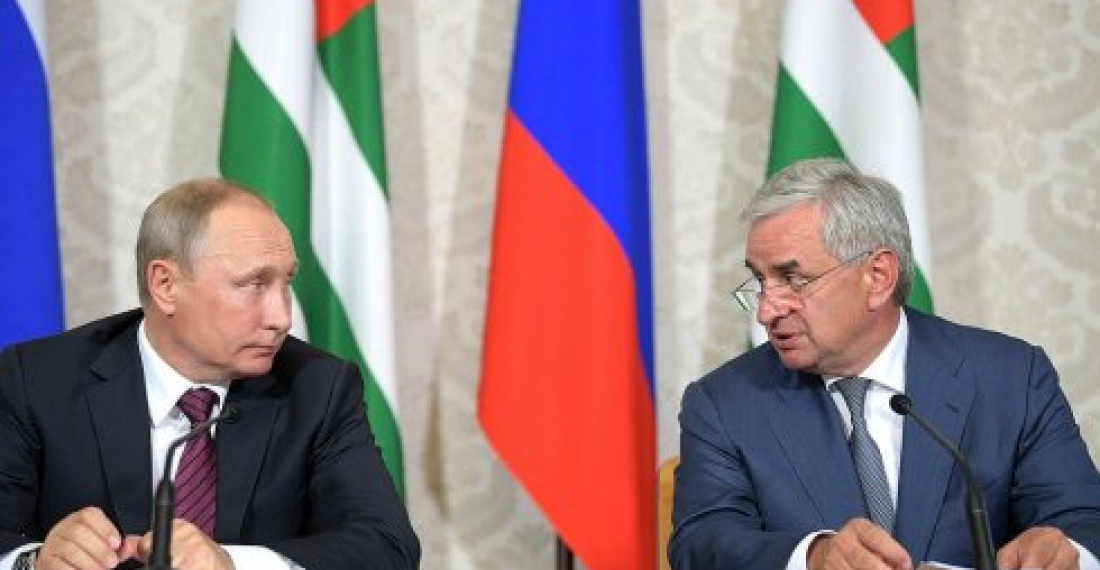
Russia is determined to firmly guarantee the security and independence of Abkhazia, Russian President Vladimir Putin said on Tuesday, the Russian news agency TASS reported. "There is a great deal for us to discuss. What is most important is we have a special relationship of trust with Abkhazia. We firmly guarantee the security and independence of Abkhazia. I am certain that it will be so further on," Putin said at a meeting with Abkhazia’s President Raul Khajimba on Tuesday.  He pointed to the need for identifying only the optimal ways of developing Abkhazia’s economy for creating jobs and its own tax base. "That’s what we are going to discuss today," Putin said. Upon completion of the talks an agreement would be signed that would open Russia’s system of medical insurance and Russian hospitals to Abkhazian citizens.

For his part Khajimba said that Abkhazia with Russia’s support was moving on along the road of social economic development and building infrastructures and addressing security and defense issues. "All questions we discussed at the previous meetings are being resolved to the benefit of our people," Khajimba said, adding that there had been steady progress in translating into reality the treaty of alliance and strategic partnership between Abkhazia and Russia. Khajimba pointed to pro-active cooperation between the two countries’ foreign ministries. "Work on the program’s investment programs is proceeding as expected. This year’s spending on them will reach about 2.5 billion rubles ($42 million). All budget documents had been drafted, scrutinized and approved," Khajimba said. He is certain that the discussions due would produce solutions serving the interests of Abkhazia’s further development.  

"Abkhazia and its people are sincerely grateful to you for the decisions being made to develop our relations. I would like to say once again that the questions to be raised and resolved today would make our relations stronger," Khajimba said. He recalled that August 8 was a memorable date for Abkhazia and South Ossetia. "On that day the Georgian army mounted a large-scale attack and the resolute measures the Russian leadership took in response allowed South Ossetia to survive and paved the way for the further recognition of our tiny states," Khajimba said.

You can aslo read: Commentary: August War exposes Russia's bad intentions

commonspace.eu with TASS news agency

photo: Presiident Putin with the president of the self declared republic of Abkhazia, Rauf Khajimba in Pitsunda on 8 August 2017. (Picture courtesy of the twitter feed of the president of Russia)
Related articles

Editor's choice
News
Council of Europe launches new International Claims Commission for Ukraine

Council of Europe launches new International Claims Commission for Ukraine

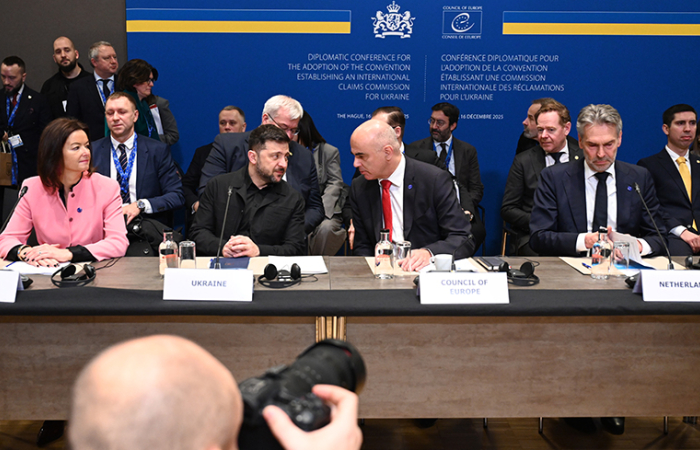
Thirty-four countries and the European Union have signed a new convention establishing an International Claims Commission for Ukraine at a diplomatic conference co-hosted by the 46-nation Council of Europe and the Netherlands in the Hague. The diplomatic conference was attended by leaders and high-level representatives from over 50 states, including the President of Ukraine, Volodymyr Zelenskyy, the President of the Republic of Moldova, Maia Sandu, and the Prime Minister of the Netherlands, Dick Schoof.  “Today marks a major step forward in ensuring accountability for Ukraine. The International Claims Commission represents justice and hope for tens of thousands of victims—our determination that those who have suffered will not be forgotten. I call for quick ratifications so we can get the commission rapidly up and running for the people of Ukraine,” said Council of Europe Secretary General Alain Berset. Ukrainian President Volodymyr Zelenskyy said: “We expect that every mechanism for compensation from the Register of Damage and Claims Commission to the actual payments – will start working and receive strong and sufficient international support, so that people can truly feel that any kind of damage caused by the war can be compensated. This war, and Russia’s responsibility for it, MUST become a clear example – so that others learn not to choose aggression.” “Accountability is about creating the conditions for peace that endures. And therefore, accountability is a condition of security – today and for the future. But accountability is not only about Ukraine. And it is not only about one aggressor and one victim. Accountability is about Europe. About every country in Europe. It is about whether Europe, as a whole, is willing to defend its peace,” said Maia Sandu, President of the Republic of Moldova, which currently holds the Presidency of the Council of Europe’s Committee of Ministers. The Prime Minister of the Netherlands, Dick Schoof, said: “Every day Russia is deliberately bombarding homes, destroying businesses and damaging infrastructure in Ukraine. Russia must compensate Ukraine for the damage caused. That is why we have launched the International Claims Commission for Ukraine and we are honoured to host it.” The International Claims Commission will be the second part of a comprehensive compensation mechanism related to Russia’s war of aggression, building on the existing Register of Damage for Ukraine. The claims commission will be established within the framework of the Council of Europe and will also be open to other countries. The Register of Damage for Ukraine, created in 2023, collects and records compensation claims submitted by individuals, organisations and public bodies in Ukraine. Forty-four states and the European Union have so far joined the Register, which has already received 86,000 claims. The International Claims Commission will review, assess and decide upon claims submitted to the Register of Damage for Ukraine and determine the amount of compensation, if any, which is due in each case. The convention establishing the commission will enter into force once it has been ratified by 25 signatories, as long as sufficient funds have been secured to support its initial work.

Popular