President Trump signs $142 billion arms package during visit to Saudi Arabia

The US has agreed to sell Saudi Arabia an arms package worth nearly $142 billion, according to a White House fact sheet that called it "the largest defence cooperation agreement" Washington has ever done. The agreement, signed during US President Donald Trump's visit to the Saudi capital Riyadh, covers deals with more than a dozen U.S. defence companies in areas including air and missile defence, air force and space advancement, maritime security and communications, the fact sheet said. Saudi Arabia is the largest customer of U.S. arms.

Former President Joe Biden's administration tried unsuccessfully to finalise a defence pact with Riyadh as part of a broad deal that envisioned Saudi Arabia normalising ties with Israel. The White House fact sheet did not mention if Riyadh would be permitted to purchase Lockheed's F-35 jets, the military aircraft that the kingdom has reportedly been interested in for years.

However, it was not clear if Washington would permit the kingdom to move forward with a purchase that would give Saudi Arabia an advanced weapon used by close U.S. ally Israel. Israel has owned F-35s for nine years, building multiple squadrons. Governments in the Gulf have long sought the most advanced fighter jet, built with stealth technology allowing it to evade enemy detection. If the U.S. did approve the transfer, Saudi Arabia would be only the second Middle East state after Israel to operate F-35 fighters.

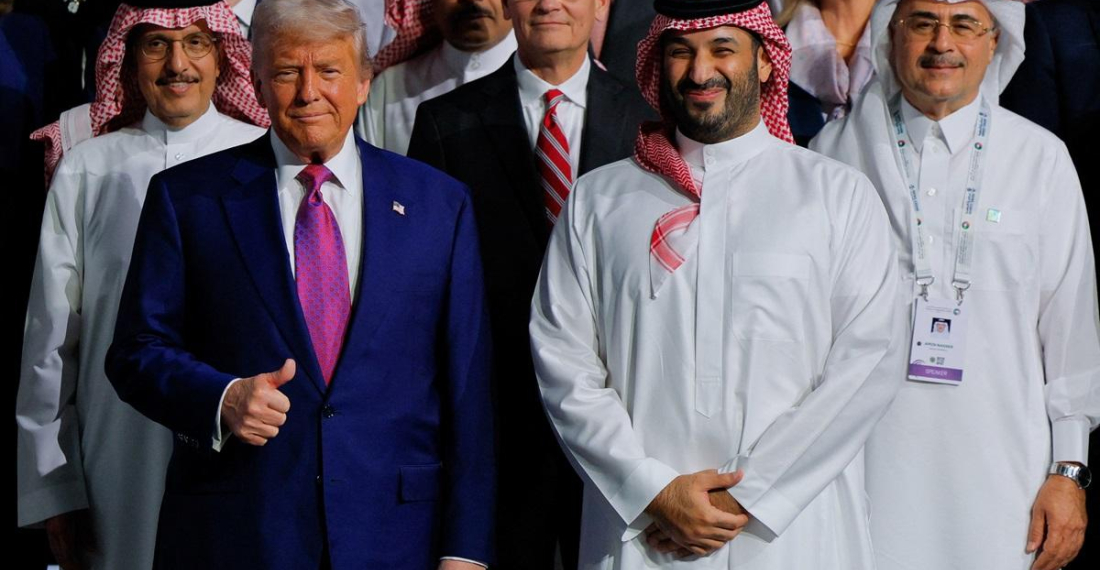
In a comprehensive hour-long speech later on Monday, the US president heaped praise on Saudi Crown Prince Mohammed Bin Salman, saying the US and Saudi Arabia were taking steps to make their relationship "more powerful than ever before".

He also announced that the US would remove sanctions from Syria in order to give the country "a chance at greatness". Trump said he wanted to strike a deal with Iran but warned the country's leaders that if they rejected his "olive branch" he would "inflict massive, maximum pressure". And on the war in Gaza, the US president said the civilian population "deserve a much better future".

Mohammed bin Salman, in contrast, spoke comparatively little at the event - but said the US and Saudi Arabia share "deep economic relations", and would "continue to build" together.

Trump will continue his four-day tour of the Middle East with visits to Qatar on Wednesday and the UAE on Friday - he is also expected to meet the Syrian President Ahmed al-Sharaa in Saudi Arabia tomorrow
Source: commonspace.eu with agencies. Photo: US President Donald Trump and Saudi Crown Prince Mohammed Bin Salman pose for a group photo during a Saudi-US Investment Forum, in Riyadh. AFP

Related articles

Editor's choice
News
Borrell tells the European Parliament that the situation in Afghanistan was critical, but the EU will remain engaged

Borrell tells the European Parliament that the situation in Afghanistan was critical, but the EU will remain engaged

Borrell underlined that the European Union will make every effort to support the peace process and to remain a committed partner to the Afghan people. "Of course, we will have to take into account the evolving situation, but disengagement is not an option.  We are clear on that: there is no alternative to a negotiated political settlement, through inclusive peace talks.
Editor's choice
News
Egypt rejects Israeli "offer" for an exit only Rafah checkpoint in Gaza

Egypt rejects Israeli "offer" for an exit only Rafah checkpoint in Gaza

Egypt has rejected an Israeli "offer" for opening for exit only the Rafah checkpoint in Gaza. According to the Egyptian State Information Service, Egyptian authorities refuted on Wednesday afternoon reports that Israel claims it will open the Rafah crossing, the only lifeline for Gaza to the outside world, but only for those wishing to leave the besieged coastal enclave.  Citing an Egyptian official, the service stated that ''any agreement to open the crossing will cover both entry and exit, in line with US President Donald Trump's plan for humanitarian and political arrangements following the ceasefire.'' Cairo reaffirmed its adherence to the plan and UN Security Council Resolution 2803, including the right of return for Palestinians and maintaining two-way operations at the crossing. Earlier in the day, Israel's Coordinator of Government Activities in the Territories (COGAT) announced that the Rafah crossing would reopen ''within the next few days,'' marking the first such move since February 2025. According to the statement, departures would require prior Israeli security approval and would follow mechanisms previously implemented under EU supervision. Notably, the statement made no mention of the entry of humanitarian aid, which continues to flow through the Kerem Shalom crossing. A Palestinian official also echoed the Egyptian denial of Israel's claim. The announced agreements stress that no Palestinians will be forced to leave Gaza. Those who choose to travel will have the right to return, while humanitarian aid will continue through UN agencies, the International Red Cross and Crescent, and other independent organisations. A European Union official, who requested anonymity and is familiar with the matter, told TNA that the EU has received no official notification from Israel regarding new arrangements, stressing that "no changes exist beyond the January agreements, and we await Israel's formal approval for crossing operations under the Trump plan. "Reopening the crossing will follow mechanisms jointly supervised by the EU and the Palestinian Authority to ensure oversight and transparency, according to the EU official.

Popular

Editor's choice
News
Egypt rejects Israeli "offer" for an exit only Rafah checkpoint in Gaza

Egypt rejects Israeli "offer" for an exit only Rafah checkpoint in Gaza

Egypt has rejected an Israeli "offer" for opening for exit only the Rafah checkpoint in Gaza. According to the Egyptian State Information Service, Egyptian authorities refuted on Wednesday afternoon reports that Israel claims it will open the Rafah crossing, the only lifeline for Gaza to the outside world, but only for those wishing to leave the besieged coastal enclave.  Citing an Egyptian official, the service stated that ''any agreement to open the crossing will cover both entry and exit, in line with US President Donald Trump's plan for humanitarian and political arrangements following the ceasefire.'' Cairo reaffirmed its adherence to the plan and UN Security Council Resolution 2803, including the right of return for Palestinians and maintaining two-way operations at the crossing. Earlier in the day, Israel's Coordinator of Government Activities in the Territories (COGAT) announced that the Rafah crossing would reopen ''within the next few days,'' marking the first such move since February 2025. According to the statement, departures would require prior Israeli security approval and would follow mechanisms previously implemented under EU supervision. Notably, the statement made no mention of the entry of humanitarian aid, which continues to flow through the Kerem Shalom crossing. A Palestinian official also echoed the Egyptian denial of Israel's claim. The announced agreements stress that no Palestinians will be forced to leave Gaza. Those who choose to travel will have the right to return, while humanitarian aid will continue through UN agencies, the International Red Cross and Crescent, and other independent organisations. A European Union official, who requested anonymity and is familiar with the matter, told TNA that the EU has received no official notification from Israel regarding new arrangements, stressing that "no changes exist beyond the January agreements, and we await Israel's formal approval for crossing operations under the Trump plan. "Reopening the crossing will follow mechanisms jointly supervised by the EU and the Palestinian Authority to ensure oversight and transparency, according to the EU official.