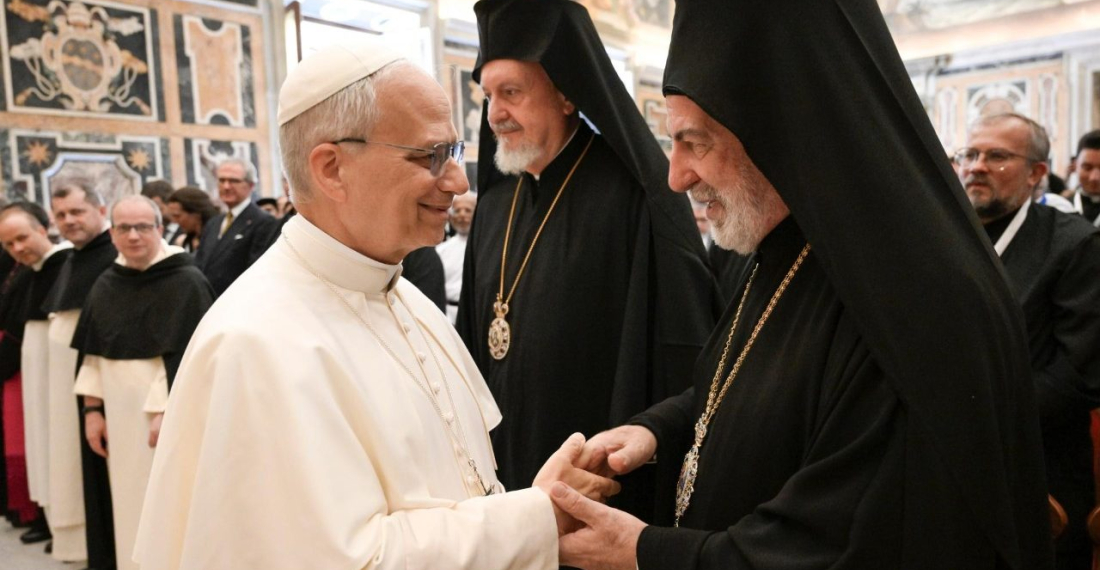
In an indication that this may be one of his priorities as leader of the Catholic Church, Pope Leo XIV met with participants in the Symposium “Nicaea and the Church of the Third Millennium: Towards Catholic-Orthodox Unity," and highlighted the many aspects that unite Christians, as the Church celebrates the 1,700th anniversary of the Council of Nicaea.
"The Council of Nicaea is not merely an event of the past but a compass that must continue to guide us towards the full visible unity of all Christians."
Pope Leo XIV expressed this when receiving in Vatican participants in the Symposium “Nicaea and the Church of the Third Millennium: Towards Catholic-Orthodox Unity,” which took place on 4-7 June, at the Pontifical University of Saint Thomas Aquinas in Rome.
In 2025, the Catholic Church is commemorating the 1,700th anniversary of the First Council of Nicaea, convened in 325 AD by Emperor Constantine I in the city of Nicaea.
The ecumenical council aimed to address theological disputes and establish a unified Christian doctrine, and its outcomes included affirming Christ's divinity and formulating the Nicene Creed
At the meeting on Saturday(7 June) the Pope gave a warm welcome to those present, expressing appreciation for the Angelicum-organized symposium as it looks toward the future according to Vatican Radio.
He called the First Ecumenical Council "foundational" for the common journey that Catholics and Orthodox have undertaken together since the Second Vatican Council.
For the Eastern Churches, which commemorate its celebration in their liturgical calendar, the Council of Nicaea, he recognized, "is not simply one Council among others or the first in a series, but the Council par excellence..."
On the eve of Pentecost, Pope Leo insisted "that the unity for which Christians long will not be primarily the fruit of our own efforts, nor will it be realized through any preconceived model or blueprint." Rather, he said, Christian unity will be "a gift received as Christ wills and by the means that He wills, by the working of the Holy Spirit."
The Pope said the three themes of the symposium—the faith of Nicaea, synodality, and the date of Easter—are especially relevant for Christians' ecumenical journey.
On the faith of Nicaea, he reiterated that this anniversary represents “an invaluable opportunity to emphasise that, what we have in common is much stronger, quantitatively and qualitatively, than what divides us."
"Together," Pope Leo said, "we believe in the Triune God, in Christ as truly human and truly God, and in salvation through Jesus Christ, according to the Scriptures read in the Church and under the guidance of the Holy Spirit," as well as "in the Church, baptism, the resurrection of the dead, and eternal life.”
"I am convinced that by returning to the Council of Nicaea and drawing together from this common source," he said, "we will be able to see in a different light the points that still separate us," and that "through theological dialogue and with God’s help, we will gain a better understanding of the mystery that unites us."
Pope Leo also said that by celebrating together this Nicene faith and by proclaiming it together, Christians will advance together toward "the restoration of full commun
Turning to the Symposium's second theme of synodality, Pope Leo observed the Council of Nicaea "inaugurated a synodal path for the Church to follow in dealing with theological and canonical questions at the universal level."
He expressed his "hope that the preparation and joint commemoration of the 1,700th anniversary of the Council of Nicaea will be a providential occasion to deepen and confess together our faith in Christ and to put into practice forms of synodality among Christians of all traditions.”
Recalling that the date of Easter is the Symposium's third theme, the Pope recalled that one of the Council of Nicaea's objectives was to establish a common date for Easter.
"Sadly, differences in their calendars no longer allow Christians to celebrate together the most important feast of the liturgical year, causing pastoral problems within communities, dividing families and weakening the credibility of our witness to the Gospel," he noted.
The Pope pointed out that several concrete solutions have been proposed, which, while respecting the principle of Nicaea, would allow Christians to celebrate together "the 'Feast of Feasts.'”
Expressing satisfaction that this year all Christians were able to celebrate Easter on the same day, Pope Leo underscored, "I would reaffirm the openness of the Catholic Church to the pursuit of an ecumenical solution favouring a common celebration of the Lord’s Resurrection and thus giving greater missionary force to our preaching of the name of Jesus and the salvation born of faith in the saving truth of the Gospel.”
source: commonspace.eu with Vatican News (Vatican City)