


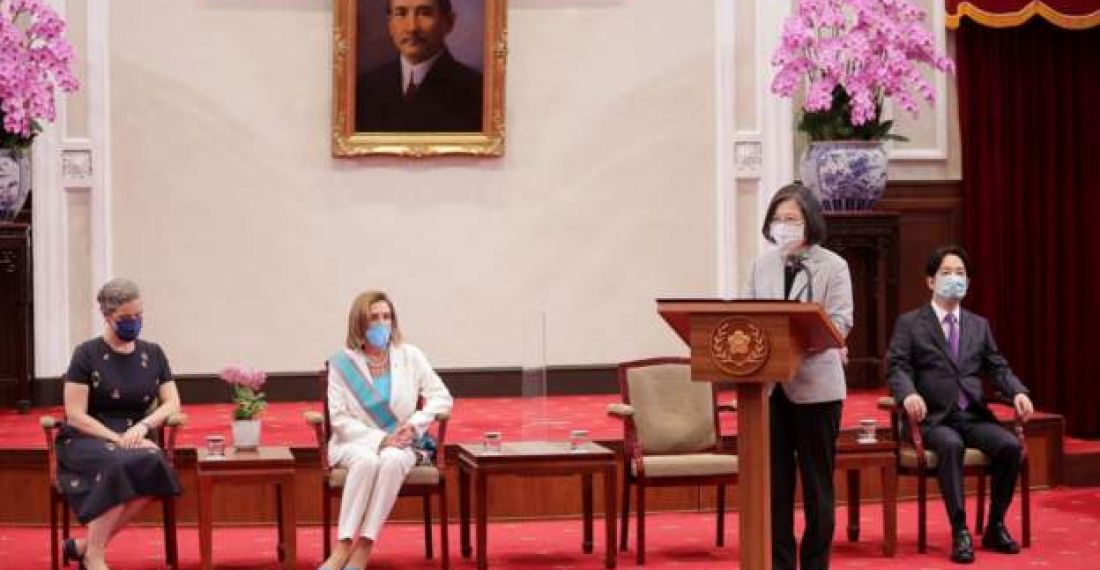
Pelosi vows support for Taiwan during controversial visit

The Speaker of the US House of Representatives, Nancy Pelosi, has vowed continued American support for Taiwan during a controversial visit to the Island which has been condemned by China.

China considers Taiwan as a renegade province, and the United States, in line with the rest of the international community, has since the 1970s maintained only full diplomatic relations with Beijing, even though it has an informal diplomatic presence on the Island, and maintains with it strong military co-operation. Pelosi, the third highest ranking US official, after the President and the Vice President, made the visit to Taiwan despite concerns from the White House and the US military and security establishment.

Speaking at the presidential palace in Taipei, Pelosi said:

We will not abandon our commitment to Taiwan and we are proud of our enduring friendship. Now, more than ever, America's solidarity with Taiwan is crucial. And that is the message we are bringing here today.

During the meeting with Taiwanese President Tsai Ing Wen, Pelosi was presented with "The Order of Propitious Clouds", which is a Taiwanese civilian honour. Presenting Pelosi with the Special Grand Cordon, which is the award's top rank, President Tsai said she was awarding it to Pelosi to thank the US for its support.

Pelosi said she was honoured to accept on behalf of the US government.

"We are so proud of your leadership; a woman president in one of the freest societies in the world. It was with immense admiration for your leadership and great personal humility that I accept this award," Pelosi said

Beijing, on its part, has expressed fury at Pelosi's visit. The US Ambassador was summoned to the Chinese Foreign Ministry to be told of Chinese displeasure, and the Chinese military have ordered military exercises around Taiwan for the next days.

During her visit to Taiwan Pelosi has echoes the position of the US government in supporting the status quo, hinting that it was not Washington but Beijing that was the revisionist power in the Taiwan Straits.

Concerns about Chinese intentions regarding Taiwan increased following the launch of the Russian invasion of Ukraine, which China has failed to condemn. China has also not condemned continued Russian violations of the territorial integrity of Ukraine despite the fact that it expected everyone else to respect its own territorial integrity.

source: commonspace.eu with agencies
photo: US House of Representatives Speaker, Nancy Pelosi, in Taipei, after being presented with Special Grand Cordon of the Order of Propitious Clouds.

Related articles

Editor's choice
News
Situation in South Yemen strains relations between Saudi Arabia and UAE

Situation in South Yemen strains relations between Saudi Arabia and UAE

The relations between Saudi Arabia and the United Arab Emirates (UAE) are increasingly strained as a result of the different approach of the two countries towards Yemen. Whilst both countries were initially together in resisting the Houthi take over in Yemen, the UAE subsequently focused on the South of the country, backing the Southern Movement (STC), which seeks to restore the independence of South Yemen. South Yemen became an independent country in 1967, at the end of British rule, and only unified with the north in 1990. The Saudi-led “Coalition to Support Legitimacy in Yemen” on Tuesday, 30 December, said it conducted a “limited” airstrike targeting two ships “that smuggled weapons and other military hardware into Mukalla in southern Yemen”. The ships originated in the UAE port of Furjeirah. In a statement carried by the Saudi Press Agency (SPA), the Coalition Forces spokesman, Major General Turki Al-Maliki, said that two ships coming from the port of Fujairah in the United Arab Emirates entered the Port of Mukalla in Hadramaut without obtaining official permits from the Joint Forces Command of the Coalition. He stressed the Coalition's "continued commitment to de-escalation and enforcing calm in the governorates of Hadramawt and Al-Mahra, and to prevent any military support from any country to any Yemeni faction without coordination with the legitimate Yemeni government and the Coalition. The Southern Transitional Council (STC), launched a sweeping military campaign early in December, seizing the governorates of Hadramaut along the Saudi border and the eastern governorate of Al-Mahra in Yemen’s border with Oman. The UAE-backed STC forces captured the city of Seiyun, including its international airport and the presidential palace. They also took control of the strategic PetroMasila oilfields, which account for a massive portion of Yemen’s remaining oil wealth. (click the image to read the article in full).

Popular

Editor's choice
News
Situation in South Yemen strains relations between Saudi Arabia and UAE

Situation in South Yemen strains relations between Saudi Arabia and UAE

The relations between Saudi Arabia and the United Arab Emirates (UAE) are increasingly strained as a result of the different approach of the two countries towards Yemen. Whilst both countries were initially together in resisting the Houthi take over in Yemen, the UAE subsequently focused on the South of the country, backing the Southern Movement (STC), which seeks to restore the independence of South Yemen. South Yemen became an independent country in 1967, at the end of British rule, and only unified with the north in 1990. The Saudi-led “Coalition to Support Legitimacy in Yemen” on Tuesday, 30 December, said it conducted a “limited” airstrike targeting two ships “that smuggled weapons and other military hardware into Mukalla in southern Yemen”. The ships originated in the UAE port of Furjeirah. In a statement carried by the Saudi Press Agency (SPA), the Coalition Forces spokesman, Major General Turki Al-Maliki, said that two ships coming from the port of Fujairah in the United Arab Emirates entered the Port of Mukalla in Hadramaut without obtaining official permits from the Joint Forces Command of the Coalition. He stressed the Coalition's "continued commitment to de-escalation and enforcing calm in the governorates of Hadramawt and Al-Mahra, and to prevent any military support from any country to any Yemeni faction without coordination with the legitimate Yemeni government and the Coalition. The Southern Transitional Council (STC), launched a sweeping military campaign early in December, seizing the governorates of Hadramaut along the Saudi border and the eastern governorate of Al-Mahra in Yemen’s border with Oman. The UAE-backed STC forces captured the city of Seiyun, including its international airport and the presidential palace. They also took control of the strategic PetroMasila oilfields, which account for a massive portion of Yemen’s remaining oil wealth. (click the image to read the article in full).

