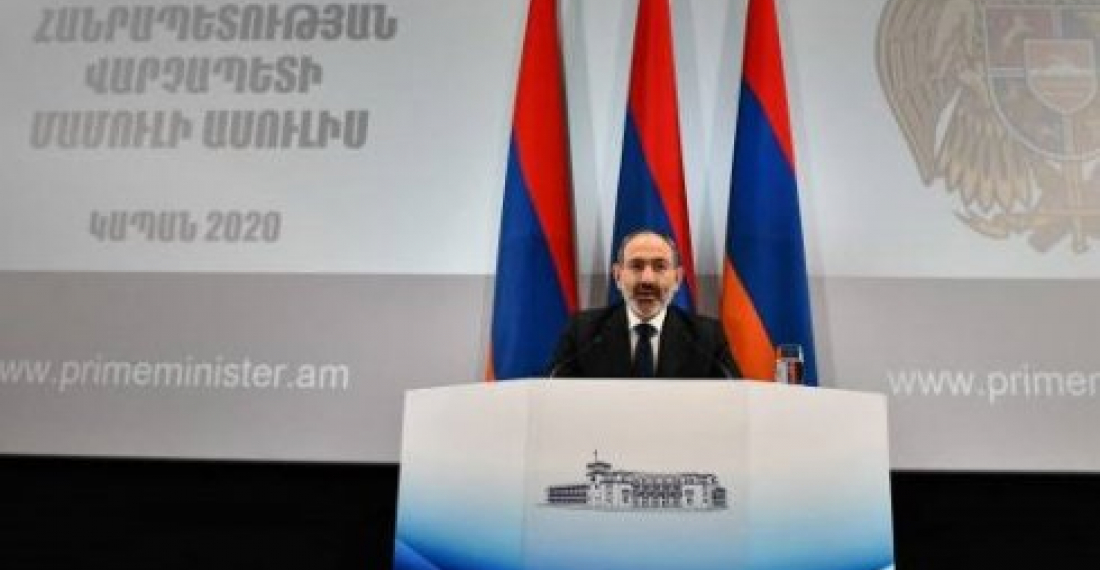
At a marathon press conference in the town of Kapan, Armenian prime minister Nikol Pashinyan touched on a range of domestic issues, as well as on the Karabakh conflict. Pashinyan said that no formal meeting with the Azerbaijani president Ilham Aliyev was scheduled when both are expected to attend the Munich Security Conference next month, but he did not exclude the possibility that an informal meeting may take place.
During the press conference Pashinyan also touched on what he called "the Karabakh legacy" inherited from the previous Armenian leader Serzh Sargsyan. The prime minister said that the opposition was often accusing him of squandering the Sargsyan legacy on Karabakh. He said he now wanted those contesting the forthcoming presidential elections in Karabakh to declare publicly if they supported this legacy or not.
Nikol Pashinyan then summarised what he said was the Armenian position when he took office. This, he said, had also been published in the media and not denied by officials of the previous government.
He added:
"So, what did Sargsyan leave on the negotiating table? Three main paragraphs.
First, and I am quoting the ultimate goals for a comprehensive settlement of the Karabakh conflict, since they are related to each other. These goals are the legacy left by Serzh Sargsyan. The return of seven regions - Aghdam, Fizuli, Jabrail, Zangilan, Gubadli, Qelbajar and Lachin - to Azerbaijan, provided that the corridor connecting Nagorno-Karabakh and Armenia is preserved.
Next point is that a vote has to be conducted to determine final legal status of Karabakh, the vote will be an expression of the will of the entire population of Nagorno-Karabakh under the auspices of the UN or OSCE, within the timeframe agreed by the parties, which will be legally binding and will comply with the norms and principles of international law. Full regulation of political, trade, economic and humanitarian ties in the region, restoration of good-neighborly cooperation, ensuring complete stability in the South Caucasus region.
Secondly, the displaced persons, with the assistance of the international community, will return to the territories of the five districts mentioned in the first paragraph. Azerbaijani civilian authorities will enter these territories after the deployment of international peacekeeping forces and the withdrawal of armed forces now located in these areas. International peacekeeping forces will be deployed along the administrative borders of the former autonomous region of Nagorno-Karabakh, except for the sections that form part of the Qelbajar and Lachin regions. The Qelbajar region will remain under transition monitoring by the OSCE.
Thirdly, simultaneously with the adoption of the above measures, until the final solution is found, Nagorno-Karabakh should be granted temporary status, which will be guarantee the organization of daily life."
Speaking about the current state of the negotiations, Pashinyan said,
“We are ready for constructive, normal work, as much as we understand how difficult a work that is."
“But that’s our responsibility in the region. I have told my colleagues, that now we – the President of Azerbaijan, the President of the Republic of Artsakh and the Prime Minister of the Republic of Armenia – are personally bearing the responsibility of the future of peace and stability in the region. This is a personal responsibility, and to some extent also a common responsibility, and bearing this responsibility and [dealing] with it with honor is a very difficult task,” he said.
Asked to elaborate on the Karabakh talks, the Pashinyan emphasized that there is no secrecy around the negotiations. “It is described and termed in my speech at the 2019 March joint Security Council session of Armenia and Artsakh in Stepanakert”, Pashinyan said. “In that speech I had outlined our circle of discussions in the negotiations process. It is this circle that we are now talking about. Currently there is no paper on the table for us to discuss. And we must work together to approach a more specific, more substantiated discussion phase."
He said this period of time must be used efficiently to approach that phase, but at the same time noted that it hasn’t been used too effectively due to certain objective and subjective reasons. As the most important reason he pointed out that Azerbaijan hasn’t appropriately responded to his statement that "any option of settlement of the Karabakh conflict has to be acceptable for the people of Armenia, the people of Artsakh and the people of Azerbaijan."
“This, if we were to express on a conceptual level today, is the biggest obstacle to the resolution process. But our stance is constructive, we find that the Karabakh issue must be resolved, resolved within the circle of concept and principles that I had said in Stepanakert, within the circle of the logic of my speeches at the UN, and within the framework of the principles that we have declared previously”.
source: commonspace .eu with agencies
photo: Prime Minister Nikol Pashinyan addressing a press conference in Kapan on 25 January 2020 (picture courtesy of armenpress.am, Yerevan)