

Mehriban Aliyeva appointed First Vice President of Azerbaijan (Updated 3)

Updated 20.00 CET / 23.00 Baku

Comments continue to come in from different parts of Azerbaijani society concerning the appointment of Mehriban Aliyeva as !st Vice President. Vetran journalist and director of Turan News Agency, Mehman Aliev, told Meydan TV the appointment could mean the first step in the transfer of power from the family of Heidar Aliyev to the family of the new Vice president.

However, the ruling YAP party has warmly endorsed Mrs Aliyeva's appointment

Deputy Executive Secretary of YAP and senior MP Siyavoush Novruzov, told report.az that the appointment was timely."The public will appreciate appointment of Mehriban Aliyeva to this post. Everyone is well-aware of her activity. This is a success for Azerbaijan". He noted that Mehriban Aliyeva is quite well-known social and political figure in the world and represented Azerbaijan as a member of the Azerbaijani Parliament and president of the Heydar Aliyev Foundation. "Four acts of amnesty have been adopted so far at the initiative of Mehriban Aliyeva, which impacted over 40 000 persons. She headed Azerbaijan's most prestigious events as a chairperson of the Organizing Committee. These events were held very successfully", he said.

Updated at 18.00 CET / 21.00 Baku

Turkish President Recip Tayip Erdogan has congratulated Mehriban Aliyeva on her appointment as 1st Vice president of Azerbaijan. Erdogan had a telephone conversation this evening with both President Ilham Aliyev and with Vice President Aliyeva.

There has been a mixed reaction in Azerbaijan to the appointment of the country's first lady as 1st Vice president.

The news agency APA quoted the Chairman of the parliamentary Committee on legal policy and state building, Ali Huseynli as saying that Mehriban Aliyeva's appointment is a very important step towards strengthening of the statehood of Azerbaijan. "Thus, so far Mehriban Aliyeva contributed to the country's development as President of Heydar Aliyev Foundation or a member of parliament. Mrs.Mehriban also made her contribution on the way of statehood as an organizer of a number of international events and head of commissions. In this regard I can say that, Mrs.Mehriban has been the closest associate of the president and this appointment is desirable. Therefore, her appointment is praiseworthy and welcomed by the public. Mehriban Aliyeva has gained great respect for her skills, knowledge and the work she done. We are confident that this appointment will further accelerate the reforms carried out in Azerbaijan", Huseynli said.

The appointment was however criticised by a number of opposition figures, as well by a number of bloggers on social media networks. A leading opposition figure, Popular Front leader Ali Kerimli harshly criticised the appointment in a comment carried by the pro-opposition Meydan TV. Kerimli considered the appointment as an insult to the republican character of Azerbaijan.

Leading anti-government blogger, Khadija Ismailova in a number of comments on facebook said that the appointment should not be seen as a step forward for women but as a sign of nepotism.

Updated at 1400 CET/1700 Baku

The new First Vice president of Azerbaijan, Mehriban Aliyeva made her first comments after her appointment whilst addressing the Azerbaijani national Security Council on Tuesday. Vice president Aliyeva spoke about the values of humanity, compassion, mutual respect, and kindness and promised to be guided by them in her new position, whilst serving the country. Mrs. Aliyeva stressed that she realizes the seriousness of the responsibility that came with her appointment to the post of First Vice President..

-----

The President of Azerbaijan, Ilham Aliev, has appointed his wife, Mehriban Aliyeva, as First Vice president of Azerbaijan.

The appointment follows constitutional changes last year which saw provisions introduced for the creation of the office of 1st Vice President and Vice Presidents.

The President introduced the new Ist Vice President at a meeting of the National Security Council yesterday.

The 1st Vice President announced her appointment on her twitter feed


Reaction to the appointment in Azerbaijan have been mixed. Opposition personalities have criticised the appointment on social media.


(This story will be updated throughout the day).

source; commonspace.eu 

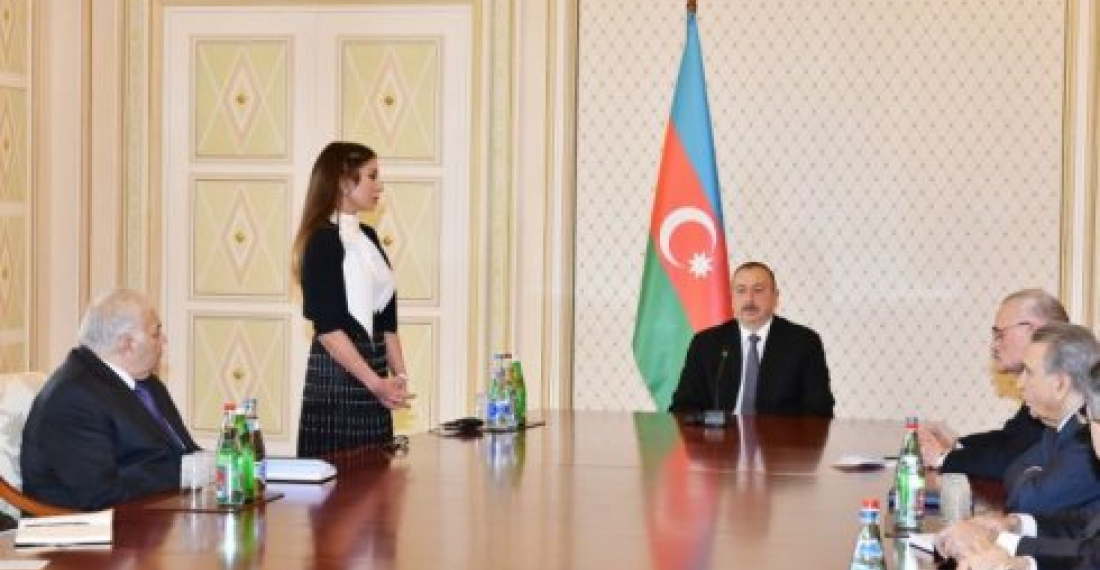
photo: Azerbaijani First Vice President, Mehriban Aliyeva being introduced to members of the National Security Council on 20 February 2017.

Related articles

Editor's choice
News
COP 17 in Armenia

COP 17 in Armenia

Armenia is currently hosting the COP17 conference of the Convention on Biological Diversity, which began earlier this week (19 October) and will run until 30 October, bringing around 15,000 participants from 196 different countries to Yerevan. At a leaders' summit held as part of COP17, Prime Minister Nikol Pashinyan expressed realistic ambitions: “We are halfway towards achieving these goals (Kunming-Montreal Global Biodiversity Framework), and we must honestly acknowledge that we are not yet moving in the right direction. Our task now is not to make new promises, but to fulfil the commitments we have already made.” Pashinyan pointed towards Armenia's own records, noting that the whitefish stock in Lake Sevan has increased substantially in the last ten years. Iranian President Masoud Pezeshkian and Georgian Prime Minister Irakli Kobakhidze also addressed the summit, with Turkiye sending its agriculture minister. However, there were no reports of Azerbaijani representatives attending. The conference has given Yerevan a valuable international platform, yet the absence of Azerbaijan is likely to be read as a sign that the peace process in the South Caucasus has not yet been translated into wider regional cooperation. The leaders' summit was opened by Armenian Prime Minister Nikol Pashinyan, who stressed that hosting the conference was a great honour for Armenia. He expressed hope that it would 'be productive and contribute to protecting our planet's biodiversity'. 'We – the citizens of Armenia, the government, state authorities and local governments – owe a debt to our nature,' the prime minister said. He noted that the international community had already developed the concept of 'living in harmony with nature’ and adopted the Kunming-Montreal Global Biodiversity Framework in 2022, setting out goals and specific targets to be achieved by 2030. 'We are halfway towards achieving these goals, and we must honestly acknowledge that we are not yet moving in the right direction. Our task now is not to make new promises, but to fulfil the commitments we have already made,' Nikol Pashinyan said. The COP17 conference is expected to adopt a declaration at leaders' level. More than 30 documents are scheduled for discussion. If approved, the commitments set out in them will become legally binding on countries that are parties to the Convention on Biological Diversity.”
Editor's choice
News
Landmines present to the European Union both a contradiction and a dilemma

Landmines present to the European Union both a contradiction and a dilemma

Finland’s decision to buy one million landmines creates a serious contradiction in the policy of the European Union, and is symbolic of a bigger dilemma facing European countries as they get used to the need to acquire “hard” power to face an increasing threat from Russia. Finland is seeking to acquire one million anti-personnel mines at a cost of 100 million euros. Finland, together with Poland, Latvia, Lithuania and Estonia last year abandoned the Ottawa agreement, the international framework that bans the use of anti-personnel mines, which the EU had been instrumental in establishing and supporting. All five countries cite the threat from Moscow as the reason. Colonel Riku Mikkonen of the Army Command told Finland’s national news agency STT that officials are now gathering information from suppliers regarding the deal, the AFP news agency reports. Helsinki would like domestic manufacturers to supply the mines, with contracts signed by the end of 2027 and production up and running by 2028. “It would be useful in many ways if Finnish companies produced the anti-personnel mines in Finland,” Mikkonen said. About half a dozen Finnish firms qualify, he told STT. “However, at this stage, buying the mines from abroad is not totally ruled out,” he added. LANDMINES PROVIDE THE EU WITH BOTH A CONTRADICTION, AND A DILEMMA Eliminating landmine contamination worldwide is one of the EU’s main soft power postures, and it basks in its record as the biggest funder of anti-landmine action in the world. But the fact that 5 of its 27 member states  have now left the Ottawa Treaty dents the EU moral high ground. It is a contradiction that is too big and important to be ignored. It also presents the European Union with a deeper dilemma. The threat from Russia is changing what the EU has stood for decades, namely a force for good able to mobilise its considerable soft power for the greater good of humanity. How the Union will implement this change will define its future. In the meantime landmines have not become any less lethal, benign, or unimportant. They remain in many parts of the world a major threat to life, an impediment to prosperity, and a potential trigger to further conflict. The 22 EU members states that still adhere to the Ottawa treaty must regroup, and be more assertive in their quest against anti-personnel land mines. All the reasons why they supported the Ottawa treaty in the first place still exist. The message must be clear: NO TO LANDMINES!

Popular

Editor's choice
Interview
Thursday Interview: Murad Muradov

Thursday Interview: Murad Muradov

Today, commonspace.eu starts a new regular weekly series. THURSDAY INTERVIEW, conducted by Lauri Nikulainen, will host  persons who are thinkers, opinion shapers, and implementors in their countries and spheres. We start the series with an interview with Murad Muradov, a leading person in Azerbaijan's think tank community. He is also the first co-chair of the Action Committee for a new Armenian-Azerbaijani Dialogue. Last September he made history by being the first Azerbaijani civil society activist to visit Armenia after the 44 day war, and the start of the peace process. Speaking about this visit Murad Muradov said: "My experience was largely positive. My negative expectations luckily didn’t play out. The discussions were respectful, the panel format bringing together experts from Armenia, Azerbaijan, and Turkey was particularly valuable during the NATO Rose-Roth Seminar in Yerevan, and media coverage, while varied in tone, remained largely constructive. Some media outlets though attempted to represent me as more of a government mouthpiece than an independent expert, which was totally misleading.  Overall, I see these initiatives as important steps in rebuilding trust and normalising professional engagement. The fact that soon a larger Azerbaijani civil society visits to Armenia followed, reinforces the sense that this process is moving in the right direction." (click the image to read the interview in full)