


Malian Prime Minister accuses France of abandoning his country in its fight against jihadists

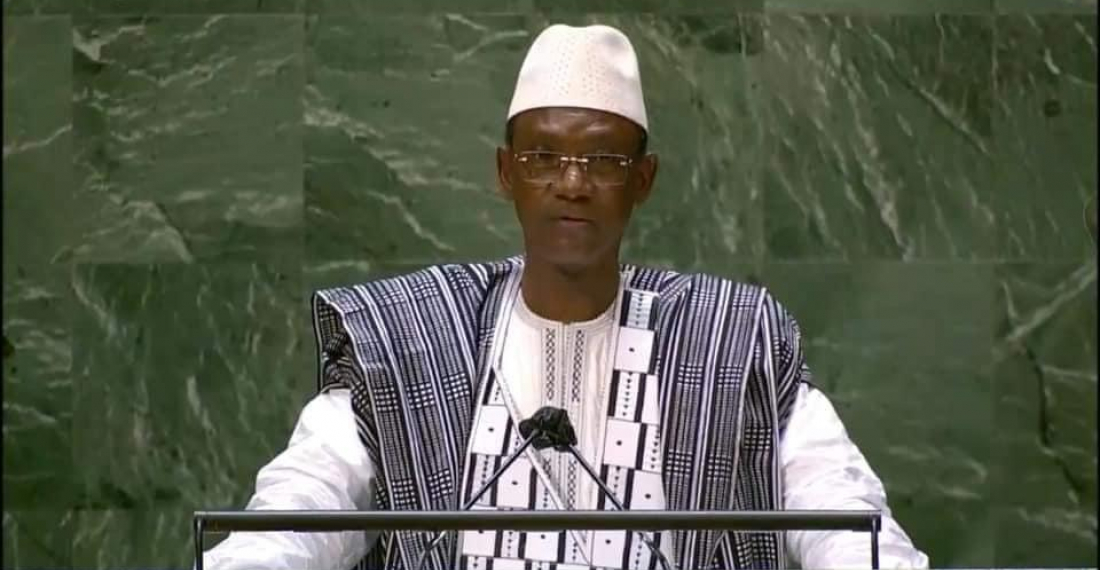
During his speech at the United Nations General Assembly on Saturday (25 September), Malian prime minister Choguel Maïga, accused France of abandoning Mali with its decision to withdraw the Barkhane force.

“The new situation born of the end of 'Barkhane', placing Mali in front of a fait accompli and exposing it to a kind of abandonment in full flight, leads us to explore the ways and means to better ensure security in an autonomous way with other partners”, Maïga declared.

It is a question of "filling the void that the closure of certain rights-of-way of "Barkhane" in northern Mali will not fail to create", specified the prime minister, deploring a "lack of consultation" from Paris, and a "unilateral" announcement without tripartite coordination with the UN and the Malian government.

Maïga explained that the security situation in Mali has not improved at all despite the foreign forces on the ground, and the inhabitants continue to suffer from the threats of jihadism. As a consequence, Bamako turned security into its number one priority, especially after the decision to withdraw the Barkhane force.

Notwithstanding, French president Emmanuel Macron "reaffirm[ed] France's determination in [its fight] against terrorism" following the death of a French soldier killed in action in Mali on Friday morning. However, the future of France's involvement in Mali will depend on the latter's decision to work with Russian mercenaries, a move deemed "incompatible" with the maintaining of French troops in Mali by the head of French diplomacy, Jean-Yves Le Drian.

Indeed, the reorganisation of the French military presence takes place as tensions are high between Paris and the Malian junta, which plans to conclude a contract with the Russian paramilitary company Wagner, described as close to Russian power. 

Not once did Maïga confirm being in contact with the Russian mercenaries from the private company Wagner. This information was however confirmed by the Russian Foreign Minister Sergei Lavrov minutes before Maïga's speech, while denying any involvement from Moscow. The Malian prime minister also asked to broaden the mandate of the UN's MINUSMA peacekeeping mission in Mali in order to increase its offensive capabilities

source: commonspace.eu with Le Monde (Paris), RFi (Paris) and agencies.
photo: Choguel Maïga during his speech at the UN General Assembly in New York on Saturday, 25 September; @ChoguelKMaiga (Twitter)

Related articles

Editor's choice
News
Borrell tells the European Parliament that the situation in Afghanistan was critical, but the EU will remain engaged

Borrell tells the European Parliament that the situation in Afghanistan was critical, but the EU will remain engaged

Borrell underlined that the European Union will make every effort to support the peace process and to remain a committed partner to the Afghan people. "Of course, we will have to take into account the evolving situation, but disengagement is not an option.  We are clear on that: there is no alternative to a negotiated political settlement, through inclusive peace talks.
Editor's choice
News
Germany accuses Russia of cyberattacks and disinformation campaign

Germany accuses Russia of cyberattacks and disinformation campaign

The German government holds Russia responsible for a cyberattack on German air traffic control, and for targeted disinformation campaigns before the last federal election. According to the German Foreign Office in Berlin, the incidents could be clearly attributed to the Russian military intelligence service, the GRU. In response, the Russian ambassador to Berlin was summoned to the Foreign Ministry. "We have been observing a massive increase in threatening hybrid activities by Russia for some time now," a spokesperson for the Foreign Ministry stated. These range from disinformation campaigns and espionage to cyberattacks and sabotage attempts. The aim is to divide society, sow distrust, and undermine confidence in democratic institutions. The spokesperson added that with these actions, Russia is "very concretely threatening our security, not only through its war of aggression against Ukraine, but also here in Germany."  The Foreign Ministry spokesperson explained that the cyberattack on air traffic control in August 2024 was clearly attributed to the hacker collective "APT28," known as "Fancy Bear," and to the responsibility of the Russian military intelligence service, the GRU. Furthermore, it could now be "conclusively stated" that Russia had attempted "to influence and destabilize both the last Federal election and the ongoing internal affairs of the Federal Republic of Germany." There was "absolutely irrefutable evidence" for this". The so-called "Storm 1516" campaign, which has been running since 2024, is allegedly backed by "reliable information" that the Moscow-based think tank "Center for Geopolitical Expertise" is behind it. The Center is also said to be supported by Russian military intelligence. Its primary aim is to influence democratic elections in the West. (Click the image to read more).

Popular

Editor's choice
News
Germany accuses Russia of cyberattacks and disinformation campaign

Germany accuses Russia of cyberattacks and disinformation campaign

The German government holds Russia responsible for a cyberattack on German air traffic control, and for targeted disinformation campaigns before the last federal election. According to the German Foreign Office in Berlin, the incidents could be clearly attributed to the Russian military intelligence service, the GRU. In response, the Russian ambassador to Berlin was summoned to the Foreign Ministry. "We have been observing a massive increase in threatening hybrid activities by Russia for some time now," a spokesperson for the Foreign Ministry stated. These range from disinformation campaigns and espionage to cyberattacks and sabotage attempts. The aim is to divide society, sow distrust, and undermine confidence in democratic institutions. The spokesperson added that with these actions, Russia is "very concretely threatening our security, not only through its war of aggression against Ukraine, but also here in Germany."  The Foreign Ministry spokesperson explained that the cyberattack on air traffic control in August 2024 was clearly attributed to the hacker collective "APT28," known as "Fancy Bear," and to the responsibility of the Russian military intelligence service, the GRU. Furthermore, it could now be "conclusively stated" that Russia had attempted "to influence and destabilize both the last Federal election and the ongoing internal affairs of the Federal Republic of Germany." There was "absolutely irrefutable evidence" for this". The so-called "Storm 1516" campaign, which has been running since 2024, is allegedly backed by "reliable information" that the Moscow-based think tank "Center for Geopolitical Expertise" is behind it. The Center is also said to be supported by Russian military intelligence. Its primary aim is to influence democratic elections in the West. (Click the image to read more).

