


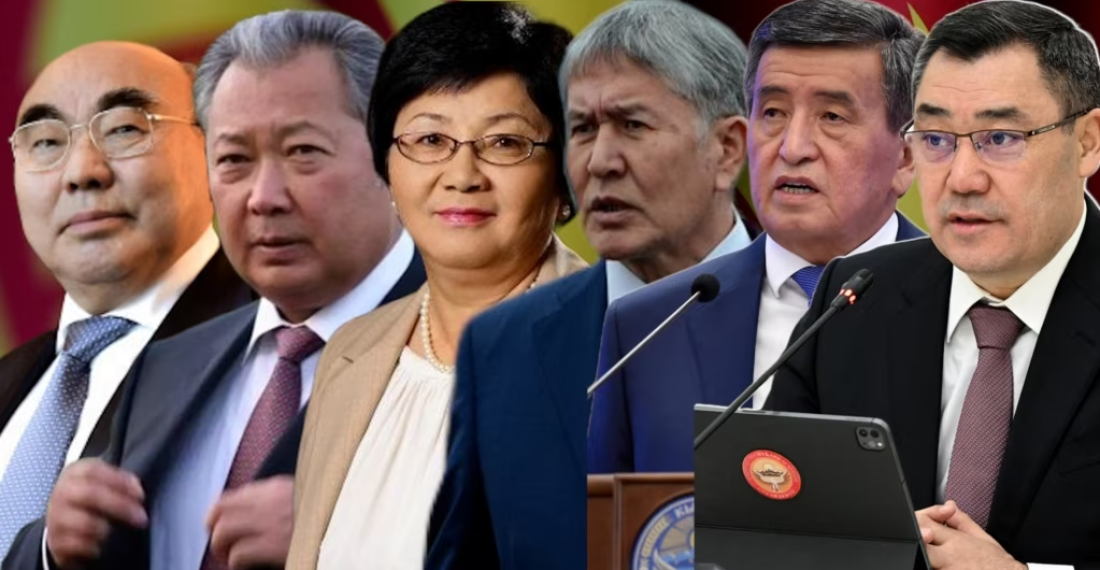
Kyrgystan President's secret meeting in Dubai with ex-presidents causes controversy

President of Kyrgyzstan Sadyr Japarov has caused controversy by convening a secret meeting in Dubai with all of Kyrgyzstan’s ex-presidents, allegedly to demonstrate their unity. Critics, however, disagree and think of it as a populist move that disrespects the victims of previous presidents’ rules.

At the meeting, the following ex-presidents were present: Askar Akayev, who was deposed in the 2005 Tulip Revolution; Kurmanbek Bakiyev, who fled the country after killing dozens of protestors; Interim President Roza Otunbayeva; Almazbek Atambayev, who had been imprisoned; Sooronbai Jeenbekov, who was forced out of office; and then the current President Sadyr Japarov. In addition, the head of security services, Kamchybek Tashiyev, joined the meeting. Tashiyev is often considered to run the country together with Japarov.

Many details of the meeting remain shrouded in mystery, with official information only stating it lasted for four hours. It is presumed the meeting took place after 14 February, as only then was Atambayev released from prison. Japarov has said he had reached out to every president individually for a private head-to-head meeting, implying the gathering was a surprise for the attendees as well. 

Japarov has described the meeting as “therapeutic”,  saying that previous presidents had all forgiven each other for past events, and are thereby willing to promote “unification of the nation” and focus on economic development.

Divided response as opposition activism in Kyrgyzstan plummets to historic lows

Not everyone in Kyrgyzstan is happy. Many believe Bakiyev should be behind bars serving a 24-year sentence for abuse of power that was handed down in 2013. Even the just released Atambayev led people to question the attendance of Bakiyev, as well as rumours that he was allowed to return to Kyrgyzstan. Atambayev said on Instagram that he wants to establish “peace and unity” and does not want to confuse this goal with the “return of the Bakiyevs to Kyrgyzstan”.

Several political analysts have suggested various motivations for Japarov's decision to convene the secret meeting. Some have argued that he may have been trying to draw a historic line in the sand and mark his time in office with a momentous event. Others suggest that he may have been seeking to shore up his popularity by presenting himself as a man of generous spirit in the face of widespread public discontent over inflation and other economic factors.

Opposition activism has plummeted to historic lows amid a spate of repressive measures from the authorities, indicating a deepening political disaffection in Kyrgyzstan. However, according to analyst Medet Tiulegenov the possible return of Bakiyev to Kyrgyzstan could swiftly awaken the public, although analyst Aida Alymbayeva argues there is “nobody left to mobilize them”.

Japarov has denied any collaboration with Bakiyev, saying “If he comes, he will be taken into custody. We must abide by the decision of the court.”

source: commonspace.eu with eurasianet, RFE/RL
photo: RFE/RL

Related articles

Editor's choice
News
Pope on Christmas Day: "Peace is a shared responsibility"

Pope on Christmas Day: "Peace is a shared responsibility"

In his Christmas address on St Peter's Square, Pope Leo XIV renewed his plea for peace, reminding the world that it is both God’s gift and humanity’s shared responsibility. Pope Leo XIV renewed his appeal for peace, dialogue, and responsibility, turning to those regions where violence and instability continue to claim innocent lives. The Pope prayed for “justice, peace, and stability for Lebanon, Palestine, Israel, and Syria,” and urged that the promise of peace rooted in righteousness be renewed. He appealed in a particular way for Ukraine, asking that “the clamor of weapons cease,” and that all those involved, with the support of the international community, find the courage to engage in “sincere, direct, and respectful dialogue.” Remembering conflicts that risk being forgotten, Pope Leo XIV expressed closeness to the victims of war and violence in Sudan, South Sudan, Mali, Burkina Faso, and the Democratic Republic of Congo, as well as to all those who suffer as a result of injustice, political instability, religious persecution, and terrorism. The Pope also prayed for Haiti, calling for an end to violence and progress along the path of peace and reconciliation. He also invoked peace for Myanmar, asking that the country be guided towards reconciliation and hope, especially for its younger generations. Turning to Latin America, he encouraged those with political responsibilities to give space to dialogue for the common good, rather than to ideological and partisan divisions. The Pope also prayed for the restoration of the "ancient friendship" between Thailand and Cambodia, and entrusted to God the peoples of South Asia and Oceania, who have been severely affected by recent natural disasters, calling for renewed commitment to assisting those who suffer.

Popular

Editor's choice
News
Pope on Christmas Day: "Peace is a shared responsibility"

Pope on Christmas Day: "Peace is a shared responsibility"

In his Christmas address on St Peter's Square, Pope Leo XIV renewed his plea for peace, reminding the world that it is both God’s gift and humanity’s shared responsibility. Pope Leo XIV renewed his appeal for peace, dialogue, and responsibility, turning to those regions where violence and instability continue to claim innocent lives. The Pope prayed for “justice, peace, and stability for Lebanon, Palestine, Israel, and Syria,” and urged that the promise of peace rooted in righteousness be renewed. He appealed in a particular way for Ukraine, asking that “the clamor of weapons cease,” and that all those involved, with the support of the international community, find the courage to engage in “sincere, direct, and respectful dialogue.” Remembering conflicts that risk being forgotten, Pope Leo XIV expressed closeness to the victims of war and violence in Sudan, South Sudan, Mali, Burkina Faso, and the Democratic Republic of Congo, as well as to all those who suffer as a result of injustice, political instability, religious persecution, and terrorism. The Pope also prayed for Haiti, calling for an end to violence and progress along the path of peace and reconciliation. He also invoked peace for Myanmar, asking that the country be guided towards reconciliation and hope, especially for its younger generations. Turning to Latin America, he encouraged those with political responsibilities to give space to dialogue for the common good, rather than to ideological and partisan divisions. The Pope also prayed for the restoration of the "ancient friendship" between Thailand and Cambodia, and entrusted to God the peoples of South Asia and Oceania, who have been severely affected by recent natural disasters, calling for renewed commitment to assisting those who suffer.

