Israeli hostages and Palestinian detainees released as Trump’s Gaza plan is endorsed in Egypt summit

Hamas freed the last living Israeli hostages from Gaza on Monday 13 October under a ceasefire deal and Israel sent home busloads of Palestinian detainees, as U.S. President Donald Trump declared the end of the two-year long war in the Middle East. Hours later, Trump convened Muslim and European leaders in Egypt to discuss the future of the Gaza Strip and the possibility of a wider regional peace, even as Hamas and Israel, both absent from the gathering, are yet to agree on the next steps. The Israeli military said it had received all 20 hostages confirmed to be alive, after their transfer form Gaza by the Red Cross. The announcement prompted cheering, hugging and weeping among thousands waiting at "Hostage Square" in Tel Aviv. In Gaza, thousands of relatives, many weeping with joy, gathered at a hospital where buses brought home some of the nearly 2,000 Palestinian prisoners and detainees to be freed by Israel as part of the accord. "The skies are calm, the guns are silent, the sirens are still and the sun rises on a Holy Land that is finally at peace," Trump told the Knesset, Israel's parliament, saying a "long nightmare" for both Israelis and Palestinians was over.

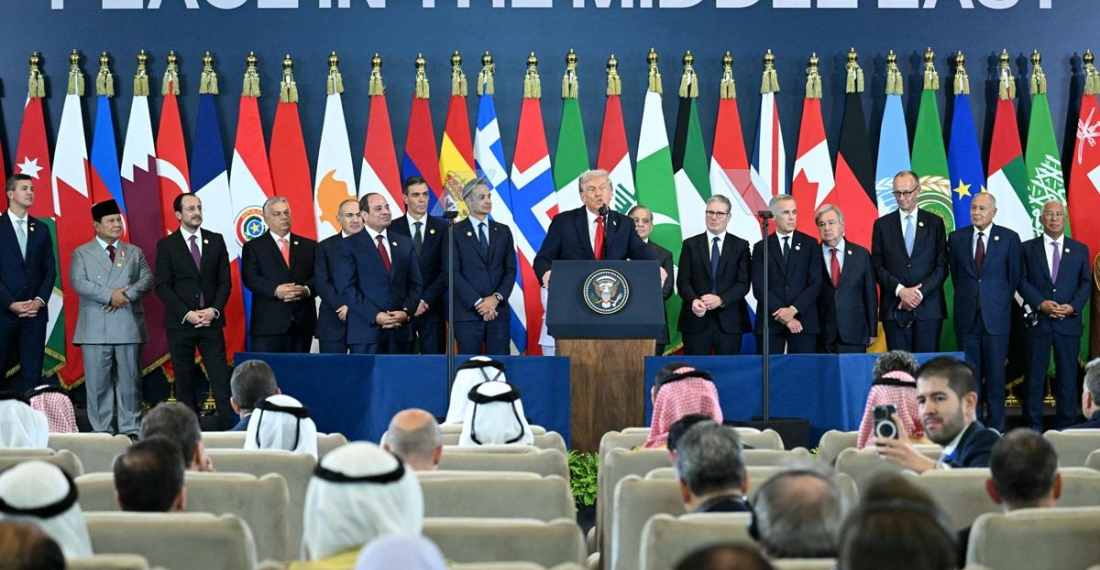
The U.S., along with Egypt, Qatar and Turkey, mediated what has been described as a first phase agreement between Israel and Hamas for a ceasefire and the release of hostages by Hamas and prisoners and detainees by Israel. At the Egyptian beach resort of Sharm el-Sheikh later on Monday, Trump and President Abdel Fattah al-Sisi hosted more than 20 world leaders for a summit intended to cement the truce.

At the opening of the summit, Trump signed a document with Egypt, Qatar and Turkey's leaders welcoming the agreements on Gaza and pledging to "work collectively to implement and sustain this legacy." Egypt's presidency said that discussions included the governance, security and reconstruction of Gaza. "Now the rebuilding begins," Trump said at the summit, delivering an expansive speech where he described in grand terms the Gaza agreement he helped broker, saying it could be "the greatest deal of them all."

Israel and Hamas were not represented at the summit, while the leaders of Saudi Arabia and the United Arab Emirates did not attend. Trump at one point greeted Palestinian Authority President Mahmoud Abbas, who spoke to the U.S. leader at length. The Palestinian Authority wants to play a significant role in the future administration of Gaza, despite objections from Israel.

The Israeli hostages freed on Monday were the last still alive in captivity from 251 seized in the Hamas-led attacks of October 7, 2023 that killed 1,200 people and triggered the war. The ceasefire and partial Israeli withdrawal agreed last week halted one of Israel's biggest offensives of the war, an all-out assault on Gaza City that was killing scores of people per day. Since then, huge numbers of Palestinians have been able to return to the ruins of homes in the Gaza Strip, swathes of which were reduced to a wasteland by Israeli bombardment that killed 68,000 people, according to Gaza health authorities.

Formidable obstacles remain, even to securing an enduring ceasefire, much less to bringing a wider, more durable peace. Among the immediate issues still to be resolved: recovering the remains of another 26 Israeli hostages believed to have died and two whose fates are unknown. Hamas says recovering the bodies could take time as not all burial sites are known. Israel's military said it had escorted four coffins containing the remains of deceased hostages to Israel and that those remains were being identified.

Aid supplies must be rushed into the enclave, where hundreds of thousands of people face famine. U.N. aid chief Tom Fletcher underlined the need to "get shelter and fuel to people who desperately need it and to massively scale up the food and medicine and other supplies going in". Beyond that, crucial issues have yet to be resolved, including how to govern and police Gaza, and the ultimate future of Hamas, which still rejects Israel's demands to disarm.

Source: commonspace.eu with Reuters, AFP and agencies. Photo: US President Donald Trump speaks during the Sharm El-Sheikh Peace Summit in the Egyptian Red Sea resort town of Sharm el-Sheikh/AFP

Related articles

Editor's choice
News
Borrell tells the European Parliament that the situation in Afghanistan was critical, but the EU will remain engaged

Borrell tells the European Parliament that the situation in Afghanistan was critical, but the EU will remain engaged

Borrell underlined that the European Union will make every effort to support the peace process and to remain a committed partner to the Afghan people. "Of course, we will have to take into account the evolving situation, but disengagement is not an option.  We are clear on that: there is no alternative to a negotiated political settlement, through inclusive peace talks.
Editor's choice
News
G7 foreign ministers issue wide ranging statement after their meeting in Canada

G7 foreign ministers issue wide ranging statement after their meeting in Canada

The Foreign Ministers of Canada, France, Germany, Italy, Japan, the United Kingdom, and the United States of America, and the High Representative of the European Union, met under Canada’s G7 Presidency, in Niagara, on November 11-12, 2025. The Foreign Ministers of Brazil, India, the Kingdom of Saudi Arabia, Mexico, the Republic of Korea, South Africa, and Ukraine, also joined the meeting for discussions on maritime security and prosperity, critical minerals, economic resilience and energy security. At the end of their meeting the G7 foreign ministers said: We reaffirmed our unwavering support for Ukraine in defending its territorial integrity and right to exist, and its freedom, sovereignty, and independence. We reiterated that an immediate ceasefire is urgently needed. We agreed that the current line of contact should be the starting point of negotiations. We remain committed to the principle that international borders must not be changed by force. We are increasing the economic costs to Russia, and exploring measures against countries and entities that are helping finance Russia’s war efforts. We condemned the provision to Russia of military assistance by DPRK and Iran, and the provision of weapons and dual-use components by China, a decisive enabler of Russia’s war. We acknowledged the ongoing discussions on a wide range of financing options, including further leveraging immobilised Russian Sovereign Assets in our jurisdictions in a coordinated way to support Ukraine. We strongly condemned Russia’s recent direct attacks on energy infrastructure and reaffirmed our support for Ukraine’s energy security. We reiterated our strong support for President Trump’s Comprehensive Plan to End the Gaza Conflict. We welcomed the ceasefire and the release of hostages. We stressed the urgency of returning the remains of deceased hostages. We also welcomed the increased flows of aid, but expressed concern about restrictions that remain in place. We called on all parties to allow for humanitarian assistance without interference at scale, through the United Nations and its agencies, and the Red Crescent, in addition to other international institutions and INGOs, as stipulated in President Trump’s plan. It is vital that all parties continue to engage constructively on the next steps outlined in the Comprehensive Plan, in pursuit of a political horizon for peaceful and prosperous co-existence for the Israeli and Palestinian peoples that advances comprehensive Middle East peace and stability. We will also continue to maintain attention on the situation in the West Bank. (click headline to read more)

Popular

Editor's choice
News
G7 foreign ministers issue wide ranging statement after their meeting in Canada

G7 foreign ministers issue wide ranging statement after their meeting in Canada

The Foreign Ministers of Canada, France, Germany, Italy, Japan, the United Kingdom, and the United States of America, and the High Representative of the European Union, met under Canada’s G7 Presidency, in Niagara, on November 11-12, 2025. The Foreign Ministers of Brazil, India, the Kingdom of Saudi Arabia, Mexico, the Republic of Korea, South Africa, and Ukraine, also joined the meeting for discussions on maritime security and prosperity, critical minerals, economic resilience and energy security. At the end of their meeting the G7 foreign ministers said: We reaffirmed our unwavering support for Ukraine in defending its territorial integrity and right to exist, and its freedom, sovereignty, and independence. We reiterated that an immediate ceasefire is urgently needed. We agreed that the current line of contact should be the starting point of negotiations. We remain committed to the principle that international borders must not be changed by force. We are increasing the economic costs to Russia, and exploring measures against countries and entities that are helping finance Russia’s war efforts. We condemned the provision to Russia of military assistance by DPRK and Iran, and the provision of weapons and dual-use components by China, a decisive enabler of Russia’s war. We acknowledged the ongoing discussions on a wide range of financing options, including further leveraging immobilised Russian Sovereign Assets in our jurisdictions in a coordinated way to support Ukraine. We strongly condemned Russia’s recent direct attacks on energy infrastructure and reaffirmed our support for Ukraine’s energy security. We reiterated our strong support for President Trump’s Comprehensive Plan to End the Gaza Conflict. We welcomed the ceasefire and the release of hostages. We stressed the urgency of returning the remains of deceased hostages. We also welcomed the increased flows of aid, but expressed concern about restrictions that remain in place. We called on all parties to allow for humanitarian assistance without interference at scale, through the United Nations and its agencies, and the Red Crescent, in addition to other international institutions and INGOs, as stipulated in President Trump’s plan. It is vital that all parties continue to engage constructively on the next steps outlined in the Comprehensive Plan, in pursuit of a political horizon for peaceful and prosperous co-existence for the Israeli and Palestinian peoples that advances comprehensive Middle East peace and stability. We will also continue to maintain attention on the situation in the West Bank. (click headline to read more)