Israel orders all Palestinians out of Gaza as Hamas official says Trump plan must be amended

Israel’s defense minister on Wednesday 1 October ordered all remaining Palestinians to leave Gaza City, saying it was their “last opportunity” and that anyone who stayed would be considered a terrorist or militant supporter and face the “full force” of Israel’s latest offensive. At least 21 Palestinians were killed across the territory, according to local hospitals, as Hamas weighed a new proposal form US President Donald Trump  aimed at ending the war and returning the remaining captives taken in Hamas’ Oct. 7, 2023, attack that triggered it. A senior Hamas official told AP that there are some points in the proposal that are unacceptable and must be amended, without elaborating. He said the official response will only come after consultations with other Palestinian factions.

On Wednesday, Egypt’s Foreign Minister Bader Abdelatty said Trump’s proposal requires more negotiations on certain elements, echoing remarks made by Qatar a day earlier. The comments by Qatar and Egypt, two key mediators, appeared to reflect Arab countries’ discontent over the text of the 20-point plan that the White House put out after Trump and Israeli Prime Minister Benjamin Netanyahu announced they had agreed on it Monday.

The Hamas official, speaking on condition of anonymity because he was not authorised to brief media about the ongoing talks, said Hamas had conveyed its concerns to Qatar and Egypt, and had requested more time to discuss the proposal.

The Trump proposal, which has received wide international support, requires Hamas to release hostages, leave power in Gaza and disarm in return for the release of Palestinian prisoners and an end to fighting. The plan guarantees the flow of humanitarian aid and promises reconstruction in Gaza, placing it and its more than 2 million Palestinians under international governance. However, it sets no path to Palestinian statehood. 

The Palestinian Authority in the occupied West Bank, led by rivals of Hamas, has welcomed the plan, as have Egypt, Jordan, Indonesia, Pakistan, Turkey, Qatar, Saudi Arabia, and United Arab Emirates. 

Around 400,000 Palestinians have fled famine-stricken Gaza City since Israel launched a major offensive last month aimed at occupying it, but hundreds of thousands remain, many because they cannot afford to leave or are too weak to make the journey to tent camps in the south. “This is the last opportunity for Gaza residents who wish to do so to move south,” Defense Minister Israel Katz wrote on X. “Those who remain in Gaza will be (considered) terrorists and terror supporters.”

The road south was packed as Palestinians fled, with hastily loaded trucks and cars driving alongside people on foot carrying their belongings. “We left barefoot,” Hussein al-Del said. The Israelis “were striking at random, with no mercy for anyone. We left behind our food, our furniture, blankets, and everything. We left only with our souls,” he said.

On Wednesday dozens of people attended a funeral service for a Palestinian freelance journalist, Yahya Barzaq. He was killed Tuesday along with five other people in an airstrike while working for Turkish broadcast outlet TRT. More than 189 Palestinian journalists and media workers have been killed by Israeli fire in Gaza since the outbreak of the war, according to the Committee to Protect Journalists.

Israel’s campaign in Gaza has killed more than 66,000 Palestinians and wounded nearly 170,000 others, according to Gaza’s Health Ministry. The ministry does not differentiate between civilians and militants in its toll, but has said women and children make up around half the dead. The ministry is part of the Hamas-run government. U.N. agencies and many independent experts view its figures as the most reliable estimate of wartime casualties.

The Hamas-led attack on southern Israel nearly two years ago killed some 1,200 people and 251 others were abducted. Most of the hostages have been freed under previous ceasefire deals, but 48 are still held in Gaza — around 20 believed by Israel to be alive.

The Israeli military said that starting at midday Wednesday, it would only allow Palestinians to flee south from Gaza City and not to head north on the only north-south route still open.

Around 90% of Gaza’s population has been displaced in the war, often multiple times, and finding food is a daily struggle for many. On Wednesday, the International Committee of the Red Cross said intensifying warfare in Gaza City forced it to suspend its operations there and relocate staff to southern Gaza.

Meanwhile, a widely watched flotilla of activists carrying a symbolic amount of humanitarian aid bound for Gaza said the Israeli navy was beginning to intercept their vessels as has happened in past such flotilla attempts.

The activists aboard the Global Sumud Flotilla of about 50 vessels have described their effort as the largest attempt to date to break Israel’s maritime blockade of the strip. The core vessels set sail from Barcelona, Spain, on Sept. 1. Israeli authorities have warned the boats would not be allowed to reach Gaza.

Thursday 2 October is Yom Kippur — the high Jewish holiday of the Day of Atonement — when stores, businesses, public transportation and broadcasting shut down in Israel, beginning around sundown on Wednesday.

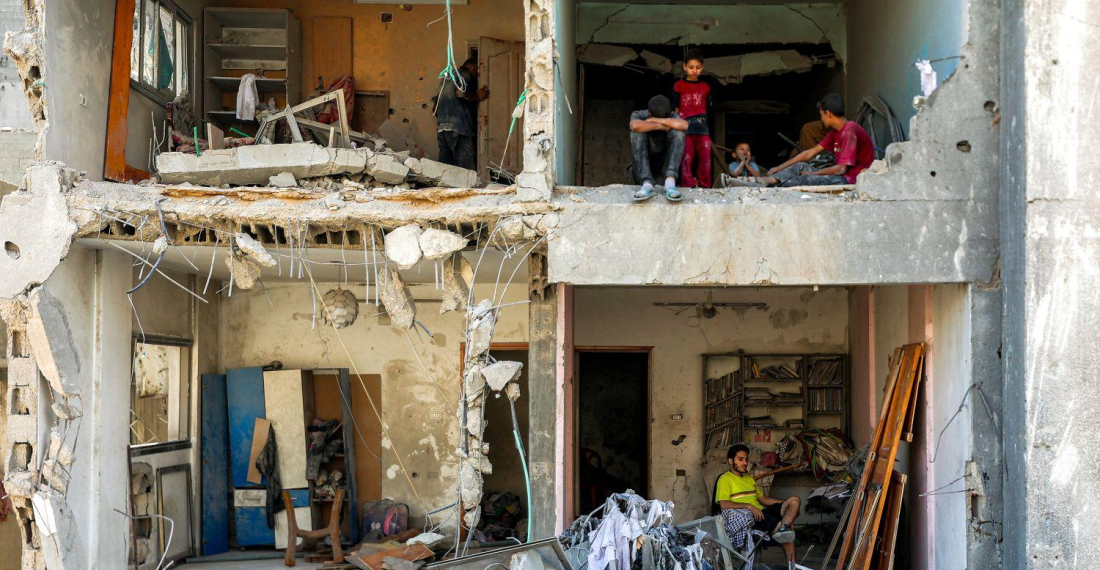
Source: commonspace.eu with AP and agencies. Photo: IPIA man and children sit in exposed rooms in a heavily damaged building near the Unknown Soldier Tower, which was destroyed by overnight Israeli bombardment/AFP

Related articles

Editor's choice
News
Borrell tells the European Parliament that the situation in Afghanistan was critical, but the EU will remain engaged

Borrell tells the European Parliament that the situation in Afghanistan was critical, but the EU will remain engaged

Borrell underlined that the European Union will make every effort to support the peace process and to remain a committed partner to the Afghan people. "Of course, we will have to take into account the evolving situation, but disengagement is not an option.  We are clear on that: there is no alternative to a negotiated political settlement, through inclusive peace talks.
Editor's choice
News
Pope's visit to Türkiye and Lebanon has a strong ecumenical character, and places interreligious dialogue at its centre

Pope's visit to Türkiye and Lebanon has a strong ecumenical character, and places interreligious dialogue at its centre

Pope Leo XIV has begun the first overseas trip of his pontificate, a six-day visit to Türkiye and Lebanon, which started yesterday (27 November) and ends on Tuesday (2 December). According to Vatican Radio, the visit "carries a strong ecumenical character and places interreligious dialogue at its centre. It will also be a moment of closeness to Christian communities and local populations across the region".   During nearly a week in the region, Pope Leo XIV will meet civil and religious authorities, visit mosques and ancient churches, pray at Beirut’s port in memory of the victims of the 2020 explosion, and hold private meetings with Presidents Recep Tayyip Erdoğan and Joseph Aoun.   A highlight of the visit will be a visit to Nicaea, where the Pope will mark the anniversary of the Council of Nicaea. Christians of many traditions recognise the Council of Nicaea as a foundation of shared faith. One of the most anticipated moments will be the Pope’s encounter with Lebanese youth in Bkerké, at the Maronite Patriarchate, a meeting expected to carry strong messages of hope in the Jubilee Year. A central event will be the ecumenical celebration in İznik, where the Pope and Ecumenical Patriarch Bartholomew will walk together toward the ruins of the Basilica of St Neophytos. The prayer, held before icons of Christ and the Council, will conclude with the lighting of a candle—a symbolic gesture of unity. The journey will also highlight interreligious engagement.   Memorable moments are expected throughout the trip: a wreath at Atatürk’s mausoleum, prayer inside the Blue Mosque, Mass at Istanbul’s Volkswagen Arena, the planting of a cedar at the presidential palace in Beirut, and prayer at the tomb of St Charbel in Lebanon. The Vatican said that "Pope Leo XIV’s pilgrimage to Türkiye and Lebanon aims to offer a voice of peace, unity, and hope at the heart of the Middle East."

Popular

Editor's choice
News
Pope's visit to Türkiye and Lebanon has a strong ecumenical character, and places interreligious dialogue at its centre

Pope's visit to Türkiye and Lebanon has a strong ecumenical character, and places interreligious dialogue at its centre

Pope Leo XIV has begun the first overseas trip of his pontificate, a six-day visit to Türkiye and Lebanon, which started yesterday (27 November) and ends on Tuesday (2 December). According to Vatican Radio, the visit "carries a strong ecumenical character and places interreligious dialogue at its centre. It will also be a moment of closeness to Christian communities and local populations across the region".   During nearly a week in the region, Pope Leo XIV will meet civil and religious authorities, visit mosques and ancient churches, pray at Beirut’s port in memory of the victims of the 2020 explosion, and hold private meetings with Presidents Recep Tayyip Erdoğan and Joseph Aoun.   A highlight of the visit will be a visit to Nicaea, where the Pope will mark the anniversary of the Council of Nicaea. Christians of many traditions recognise the Council of Nicaea as a foundation of shared faith. One of the most anticipated moments will be the Pope’s encounter with Lebanese youth in Bkerké, at the Maronite Patriarchate, a meeting expected to carry strong messages of hope in the Jubilee Year. A central event will be the ecumenical celebration in İznik, where the Pope and Ecumenical Patriarch Bartholomew will walk together toward the ruins of the Basilica of St Neophytos. The prayer, held before icons of Christ and the Council, will conclude with the lighting of a candle—a symbolic gesture of unity. The journey will also highlight interreligious engagement.   Memorable moments are expected throughout the trip: a wreath at Atatürk’s mausoleum, prayer inside the Blue Mosque, Mass at Istanbul’s Volkswagen Arena, the planting of a cedar at the presidential palace in Beirut, and prayer at the tomb of St Charbel in Lebanon. The Vatican said that "Pope Leo XIV’s pilgrimage to Türkiye and Lebanon aims to offer a voice of peace, unity, and hope at the heart of the Middle East."