Great power interest in Central Asia putting Uzbekistan in the spotlight

In recent times, Central Asia’s most populous nation has become the centre of attention for great powers, underscored by high level diplomatic contacts with the United States, the hosting of a regional summit with the leadership of the European Union and a high profile visit by hundreds of Russian officials and executives who participated in a trade fair in Tashkent. Western interest centres on Uzbekistan’s abundant reserves of critical minerals and a desire to develop clean energy  sources, including nuclear power. Russia, along with China, has broader trade interests, including developing manufacturing capacity.

So far, all the discussions have generated lots of optimistic jargon about the future potential of expanding trade, but few tangible results. EU officials announced a 12 billion euro investment package, but it was short on details. The Russian delegation visit, meanwhile, yielded no substantive announcements.

“The importance of enhancing trade and economic cooperation, promoting cooperation projects and programs, including through the development of coordinated solutions on the platform of the ‘Innoprom’ trade fair has been noted,” read a statement issued by Uzbek President Shavkat Mirziyoyev’s office in late April following talks with Kremlin representatives.

Deals or no deals, the maneuvering shows no signs of letting up. According to Uzbek media reports, Uzbek Foreign Minister Bakhtiyor Saidov during an early April trip  to Washington extended an official invitation for President Trump to visit Uzbekistan. Speaking to journalists in Tashkent, US envoy to Tashkent, Jonathan Henick, indicated that the invitation is under serious consideration by the White House.

“Taking into account that more than 30 years have passed since independence, I believe that now is the right time for a visit by a US president to the region,” the Kun.uz news outlet quoted Henick as saying. The US ambassador suggested that any Trump trip would occur within the C5+1 format, a US initiative to strengthen ties with all five Central Asian states.

Henick praised Uzbekistan’s cooperation with the Trump administration on the issue of illegal migration, while framing the president’s “American First” outlook as a win-win approach for bilateral trade relations. “Our work in Uzbekistan is not a relationship based on charity or humanitarian aid. This is a relationship based on partnership and mutual benefit,” the Gazeta.uz outlet quoted Henick as saying.

Perhaps the most spirited great-power jockeying at present centers on nuclear power. Rosatom, Russia’s nuclear energy agency, has an agreement in place to build a reactor, but Uzbek officials have expressed a desire to diversify the operation of a nuclear plant to prevent any single outside power from having a controlling interest, and, therefore, possessing the ability to apply political pressure on Tashkent.

Judging by Mirziyoyev’s statement, there was no change in the Uzbek position arising out of his late April meeting with Rosatom’s chief, Alexey Likhachev. 

Financing remains a major issue for the construction of a nuclear power plant, and it is evident Tashkent does not hold all the cards in trying to strike the best deal. On April 25, top officials from Uzbekistan’s nuclear energy agency, Uzatom, sought funding from China’s Eximbank, apparently only to be told by bank representatives that financing would be contingent on the participation of Chinese companies in the implementation of nuclear projects in Uzbekistan.

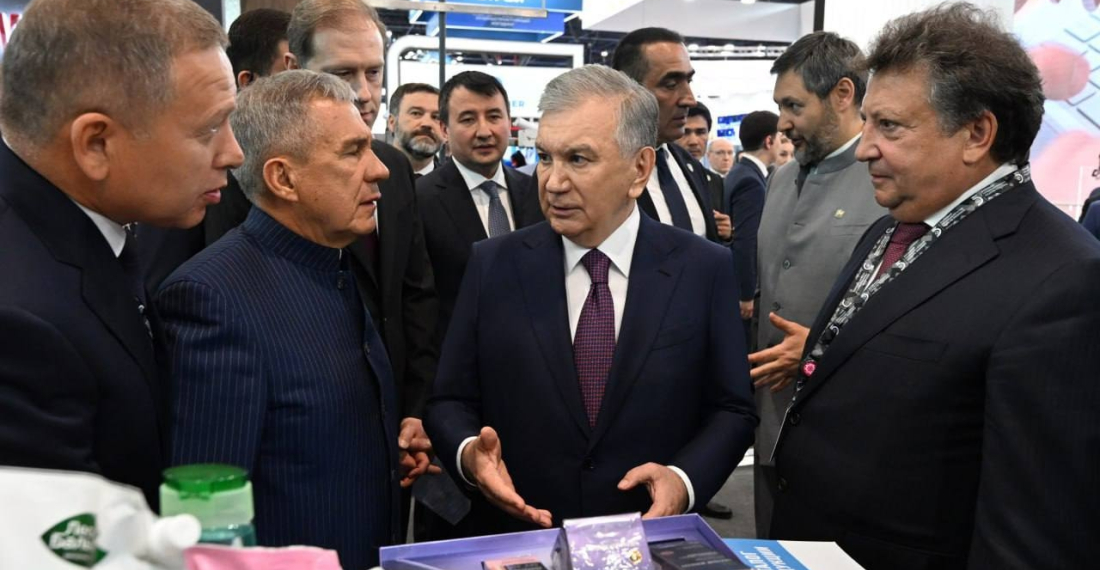
Source: commonspace.eu with agencies and Eurasia.net. Photo: Uzbek President Shavkat Mirziyoyev speaks with the top officials of a visiting Russian delegation at the Innoprom trade fair in Tashkent on April 28. Source: president.uz
 

Related articles

Editor's choice
News
Borrell tells the European Parliament that the situation in Afghanistan was critical, but the EU will remain engaged

Borrell tells the European Parliament that the situation in Afghanistan was critical, but the EU will remain engaged

Borrell underlined that the European Union will make every effort to support the peace process and to remain a committed partner to the Afghan people. "Of course, we will have to take into account the evolving situation, but disengagement is not an option.  We are clear on that: there is no alternative to a negotiated political settlement, through inclusive peace talks.
Editor's choice
News
Pope's visit to Türkiye and Lebanon has a strong ecumenical character, and places interreligious dialogue at its centre

Pope's visit to Türkiye and Lebanon has a strong ecumenical character, and places interreligious dialogue at its centre

Pope Leo XIV has begun the first overseas trip of his pontificate, a six-day visit to Türkiye and Lebanon, which started yesterday (27 November) and ends on Tuesday (2 December). According to Vatican Radio, the visit "carries a strong ecumenical character and places interreligious dialogue at its centre. It will also be a moment of closeness to Christian communities and local populations across the region".   During nearly a week in the region, Pope Leo XIV will meet civil and religious authorities, visit mosques and ancient churches, pray at Beirut’s port in memory of the victims of the 2020 explosion, and hold private meetings with Presidents Recep Tayyip Erdoğan and Joseph Aoun.   A highlight of the visit will be a visit to Nicaea, where the Pope will mark the anniversary of the Council of Nicaea. Christians of many traditions recognise the Council of Nicaea as a foundation of shared faith. One of the most anticipated moments will be the Pope’s encounter with Lebanese youth in Bkerké, at the Maronite Patriarchate, a meeting expected to carry strong messages of hope in the Jubilee Year. A central event will be the ecumenical celebration in İznik, where the Pope and Ecumenical Patriarch Bartholomew will walk together toward the ruins of the Basilica of St Neophytos. The prayer, held before icons of Christ and the Council, will conclude with the lighting of a candle—a symbolic gesture of unity. The journey will also highlight interreligious engagement.   Memorable moments are expected throughout the trip: a wreath at Atatürk’s mausoleum, prayer inside the Blue Mosque, Mass at Istanbul’s Volkswagen Arena, the planting of a cedar at the presidential palace in Beirut, and prayer at the tomb of St Charbel in Lebanon. The Vatican said that "Pope Leo XIV’s pilgrimage to Türkiye and Lebanon aims to offer a voice of peace, unity, and hope at the heart of the Middle East."

Popular

Editor's choice
News
Pope's visit to Türkiye and Lebanon has a strong ecumenical character, and places interreligious dialogue at its centre

Pope's visit to Türkiye and Lebanon has a strong ecumenical character, and places interreligious dialogue at its centre

Pope Leo XIV has begun the first overseas trip of his pontificate, a six-day visit to Türkiye and Lebanon, which started yesterday (27 November) and ends on Tuesday (2 December). According to Vatican Radio, the visit "carries a strong ecumenical character and places interreligious dialogue at its centre. It will also be a moment of closeness to Christian communities and local populations across the region".   During nearly a week in the region, Pope Leo XIV will meet civil and religious authorities, visit mosques and ancient churches, pray at Beirut’s port in memory of the victims of the 2020 explosion, and hold private meetings with Presidents Recep Tayyip Erdoğan and Joseph Aoun.   A highlight of the visit will be a visit to Nicaea, where the Pope will mark the anniversary of the Council of Nicaea. Christians of many traditions recognise the Council of Nicaea as a foundation of shared faith. One of the most anticipated moments will be the Pope’s encounter with Lebanese youth in Bkerké, at the Maronite Patriarchate, a meeting expected to carry strong messages of hope in the Jubilee Year. A central event will be the ecumenical celebration in İznik, where the Pope and Ecumenical Patriarch Bartholomew will walk together toward the ruins of the Basilica of St Neophytos. The prayer, held before icons of Christ and the Council, will conclude with the lighting of a candle—a symbolic gesture of unity. The journey will also highlight interreligious engagement.   Memorable moments are expected throughout the trip: a wreath at Atatürk’s mausoleum, prayer inside the Blue Mosque, Mass at Istanbul’s Volkswagen Arena, the planting of a cedar at the presidential palace in Beirut, and prayer at the tomb of St Charbel in Lebanon. The Vatican said that "Pope Leo XIV’s pilgrimage to Türkiye and Lebanon aims to offer a voice of peace, unity, and hope at the heart of the Middle East."