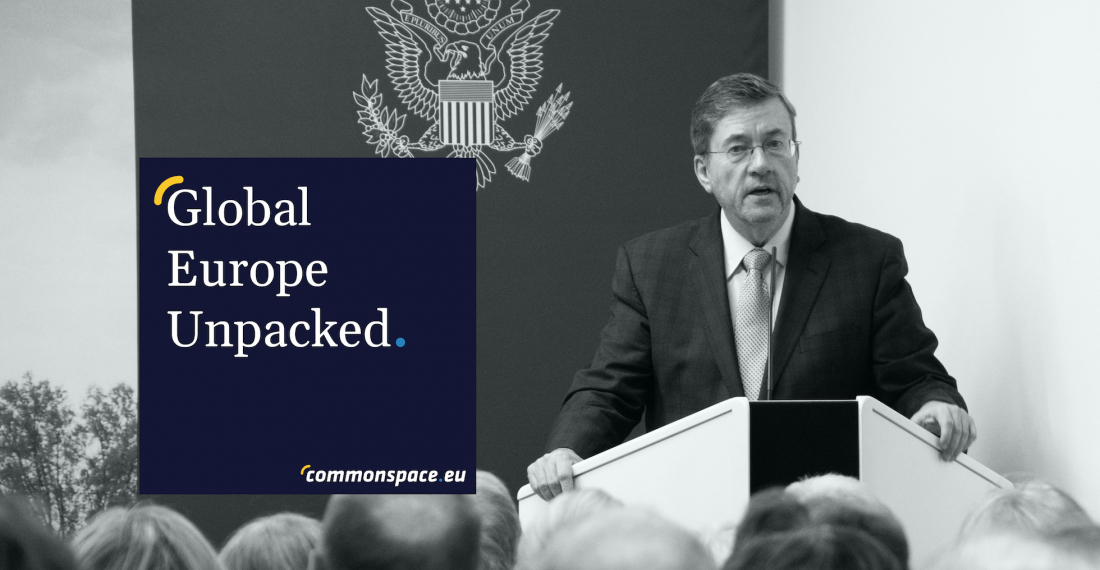
GEU Podcast: What does President Biden mean for the EU-US relationship? – with Dr Dan S. Hamilton

“Well, I think Americans would be the first to welcome a more capable Europe – that's been a theme of American presidents back to John F. Kennedy.”

[The podcast is available on all of the usual channels, including Apple Podcasts, Spotify and Google Podcasts.]

After four years of President Donald Trump, the United States of America appears considerably removed from Europe. In Brussels and in many European capitals, Trump’s legacy is characterised by an American rejection of longstanding multilateral commitments and institutions, and an “America first” policy, which in practice often meant frequent unfriendly moves against long-standing European allies.

Trump’s presidency has been described as a wakeup call – a cautionary example that Europe cannot be reliant on the US for its security and must become a geostrategic entity in its own right, independently responsible for the safety of its member states and the stability of its neighbourhood.

But today, with the inauguration of President Joe Biden, there is sense of excitement in Europe at the prospect of a new era of transatlantic relations. During the presidential election campaign, Biden often emphasised the importance of the United States working closely with European allies. So, with President Biden safely installed in the White House, are we to expect a new golden era for the transatlantic relationship?

In this episode of Global Europe Unpacked, I speak to Dr Dan S. Hamilton, the Director of the Global Europe Program at the Wilson Center (Washington DC) and former US State Department Deputy Assistant Secretary for European Affairs, about:

  • what a Biden presidency means for the EU-US relationship;
  • what the new administration’s foreign policy priorities look like, and how will these coincide with Europe’s own priorities and concerns;
  • how the Biden administration will perceive this desire of the EU to become a more geostrategically independent actor; and 
  • issues in the transatlantic relationship of the Trump era that we are likely to see carried over into the new administration.

It was also broadcast on Radio GIPA FM 94.3 in Tbilisi, Georgia, on Thursday 21 January at 16:00 local time (13:00CET).

Related articles

Editor's choice
News
Borrell tells the European Parliament that the situation in Afghanistan was critical, but the EU will remain engaged

Borrell tells the European Parliament that the situation in Afghanistan was critical, but the EU will remain engaged

Borrell underlined that the European Union will make every effort to support the peace process and to remain a committed partner to the Afghan people. "Of course, we will have to take into account the evolving situation, but disengagement is not an option.  We are clear on that: there is no alternative to a negotiated political settlement, through inclusive peace talks.
Editor's choice
News
Germany accuses Russia of cyberattacks and disinformation campaign

Germany accuses Russia of cyberattacks and disinformation campaign

The German government holds Russia responsible for a cyberattack on German air traffic control, and for targeted disinformation campaigns before the last federal election. According to the German Foreign Office in Berlin, the incidents could be clearly attributed to the Russian military intelligence service, the GRU. In response, the Russian ambassador to Berlin was summoned to the Foreign Ministry. "We have been observing a massive increase in threatening hybrid activities by Russia for some time now," a spokesperson for the Foreign Ministry stated. These range from disinformation campaigns and espionage to cyberattacks and sabotage attempts. The aim is to divide society, sow distrust, and undermine confidence in democratic institutions. The spokesperson added that with these actions, Russia is "very concretely threatening our security, not only through its war of aggression against Ukraine, but also here in Germany."  The Foreign Ministry spokesperson explained that the cyberattack on air traffic control in August 2024 was clearly attributed to the hacker collective "APT28," known as "Fancy Bear," and to the responsibility of the Russian military intelligence service, the GRU. Furthermore, it could now be "conclusively stated" that Russia had attempted "to influence and destabilize both the last Federal election and the ongoing internal affairs of the Federal Republic of Germany." There was "absolutely irrefutable evidence" for this". The so-called "Storm 1516" campaign, which has been running since 2024, is allegedly backed by "reliable information" that the Moscow-based think tank "Center for Geopolitical Expertise" is behind it. The Center is also said to be supported by Russian military intelligence. Its primary aim is to influence democratic elections in the West. (Click the image to read more).

Popular

Editor's choice
News
Germany accuses Russia of cyberattacks and disinformation campaign

Germany accuses Russia of cyberattacks and disinformation campaign

The German government holds Russia responsible for a cyberattack on German air traffic control, and for targeted disinformation campaigns before the last federal election. According to the German Foreign Office in Berlin, the incidents could be clearly attributed to the Russian military intelligence service, the GRU. In response, the Russian ambassador to Berlin was summoned to the Foreign Ministry. "We have been observing a massive increase in threatening hybrid activities by Russia for some time now," a spokesperson for the Foreign Ministry stated. These range from disinformation campaigns and espionage to cyberattacks and sabotage attempts. The aim is to divide society, sow distrust, and undermine confidence in democratic institutions. The spokesperson added that with these actions, Russia is "very concretely threatening our security, not only through its war of aggression against Ukraine, but also here in Germany."  The Foreign Ministry spokesperson explained that the cyberattack on air traffic control in August 2024 was clearly attributed to the hacker collective "APT28," known as "Fancy Bear," and to the responsibility of the Russian military intelligence service, the GRU. Furthermore, it could now be "conclusively stated" that Russia had attempted "to influence and destabilize both the last Federal election and the ongoing internal affairs of the Federal Republic of Germany." There was "absolutely irrefutable evidence" for this". The so-called "Storm 1516" campaign, which has been running since 2024, is allegedly backed by "reliable information" that the Moscow-based think tank "Center for Geopolitical Expertise" is behind it. The Center is also said to be supported by Russian military intelligence. Its primary aim is to influence democratic elections in the West. (Click the image to read more).