


Georgian politics in turmoil

This story will be updated throughout the day

1330 CET (1630 Tbilisi)

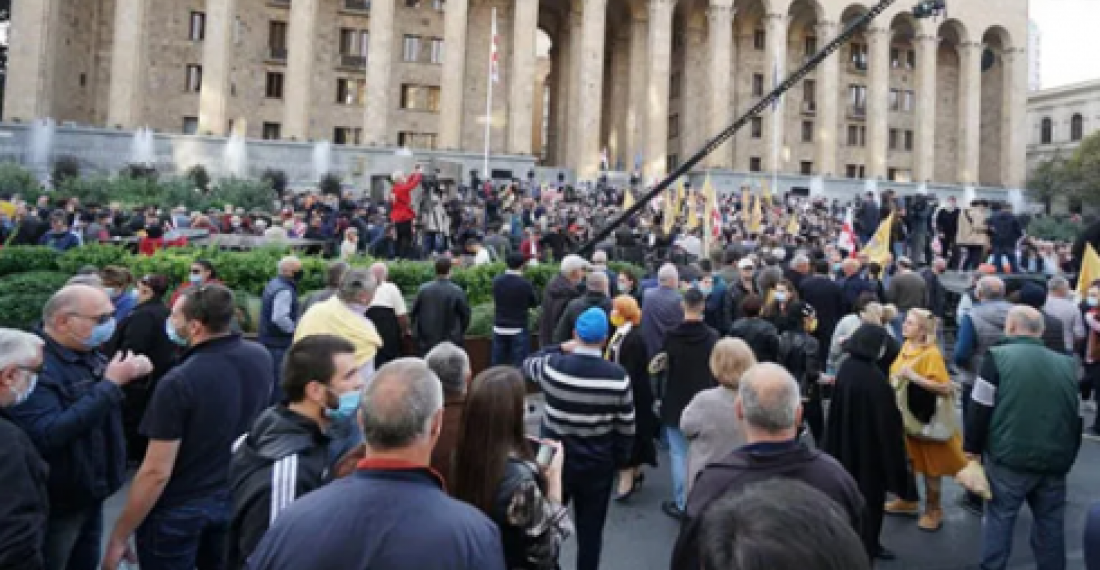
Opposition leaders appear adamant in rejecting the result of Saturday's election. They are gathering in front of the parliament with supporters. Some opposition parties have already declared they will boycott parliament.

International and domestic observers have reported a rather mixed set of observations. International observers highlighted that it was a free election with shortcomings, but local observers are more critical of the process.

Some interesting information from ISFED, one of the most credible domestic election observation organisations in Georgia. They conducted parallel vote tabulation (PVT) for the proportional, party-list vote in the October 31 parliamentary elections. Their results largely coincide with the official results based on 3409 precincts from 3847 (88.61%).

The largest gap is in the share of votes received by the ruling Georgian Dream party, where the PVT result is 3 percentage points lower than the CEC result so far.

1300 CET (1600 Tbilisi)

The international observation missions that followed the parliamentary elections have said that "Georgia's parliamentary elections were competitive and, overall, fundamental freedoms were respected. Nevertheless, pervasive allegations of pressure on voters and blurring of the line between the ruling party and the state reduced public confidence in some aspects of the process". "The elections were conducted under a substantially revised legal framework, following broad public consultations that brought some improvements for the holding of democratic elections, but further efforts to address shortcomings are needed." 

They presented their findings at a press conference in Tbilisi this afternoon.

You can read more on the OSCE website here

The full statement is also available on the OSCE website, here

0730 CET (1030 Tbilisi)

Georgia was thrown in political chaos on Sunday (1 November) after opposition parties rejected the results of the parliamentary elections held the previous day, describing them as illegitimate, and calling for street protests.

Domestic election monitoring organisations - Georgian Young Lawyers Association, Transparency International Georgia and ISFED were critical of the process on election day, citing a number of violations. 

Early signs of problems ahead emerged when exit polls commissioned by the political parties themselves, or by TV stations aligned with them, gave widely differing predictions, allowing both sides to claim victory. When official results started coming in however, the ruling Georgian Dream party appeared to be receiving more than 50% of the votes cast, and the opposition immediately cried foul. According to the latest data based on results from about two-thirds of the constituencies 2556 out of 3847 precincts), the result is as follows: 

"Georgian Dream - Democratic Georgia" - 48.8%

"United National Movement - United Opposition is a force in unity" - 26.07%

"European Georgia - Movement for Freedom" -3.79%

"Alliance of Georgian Patriots" - 3.23%

"Strategy Builder" - 3.14%

"Try - 3.23%

Girchi - 2.99%

"Aleko Elisashvili-Citizens" - 1.38%

"Georgian Labor Party" - 1.03%

" Nino Burjanadze - United Georgia-Democratic Movement" - 0.85%

The results being contested relate to the 120 seats elected by proportional party lists. There are also 30 seats elected by a majoritarian system, where the picture appears more nuanced. In all eight constituencies in the capital Tbilisi none of the candidates has overcome the 50% threshold and there will have to be a second round between the candidates of Georgian Dream and those of the main opposition party, the United National Movement. There is a similar situation in some of the other 22 constituencies in the regions.

The opposition has called for street protests starting at 16.00 hours today. The international monitoring missions will also hold a press conference this afternoon to report their findings.

source: commonspace.eu with agencies

photo: Zaal Udumashvili, one of the leaders of the United National Movement party, gestures as party supporters gather in front of the parliament building after exit polls were announced during parliamentary election, in Tbilisi, Georgia, October 31, 2020 (picture courtesy of Reuters, London)

Related articles

Editor's choice
News
Council of Europe launches new International Claims Commission for Ukraine

Council of Europe launches new International Claims Commission for Ukraine

Thirty-four countries and the European Union have signed a new convention establishing an International Claims Commission for Ukraine at a diplomatic conference co-hosted by the 46-nation Council of Europe and the Netherlands in the Hague. The diplomatic conference was attended by leaders and high-level representatives from over 50 states, including the President of Ukraine, Volodymyr Zelenskyy, the President of the Republic of Moldova, Maia Sandu, and the Prime Minister of the Netherlands, Dick Schoof.  “Today marks a major step forward in ensuring accountability for Ukraine. The International Claims Commission represents justice and hope for tens of thousands of victims—our determination that those who have suffered will not be forgotten. I call for quick ratifications so we can get the commission rapidly up and running for the people of Ukraine,” said Council of Europe Secretary General Alain Berset. Ukrainian President Volodymyr Zelenskyy said: “We expect that every mechanism for compensation from the Register of Damage and Claims Commission to the actual payments – will start working and receive strong and sufficient international support, so that people can truly feel that any kind of damage caused by the war can be compensated. This war, and Russia’s responsibility for it, MUST become a clear example – so that others learn not to choose aggression.” “Accountability is about creating the conditions for peace that endures. And therefore, accountability is a condition of security – today and for the future. But accountability is not only about Ukraine. And it is not only about one aggressor and one victim. Accountability is about Europe. About every country in Europe. It is about whether Europe, as a whole, is willing to defend its peace,” said Maia Sandu, President of the Republic of Moldova, which currently holds the Presidency of the Council of Europe’s Committee of Ministers. The Prime Minister of the Netherlands, Dick Schoof, said: “Every day Russia is deliberately bombarding homes, destroying businesses and damaging infrastructure in Ukraine. Russia must compensate Ukraine for the damage caused. That is why we have launched the International Claims Commission for Ukraine and we are honoured to host it.” The International Claims Commission will be the second part of a comprehensive compensation mechanism related to Russia’s war of aggression, building on the existing Register of Damage for Ukraine. The claims commission will be established within the framework of the Council of Europe and will also be open to other countries. The Register of Damage for Ukraine, created in 2023, collects and records compensation claims submitted by individuals, organisations and public bodies in Ukraine. Forty-four states and the European Union have so far joined the Register, which has already received 86,000 claims. The International Claims Commission will review, assess and decide upon claims submitted to the Register of Damage for Ukraine and determine the amount of compensation, if any, which is due in each case. The convention establishing the commission will enter into force once it has been ratified by 25 signatories, as long as sufficient funds have been secured to support its initial work.

Popular

Editor's choice
News
Council of Europe launches new International Claims Commission for Ukraine

Council of Europe launches new International Claims Commission for Ukraine

Thirty-four countries and the European Union have signed a new convention establishing an International Claims Commission for Ukraine at a diplomatic conference co-hosted by the 46-nation Council of Europe and the Netherlands in the Hague. The diplomatic conference was attended by leaders and high-level representatives from over 50 states, including the President of Ukraine, Volodymyr Zelenskyy, the President of the Republic of Moldova, Maia Sandu, and the Prime Minister of the Netherlands, Dick Schoof.  “Today marks a major step forward in ensuring accountability for Ukraine. The International Claims Commission represents justice and hope for tens of thousands of victims—our determination that those who have suffered will not be forgotten. I call for quick ratifications so we can get the commission rapidly up and running for the people of Ukraine,” said Council of Europe Secretary General Alain Berset. Ukrainian President Volodymyr Zelenskyy said: “We expect that every mechanism for compensation from the Register of Damage and Claims Commission to the actual payments – will start working and receive strong and sufficient international support, so that people can truly feel that any kind of damage caused by the war can be compensated. This war, and Russia’s responsibility for it, MUST become a clear example – so that others learn not to choose aggression.” “Accountability is about creating the conditions for peace that endures. And therefore, accountability is a condition of security – today and for the future. But accountability is not only about Ukraine. And it is not only about one aggressor and one victim. Accountability is about Europe. About every country in Europe. It is about whether Europe, as a whole, is willing to defend its peace,” said Maia Sandu, President of the Republic of Moldova, which currently holds the Presidency of the Council of Europe’s Committee of Ministers. The Prime Minister of the Netherlands, Dick Schoof, said: “Every day Russia is deliberately bombarding homes, destroying businesses and damaging infrastructure in Ukraine. Russia must compensate Ukraine for the damage caused. That is why we have launched the International Claims Commission for Ukraine and we are honoured to host it.” The International Claims Commission will be the second part of a comprehensive compensation mechanism related to Russia’s war of aggression, building on the existing Register of Damage for Ukraine. The claims commission will be established within the framework of the Council of Europe and will also be open to other countries. The Register of Damage for Ukraine, created in 2023, collects and records compensation claims submitted by individuals, organisations and public bodies in Ukraine. Forty-four states and the European Union have so far joined the Register, which has already received 86,000 claims. The International Claims Commission will review, assess and decide upon claims submitted to the Register of Damage for Ukraine and determine the amount of compensation, if any, which is due in each case. The convention establishing the commission will enter into force once it has been ratified by 25 signatories, as long as sufficient funds have been secured to support its initial work.

