


Georgian opposition outraged as ruling party tears up EU brokered deal

It always looked wobbly, and with little chance that it would succeed in resolving Georgia's deep political crisis. But on Wednesday (28 July), the ruling Georgian Dream (GD) party finally sunk the so called "Michel Agreement" signed with much fanfare on 19 April. The Georgian opposition is outraged, and things are back to square one, if not worse.

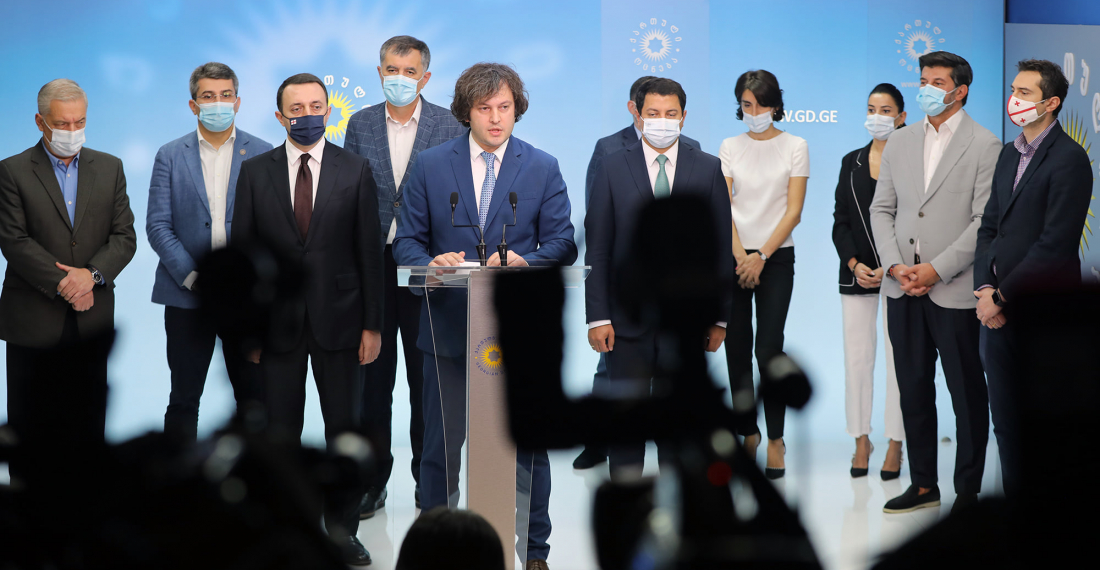
Georgian Dream party chair Irakli Kobakhidze announced the EU-brokered April 19 deal as “annulled,” claiming it “served its mission and exhausted itself” 100 days after signing..

“We can see our international partners do not find it necessary to strictly demand from the radical opposition to sign and participate in implementing the document,” said MP Kobakhidze. “One-sided loyalty to the April 19 agreement is insulting for our party, and our voters will not forgive us this.”

Kobakhidze pointed out that the opposition parties that had signed the agreement received only 10% of the votes in the October 2020 parliamentary elections, while the electoral bloc led by the largest opposition United National Movement party, as well as the Alliance of Patriots, European Georgia and Labor party, the four opposition groups that received parliamentary mandates, refused to join the deal. 

The decision leaves a number of political parties and individual MPs who had signed the agreement in a very difficult position.

David Bakradze, a moderate opposition politician said the Georgian Dream has officially ended the opportunity to move the country forward through reforms and the country is facing a new, acute threat of civil and political confrontation.

"After many months of political crisis, the April 19 agreement created an opportunity to end the crisis, get the country out of the phase of the sharpest confrontation, open the parliament and, together with our European and American partners, move forward through agreed reforms and steps. Unfortunately, today the Georgian Dream has officially ended this opportunity - the country, already in a swamp of polarization and violence, is facing a new, acute threat of civil and political confrontation.

No less alarming is the fact that this decision could significantly damage our relationship with our European and American allies. Any such confrontation poses a problem for the country's European and Euro-Atlantic perspective and inevitably leads Georgia to Russia, which is a disastrous scenario for the future of our country. Today, the Georgian Dream has crossed a dividing line, on one side of which the ruling team is left alone and the Russian future is threatened, and on the other side, the Georgian society, the opposition and our Western partners must stand together. It is the duty of each of us not to allow the possibility of confrontation with our friends and deviation from the Western course”, Bakradze said.

According to him, in the current situation, it is necessary for the opposition to act responsibly and prudently.

Mamuka Khazaradze, Lelo party leader, condemned the GD for “betraying our Western partners, the Georgian people, peace and stability.” He invited opposition parties for holding consultations on the way forward, “that could include boycotting the local elections.” Local elections are scheduled to take place in Georgia in October, and under the provisions of the 19 April agreement if the ruling party did not get 43% of the votes it would then move to early parliamentary elections.

 
source: commonspace.eu with agencies
photo: Georgian Dream Chairman Irakli Kobakhidze; Georgian Dream facebook

Related articles

Editor's choice
News
Borrell tells the European Parliament that the situation in Afghanistan was critical, but the EU will remain engaged

Borrell tells the European Parliament that the situation in Afghanistan was critical, but the EU will remain engaged

Borrell underlined that the European Union will make every effort to support the peace process and to remain a committed partner to the Afghan people. "Of course, we will have to take into account the evolving situation, but disengagement is not an option.  We are clear on that: there is no alternative to a negotiated political settlement, through inclusive peace talks.
Editor's choice
News
Pope's visit to Türkiye and Lebanon has a strong ecumenical character, and places interreligious dialogue at its centre

Pope's visit to Türkiye and Lebanon has a strong ecumenical character, and places interreligious dialogue at its centre

Pope Leo XIV has begun the first overseas trip of his pontificate, a six-day visit to Türkiye and Lebanon, which started yesterday (27 November) and ends on Tuesday (2 December). According to Vatican Radio, the visit "carries a strong ecumenical character and places interreligious dialogue at its centre. It will also be a moment of closeness to Christian communities and local populations across the region".   During nearly a week in the region, Pope Leo XIV will meet civil and religious authorities, visit mosques and ancient churches, pray at Beirut’s port in memory of the victims of the 2020 explosion, and hold private meetings with Presidents Recep Tayyip Erdoğan and Joseph Aoun.   A highlight of the visit will be a visit to Nicaea, where the Pope will mark the anniversary of the Council of Nicaea. Christians of many traditions recognise the Council of Nicaea as a foundation of shared faith. One of the most anticipated moments will be the Pope’s encounter with Lebanese youth in Bkerké, at the Maronite Patriarchate, a meeting expected to carry strong messages of hope in the Jubilee Year. A central event will be the ecumenical celebration in İznik, where the Pope and Ecumenical Patriarch Bartholomew will walk together toward the ruins of the Basilica of St Neophytos. The prayer, held before icons of Christ and the Council, will conclude with the lighting of a candle—a symbolic gesture of unity. The journey will also highlight interreligious engagement.   Memorable moments are expected throughout the trip: a wreath at Atatürk’s mausoleum, prayer inside the Blue Mosque, Mass at Istanbul’s Volkswagen Arena, the planting of a cedar at the presidential palace in Beirut, and prayer at the tomb of St Charbel in Lebanon. The Vatican said that "Pope Leo XIV’s pilgrimage to Türkiye and Lebanon aims to offer a voice of peace, unity, and hope at the heart of the Middle East."

Popular

Editor's choice
News
Pope's visit to Türkiye and Lebanon has a strong ecumenical character, and places interreligious dialogue at its centre

Pope's visit to Türkiye and Lebanon has a strong ecumenical character, and places interreligious dialogue at its centre

Pope Leo XIV has begun the first overseas trip of his pontificate, a six-day visit to Türkiye and Lebanon, which started yesterday (27 November) and ends on Tuesday (2 December). According to Vatican Radio, the visit "carries a strong ecumenical character and places interreligious dialogue at its centre. It will also be a moment of closeness to Christian communities and local populations across the region".   During nearly a week in the region, Pope Leo XIV will meet civil and religious authorities, visit mosques and ancient churches, pray at Beirut’s port in memory of the victims of the 2020 explosion, and hold private meetings with Presidents Recep Tayyip Erdoğan and Joseph Aoun.   A highlight of the visit will be a visit to Nicaea, where the Pope will mark the anniversary of the Council of Nicaea. Christians of many traditions recognise the Council of Nicaea as a foundation of shared faith. One of the most anticipated moments will be the Pope’s encounter with Lebanese youth in Bkerké, at the Maronite Patriarchate, a meeting expected to carry strong messages of hope in the Jubilee Year. A central event will be the ecumenical celebration in İznik, where the Pope and Ecumenical Patriarch Bartholomew will walk together toward the ruins of the Basilica of St Neophytos. The prayer, held before icons of Christ and the Council, will conclude with the lighting of a candle—a symbolic gesture of unity. The journey will also highlight interreligious engagement.   Memorable moments are expected throughout the trip: a wreath at Atatürk’s mausoleum, prayer inside the Blue Mosque, Mass at Istanbul’s Volkswagen Arena, the planting of a cedar at the presidential palace in Beirut, and prayer at the tomb of St Charbel in Lebanon. The Vatican said that "Pope Leo XIV’s pilgrimage to Türkiye and Lebanon aims to offer a voice of peace, unity, and hope at the heart of the Middle East."

