A Georgian man has been injured and detained in an incident in the South Ossetia conflict zone

An incident occured on Saturday morning (11 July) on the administrative boundary line in the South Ossetia conflict zone, as a result of which one Georgian man was injured and detained by the Tskhinvali de facto authorities.

According to a report carried by RES news agency, which is the mouthpiece of the authorities of the self-declared Republic of South Ossetia, the man was named as 33 year old Zaza Mikhailovich Kakheladze. The Ossetian agency said that the man "entered into the territory of South Ossetia in the vicinity of the village of Akhmadz in the Leningori region. When challenged by the South Ossetian border authorities he fired several shots at them with a shotgun. Kakheladze was wounded in the ankle by the return fire and was subsequently detained ". 

The agency said that at present the necessary medical assistance has been provided to the violator, and his state of health is satisfactory and stable. It is understood that the detained person is from the village of Kvemo Chala which is in the immediate vicinity of the administrative boundary line between Tbilisi controlled territory and territory controlled by Russian troops and local South Ossetian allies.

In a swift reaction to the incident, Georgian Deputy Foreign Minister Lasha Darsalia said that the illegal detention of a Georgian citizen by Russian occupation forces is a gross violation of the ceasefire agreement. "This is a blatant and gross violation of the ceasefire agreement. Unfortunately, recently, as a result of various types of provocations, the security environment on the ground has been further aggravated, for which the occupation regime is unequivocally responsible. Now, at this moment, it is important that our citizen returns to the territory controlled by the Georgian government as soon as possible" Lasha Darsalia said.  Darsalia added that he had been in touch with the co-chair of the Geneva International Process (representatives of the EU, UN and OSCE) on this matter.

The area around Akhalgori (referred to sometimes as Leningori) is a particularly problematic part of the South Ossetia conflict zone due to the fact that the territory came under Russian and South Ossetian jurisdiction during the 2008 Georgia-Russia war. Continued Russian presence in the area is in violation of the cease fire agreement brokered at the time by French president Nikola Sarkozy on behalf of the Euroipean Union which stipulates that all sides had to return to their positions before the fighting started. Attempts by Russian border guards and local proxies to set up a physical border in the area, that sometimes divides local people from their traditional farming land, has been a source of great hardship to the local communities, and has been condemned by Georgia. 

Russia recognised the Tskinvali based South Ossetian leadership as an independent country after the 2008 war, and currently maintains a large military base on the territory. The international community recognises South Ossetia as part of Georgia. Earlier this week Russia announced that it was holding military exercises in South Ossetia, 3500 troops and 800 tanks, vehicles and military hardware are involved.

related content on commonspace.eu: Russian military hold drills in South Ossetia


source: commonspace.eu

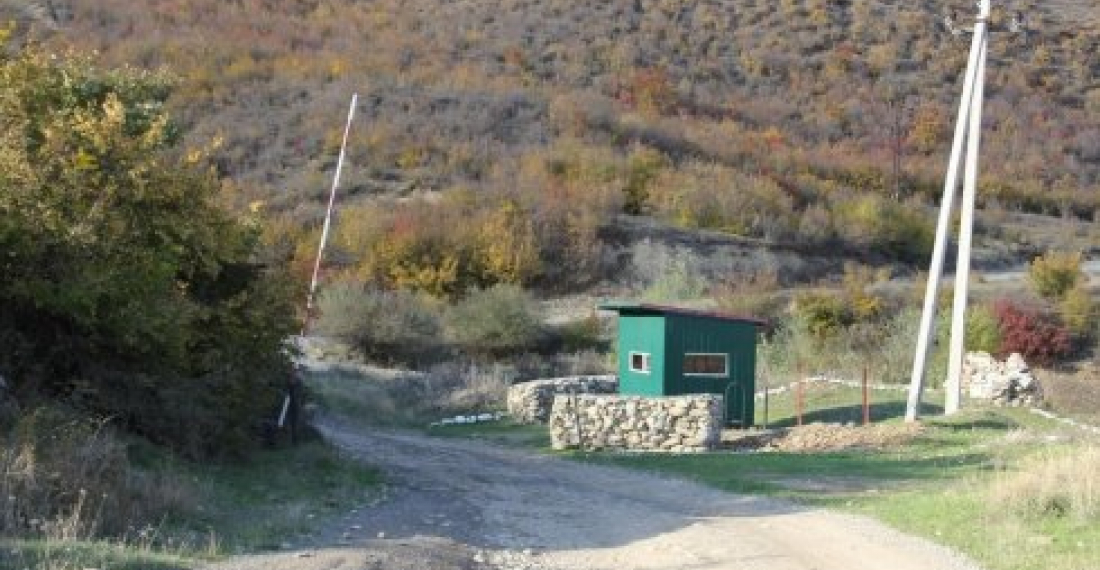
photo: A South Ossetian checkpoint (picture courtesy of RES news agency, Tskhinvali)

Related articles

Editor's choice
News
Borrell tells the European Parliament that the situation in Afghanistan was critical, but the EU will remain engaged

Borrell tells the European Parliament that the situation in Afghanistan was critical, but the EU will remain engaged

Borrell underlined that the European Union will make every effort to support the peace process and to remain a committed partner to the Afghan people. "Of course, we will have to take into account the evolving situation, but disengagement is not an option.  We are clear on that: there is no alternative to a negotiated political settlement, through inclusive peace talks.
Editor's choice
News
NATO Chief says war is on Europe's doorstep, and warns against complacency

NATO Chief says war is on Europe's doorstep, and warns against complacency

Russia could attack a Nato country within the next five years, the Secretary General of NATO, Mark Rutte, said in a stark new warning. "Nato's own defences can hold for now," Rutte warned in Berlin, but conflict was "next door" to Europe and he feared "too many are quietly complacent, and too many don't feel the urgency, too many believe that time is on our side. "Russia is already escalating its covert campaign against our societies," Rutte said in a speech in Germany. "We must be prepared for the scale of war our grandparents or great-grandparents endured." Earlier this month, Russia's President Vladimir Putin said his country was not planning to go to war with Europe, but it was ready "right now" if Europe wanted to - or started a war. But similar reassurances were given by Moscow in 2022, just before 200,000 Russian troops crossed the border and invaded Ukraine. Putin has accused European countries of hindering US efforts to bring peace in Ukraine - a reference to the role Ukraine's European allies have recently played in trying to change a US peace plan to end the war, whose initial draft was seen as favouring Russia. But Putin was not sincere, Nato's secretary-general said in the German capital, Berlin. Supporting Ukraine, he added, was a guarantee for European security. "Just imagine if Putin got his way; Ukraine under the boot of Russian occupation, his forces pressing against a longer border with Nato, and the significantly increased risk of an armed attack against us." Russia's economy has been on a war footing for more than three years now - its factories churn out ever more supplies of drones, missiles and artillery shells. According to a recent report by the Kiel Institute for the World Economy, Russia has been producing each month around 150 tanks, 550 infantry fighting vehicles, 120 Lancet drones and more than 50 artillery pieces. The UK, and most of its Western allies, are simply not anywhere near this point. Analysts say it would take years for Western Europe's factories to come close to matching Russia's mass-production of weapons. "Allied defence spending and production must rise rapidly, our armed forces must have what they need to keep us safe," the Nato chief said.

Popular

Editor's choice
News
NATO Chief says war is on Europe's doorstep, and warns against complacency

NATO Chief says war is on Europe's doorstep, and warns against complacency

Russia could attack a Nato country within the next five years, the Secretary General of NATO, Mark Rutte, said in a stark new warning. "Nato's own defences can hold for now," Rutte warned in Berlin, but conflict was "next door" to Europe and he feared "too many are quietly complacent, and too many don't feel the urgency, too many believe that time is on our side. "Russia is already escalating its covert campaign against our societies," Rutte said in a speech in Germany. "We must be prepared for the scale of war our grandparents or great-grandparents endured." Earlier this month, Russia's President Vladimir Putin said his country was not planning to go to war with Europe, but it was ready "right now" if Europe wanted to - or started a war. But similar reassurances were given by Moscow in 2022, just before 200,000 Russian troops crossed the border and invaded Ukraine. Putin has accused European countries of hindering US efforts to bring peace in Ukraine - a reference to the role Ukraine's European allies have recently played in trying to change a US peace plan to end the war, whose initial draft was seen as favouring Russia. But Putin was not sincere, Nato's secretary-general said in the German capital, Berlin. Supporting Ukraine, he added, was a guarantee for European security. "Just imagine if Putin got his way; Ukraine under the boot of Russian occupation, his forces pressing against a longer border with Nato, and the significantly increased risk of an armed attack against us." Russia's economy has been on a war footing for more than three years now - its factories churn out ever more supplies of drones, missiles and artillery shells. According to a recent report by the Kiel Institute for the World Economy, Russia has been producing each month around 150 tanks, 550 infantry fighting vehicles, 120 Lancet drones and more than 50 artillery pieces. The UK, and most of its Western allies, are simply not anywhere near this point. Analysts say it would take years for Western Europe's factories to come close to matching Russia's mass-production of weapons. "Allied defence spending and production must rise rapidly, our armed forces must have what they need to keep us safe," the Nato chief said.