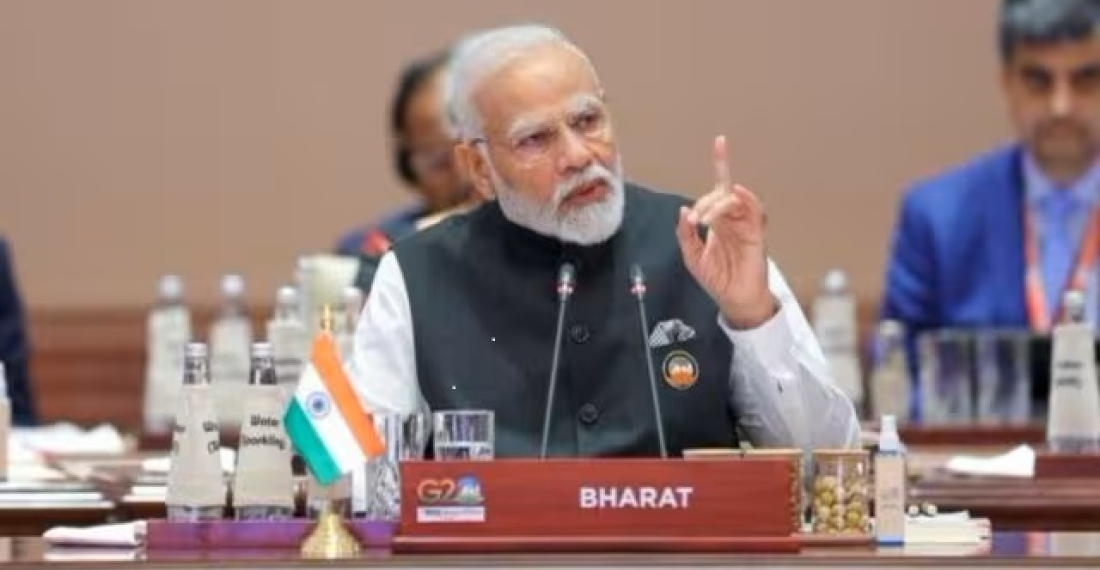
The G20 summit opened in India's capital New Delhi on Saturday (9 September) with a speech by prime minister Narendra Modi during which he welcomed the African Union as the 21st member of the grouping, whose name will presumably now change to G21. It seems also that it is not the only name that is changing. The country name-plate in front of Modi during his speech did not say India, but Bharat.
Modi invited the Comoros President and current Chairperson of the African Union (AU), Azali Assoumani, to take his seat together with other global leaders of the G20. There was widespread support, for adding the AU to the G20, making it the second regional bloc to become a permanent member after the European Union.
Modi rapped his gavel three times before announcing the move to applause in the room.
He shook hands with the current AU chair, Comoros President Azali Assoumani, and embraced him warmly before inviting him to sit at the table. "I invite the representative of the African Union to take his place as a permanent member of the G20," Modi said.
Modi addressed the delegates from behind a nameplate that listed his country not as India but as "Bharat," an ancient Sanskrit name championed by his Hindu nationalist supporters that his government has been pushing at the G20.
Modi has made giving voice to the Global South a centerpiece of this year's summit, and adding the AU at the outset was a strong step in that direction.
He told leaders that they must find "concrete solutions" to the widespread challenges that he said stemmed from the "ups and downs in the global economy, the north and the south divide, the chasm between the east and the west," and other issues like terrorism, cyber security, health and water security.
With much of the world's focus on the Russian war against Ukraine, India has been working to try and direct more attention to addressing the needs of the developing world at the summit — though it is impossible to decouple many issues, such as food and energy security, from the European conflict.
Modi did make a presumed reference to the war in his opening remarks, though he avoided mentioning the names of any countries involved.
Among the top leaders present in New Delhi are US President Joe Biden, British Prime Minister Rishi Sunak; European Council President, Charles Michel; Saudi Crown Prince, Mohammed bin Salman, and UAE president Mohammed Bin Zayed.
At the start of his speech Modi expressed condolences for those affected by the earthquake in Morocco. "I want to express my condolences over the loss of lives due to an earthquake in Morocco. We pray that all injured recover at the earliest. India is ready to offer all possible assistance to Morocco in this difficult time," he said.
Welcoming global leaders in the multilateral summit, Modi said, "The 21st century is an important time to show the world a new direction. Today, centuries-old challenges are seeking new solutions from us and that's why we should move ahead while fulfilling our responsibilities with a human-centric approach."
Referring to the Russia-Ukraine war, the Indian leader said that,"after COVID-19, the world if facing an unbelievable crisis. The war has deepened the trust deficit. If we can defeat COVID-19, we can triumph over the trust deficit caused by the war. India calls on the world to convert the trust deficit into belief and faith."
Commonspace.eu political editor said in a comment that the G20 summit had become a coming of age party for India, as it projects increasing confidence and assertiveness in the international arena. Having recently celebrated the success of having a successful lunar mission, the summit was an opportunity to come down to earth with a bang. The decision of prime minister Modi to speak as the leader of Bharat was a symbolic gesture marking a break between the country and its long and often painful colonial era past. By securing the admittance of the African Union in the G20, India also consolidated its role as one of the leaders of the Global South - a role India actively played in the 1950s and 1960s under prime ministers Nehru and Gandhi, but one which in recent years appeared to take back stage to more immediate urgent issues. For the G20, India has thrown a lavish party. But guests were left under no illusion that this was not also a Modi celebration. The Indian prime minister faces a tough election next year, and appearing as the leader amongst global statesman helps the prime minister's image. A reminder perhaps that in India these things matter, because India is a democracy, and in the end it is the people that have the final word. One reason perhaps why two G20 leaders were conspicuously absent: President Xi of China, and President Putin of Russia. Their absence was noted, although not necessarily missed.