France and Turkey find common language on defence and trade

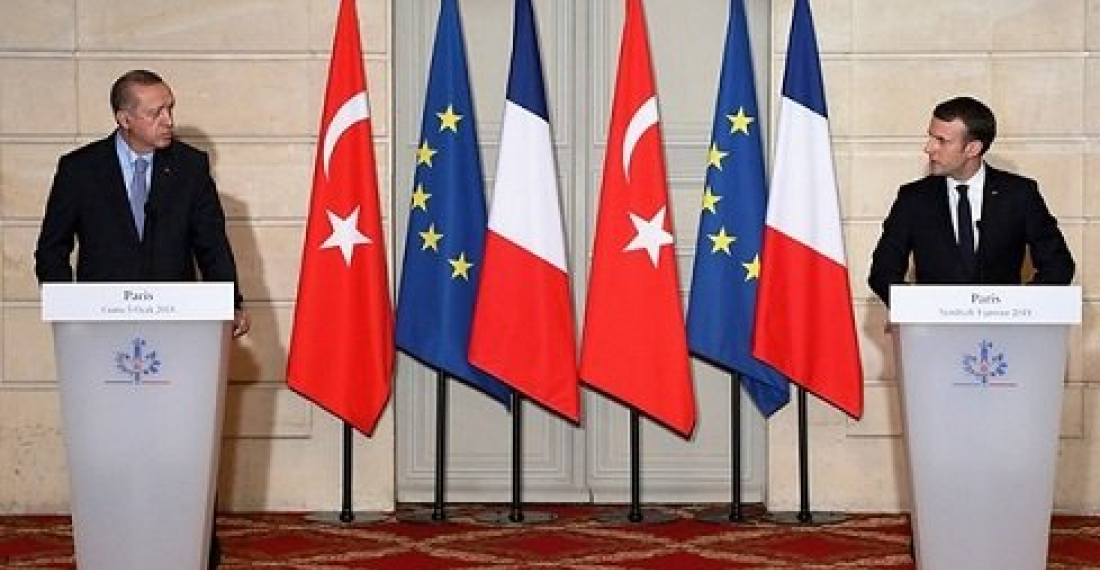
President Recip Tayip Erdogan of Turkey paid an official visit to Paris on Friday, 5 January, for talks with his French counterpart Emmanuel Macron.

During the visit the two countries agreed a number of deals in trade and defence sectors. Turkey's defense industry and the Franco-Italian EUROSAM consortium will now work together to develop a new missile and air defence system. Turkish airlines will also buy 25 new airbus planes. Both sides said they aim for a trade volume of €20 billion annually in the near future.

However differences between the two countries in the field of human rights and on Turkey's EU membership ambitions also emerged. President Macron at a press conference after the talks said that Turkey and France must continue fighting terrorism within the framework of the rule of Law. Earlier Macron referred to Turkey and France membership of NATO and of the European Convention on Human Rights as the two pillars that drive the relations between the two countries.

On Turkey's relations with the EU, Macron said that the ties between Ankara and Paris are based on "dialogue and a common approach" while keeping disagreements in mind. He said it is crucial for Turkey to remain and be part of the European Convention on Human Rights, European Court of Human Rights and the Council of Europe. He added that dialogue with Turkey is important and should be established, and any hypocritical position should be left behind.

Macron made it clear that there will be no chapters opened in the negotiations on Turkey's EU accession in the near future, which triggered a sharp reaction from Erdogan who said that Turkey has been waiting for 54 years and that this was an unprecented situation that the EU could not explain." The EU's reluctance to accept Turkey's accession to the bloc has exhausted the Turkish public, Erdogan said.

The visit marks the start of a Turkish effort to recalibrate the country's relations with Europe. The Ankara newspaper, Daily Sabah, which is close to the ruling AKP party, said on Saturday that "Turkish politicians are intensifying their positive remarks and willingness for a fresh start in the country's ties with the European Union in the new year with a recent visit by President Recep Tayyip Erdogan to France, and Foreign Minister Mevlut Cavuşogu's expected visit to Germany, two of the most significant players in the 28-member bloc".

Anadolu news agency reported that President Erdogan arrived back in Istanbul in the early hours of Saturday morning.

source: commonspace.eu with elysee.fr, Andaolu Agency, Daily Sabah and Hurriyet Daily News.

Photo: President Erdogan of Turkey and President Macron of France at their press conference in Paris on 5 January 2018.

Related articles

Editor's choice
News
Borrell tells the European Parliament that the situation in Afghanistan was critical, but the EU will remain engaged

Borrell tells the European Parliament that the situation in Afghanistan was critical, but the EU will remain engaged

Borrell underlined that the European Union will make every effort to support the peace process and to remain a committed partner to the Afghan people. "Of course, we will have to take into account the evolving situation, but disengagement is not an option.  We are clear on that: there is no alternative to a negotiated political settlement, through inclusive peace talks.
Editor's choice
News
Germany accuses Russia of cyberattacks and disinformation campaign

Germany accuses Russia of cyberattacks and disinformation campaign

The German government holds Russia responsible for a cyberattack on German air traffic control, and for targeted disinformation campaigns before the last federal election. According to the German Foreign Office in Berlin, the incidents could be clearly attributed to the Russian military intelligence service, the GRU. In response, the Russian ambassador to Berlin was summoned to the Foreign Ministry. "We have been observing a massive increase in threatening hybrid activities by Russia for some time now," a spokesperson for the Foreign Ministry stated. These range from disinformation campaigns and espionage to cyberattacks and sabotage attempts. The aim is to divide society, sow distrust, and undermine confidence in democratic institutions. The spokesperson added that with these actions, Russia is "very concretely threatening our security, not only through its war of aggression against Ukraine, but also here in Germany."  The Foreign Ministry spokesperson explained that the cyberattack on air traffic control in August 2024 was clearly attributed to the hacker collective "APT28," known as "Fancy Bear," and to the responsibility of the Russian military intelligence service, the GRU. Furthermore, it could now be "conclusively stated" that Russia had attempted "to influence and destabilize both the last Federal election and the ongoing internal affairs of the Federal Republic of Germany." There was "absolutely irrefutable evidence" for this". The so-called "Storm 1516" campaign, which has been running since 2024, is allegedly backed by "reliable information" that the Moscow-based think tank "Center for Geopolitical Expertise" is behind it. The Center is also said to be supported by Russian military intelligence. Its primary aim is to influence democratic elections in the West. (Click the image to read more).

Popular

Editor's choice
News
Germany accuses Russia of cyberattacks and disinformation campaign

Germany accuses Russia of cyberattacks and disinformation campaign

The German government holds Russia responsible for a cyberattack on German air traffic control, and for targeted disinformation campaigns before the last federal election. According to the German Foreign Office in Berlin, the incidents could be clearly attributed to the Russian military intelligence service, the GRU. In response, the Russian ambassador to Berlin was summoned to the Foreign Ministry. "We have been observing a massive increase in threatening hybrid activities by Russia for some time now," a spokesperson for the Foreign Ministry stated. These range from disinformation campaigns and espionage to cyberattacks and sabotage attempts. The aim is to divide society, sow distrust, and undermine confidence in democratic institutions. The spokesperson added that with these actions, Russia is "very concretely threatening our security, not only through its war of aggression against Ukraine, but also here in Germany."  The Foreign Ministry spokesperson explained that the cyberattack on air traffic control in August 2024 was clearly attributed to the hacker collective "APT28," known as "Fancy Bear," and to the responsibility of the Russian military intelligence service, the GRU. Furthermore, it could now be "conclusively stated" that Russia had attempted "to influence and destabilize both the last Federal election and the ongoing internal affairs of the Federal Republic of Germany." There was "absolutely irrefutable evidence" for this". The so-called "Storm 1516" campaign, which has been running since 2024, is allegedly backed by "reliable information" that the Moscow-based think tank "Center for Geopolitical Expertise" is behind it. The Center is also said to be supported by Russian military intelligence. Its primary aim is to influence democratic elections in the West. (Click the image to read more).