Hours after US President Donald Trump said his ceasefire had taken effect, Israel said it intercepted two Iranian missiles, with Defence Minister Israel Katz vowing that the military would "respond forcefully". Israel had stated on Tuesday it agreed to Trump's declaration of a ceasefire with Iran, adding that it had achieved all its objectives in the 12-day war with its arch-enemy. According to AFP, Iran denied launching missiles at Israel after the ceasefire announcement, and said it had "compelled" Israel to "unilaterally halt its aggression", while stopping short of officially accepting the ceasefire plan.
Foreign Minister Abbas Araghchi had earlier said that if Israel stopped "its illegal aggression," Tehran would have "no intention" to continue fighting. Trump had said the ceasefire would be a phased 24-hour process beginning at around 0400 GMT Tuesday, with Iran unilaterally halting all operations. Israel would follow suit 12 hours later. "It has been fully agreed by and between Israel and Iran that there will be a Complete and Total CEASEFIRE," Trump wrote on his Truth Social platform.
"Upon the 24th hour, an official end to the 12-day war will be saluted by the world," Trump said, adding that both sides had agreed to remain "peaceful and respectful" during each phase of the process.
The Israeli government , quoted by AFP, said: "Last night, Prime Minister Benjamin Netanyahu convened the cabinet... to announce that Israel had achieved all the objectives of Operation 'Rising Lion' and much more." It added that it had removed "an immediate dual existential threat: nuclear and ballistic". "Israel will respond forcefully to any violation of the ceasefire," the statement said, while the army added that the "danger persists" despite the truce announcement.
Iran's top security body said the Islamic republic's forces had "compelled" Israel to "unilaterally" cease fire, adding that they remained "on high alert" to respond to "any act of aggression". Referring to a "divine gift", the Supreme National Security Council said Iran's actions against Israel led to "victory and triumph that compelled the enemy to regret, accept defeat, and unilaterally halt its aggression".
After Trump said the truce had taken hold, Israel's Katz said he had ordered the Israeli army "to respond forcefully to Iran's violation of the ceasefire" after incoming Iranian missiles were reported by the military. A military official told AFP on condition of anonymity that "two missiles were launched from Iran and they were intercepted".
Iran, however, denied launching missiles at Israel after the announcement. Earlier, Israeli rescuers said four people were killed in an Iranian strike, with state media in the Islamic Republic reporting waves of missiles were headed toward Israel. In Iran, state television said an overnight Israeli strike in northern Iran killed nuclear scientist Mohammad Reza Seddighi Saber, who was under US sanctions.
Any cessation in hostilities would come as a huge relief to world leaders frantic about an escalation in violence igniting an even wider war. Israel launched "preemptive" strikes against Iran on June 13, hitting nuclear and military sites as well as residential areas, and prompting waves of Iranian missile attacks on Israel.
While Iran and Israel have been in a shadow war against each other for decades, this has been by far the most destructive confrontation between the arch-foes. The war has also seen US strikes on Iranian nuclear facilities, followed by an Iranian missile launch towards the largest US military facility in the Middle East, Al Udeid Air Base in Qatar, in a move Trump shrugged off as "very weak."
Calling for a de-escalation, Trump said Tehran had given advance notice of the barrage. Iran's National Security Council confirmed having targeted the base "in response to the US aggressive and insolent action against Iran's nuclear sites and facilities". But, according to Reuters, it added that the number of missiles launched "was the same as the number of bombs that the US had used" -- a signal that it had calibrated its response to be directly proportional rather than escalatory.
"This was calibrated and telegraphed in a way that would not result in any American casualties, so that there is an off ramp for both sides," Ali Vaez, a senior advisor at the International Crisis Group, told AFP. The offensive came after the United States joined its ally Israel's military campaign against Iran, attacking an underground uranium enrichment centre with massive bunker-busting bombs and hitting two other nuclear facilities overnight Saturday into Sunday.
As international concern mounted that Israel's campaign and the US strikes could ignite a wider conflict, French President Emmanuel Macron insisted that "the spiral of chaos must end" while China warned of the potential economic fallout.
Iran said its assault in Qatar wasn't targeting the Middle Eastern neighbour, but the government in Doha accused Tehran of "blatant aggression" and claimed its right to a "proportional" response. Iran's state media quoted the Revolutionary Guard Corps announcing that six missiles had hit Al Udeid, which had been evacuated beforehand, according to the Qataris.
The broadside was made up of "short-range and medium-range ballistic missiles," a US defence official said. AFP reporters said they heard blasts in central Doha and in Lusail, north of the capital, on Monday evening, and saw projectiles moving across the night sky. Iranians gathered in central Tehran to celebrate, images on state TV showed, with some waving the flag of the Islamic republic and chanting "Death to America".
Qatar earlier announced the temporary closure of its airspace in light of "developments in the region", while the US embassy and other foreign missions warned their citizens to shelter in place. Israeli strikes on Iran have killed more than 400 people, Iran's health ministry has said. Twenty-four people have died in Iran's attacks on Israel, according to official figures.
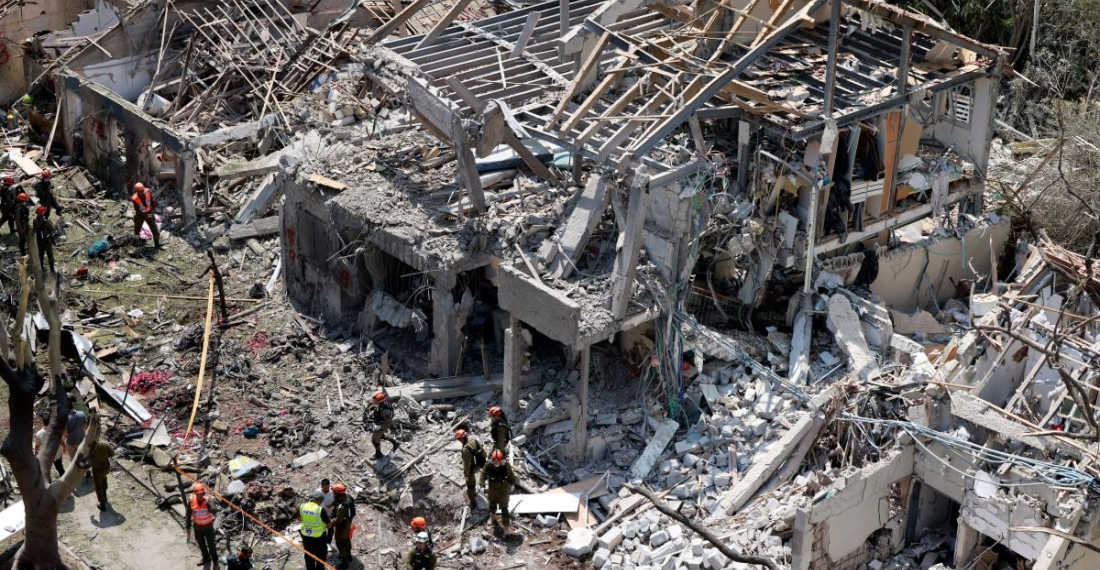
Source: commonspace.eu with AFP, Reuters and agencies. Photo: Israeli security forces and first responders gather at the site of an Iranian strike following US attacks on Iran's nuclear facilities. Photo: Menahem KAHANA / AFP.