


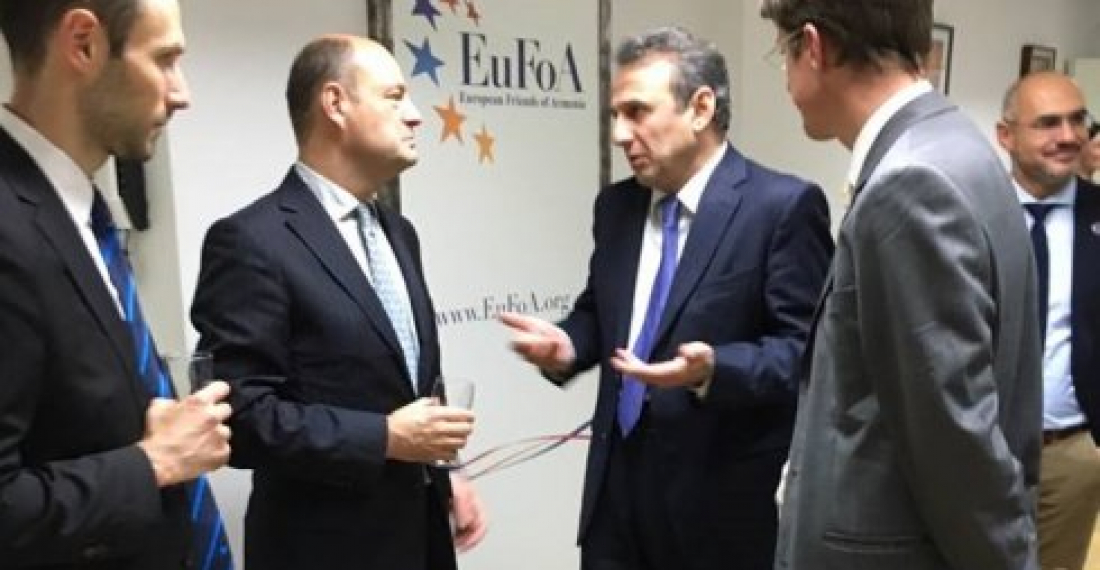
EuFoA new Director outlines priorities

The European Friends of Armenia (EuFoA), the Brussels based advocacy organisation has a new Director. Diogo Pinto took over as head of the organisation on 1 September, stating that he was "deeply committed to consolidate and further develop all possible bridges between Europe and Armenia"

Pinto, on Wednesday, 19 October, reaffirmed his ideas when he addressed a gathering of diplomats, officials and civil society representatives at a reception at the organisation's offices in Brussels' European Quarter. 

Diogo Pinto said that the objectives of the organisation will remain "building bridges between Armenia and the European institutions, decision-makers and civil society, for further and deeper integration of Armenia in the European family." 

Pinto added, "we are not an Armenian organisation and we represent neither the Armenian government nor the Armenian people. We are other Europeans, and we are friends of Armenia. As good friends, we will always be honest and, when Armenians are wrong, we will tell them so. But, also as good friends, we will always be loyal. So, don't expect us to make a public fuss about the Armenian shortcomings; there are many others already taking care of that... But, on the other hand, don't assume that just because we don't make a fuss, that we are ignoring those shortcomings or covering up for them."

"Let me also be clear about one other thing. On those areas where Armenia is a party of unsolved controversies, we will always be on the side of Armenia. Don't expect us to be neutral, or to try to be balanced. But don't jump into wrong conclusions either: it's not that we take their side because we are friends of Armenia; it's the opposite: we are friends of Armenia because we realised we were on their side on those issues. So, both when it comes to the aspiration for the recognition of the Genocide of the Armenians, or the dispute around Nagorno-Karabakh, we are and will always be with our Armenian friends in their fight for justice, recognition and self-determination, and we will never refuse to fight along them for their right to live in peace and security, and pursue prosperity and happiness."

Diogo Pinto stressed that EuFoA stands ready to cooperate with anyone sharing its objectives, principles and values, including EU Institutions, EU Member States (especially Belgium), civil society organisations and the media, and concluded his speech with a toast for peace: "Because peace is at the heart of the European project and peace is the biggest aspiration of Armenians!"

Also present at the event was Dr Tatoul Markarian, Ambassador of the Republic of Armenia to Belgium and Head of the Armenian Mission to the European Union; Ms Theodora Gentzis, Counsellor in the Office of the Belgian Deputy Prime Minister, and Minister of Foreign Affairs and European Affairs; Ambassador Jo Indekeu, Director for Oriental and South-East Europe and Central Asia, at the Belgian Federal Ministry of Foreign Affairs, and representatives of EU institutions, civil society and media.

source: commonspace.eu

photo: Some of the guests at the EuFoA reception in Brussels on 19 Ocotber 2016 (poicture courtesy of EuFoA)
Related articles

Editor's choice
News
Finland hosts European Arctic Summit

Finland hosts European Arctic Summit

The Arctic summit of European leaders will be held in Rovaniemi, a municipality in Northern Finland on 13–14 September. Prime Minister Petteri Orpo has invited a group of EU leaders to the summit. The aim of the summit is to strengthen the EU’s common strategic approach to the Arctic region as its geopolitical significance continues to grow rapidly. “The Arctic region is an increasingly important part of Europe's security environment. The European Union has direct interests in its stability, security and sustainable development. It is very valuable to be able to discuss these issues together with a comprehensive group of EU leaders,” said Orpo. The summit will be attended by German Chancellor Friedrich Merz, Prime Minister of Poland Donald Tusk, Prime Minister of Denmark Mette Frederiksen, Prime Minister of Estonia Kristen Michal, Prime Minister of Latvia Andris Kulbergs, President of Lithuania Gitanas Nausėda and President of Romania Nicușor Dan. President of the European Council António Costa and High Representative of the Union for Foreign Affairs and Security Policy Kaja Kallas will also take part in the summit. The summit is taking place against an extremely dynamic backdrop. In the face of accelerating climate change and geopolitical tensions in the Strait of Hormuz, the economic importance of the northeast passage is growing. For 2026, more than forty million tonnes of freight are expected to pass through the Northern Sea Route for the first time, primarily due to expanded trade between Russia and China. Furthermore, in August, China launched its first regular container service through the Arctic. Finally, the EU’s Arctic policy itself is set for a reorientation: the Commission intends to present an updated Arctic strategy this autumn, in which security is to play a central role for the first time. Kaja Kallas had already advocated for this at the Arctic Frontiers conference in Tromsø earlier this year, stating that the Arctic needed more attention, more resources, and more hard power. The summit in Rovaniemi can therefore also be seen as a dress rehearsal for the new strategy. Finland brings a unique perspective to this debate: over 95 per cent of Finland’s foreign trade in goods is conducted by sea, and its ports freeze over almost every winter. This structural peculiarity has given rise to a strong export sector in the field of icebreakers: Finnish companies have designed around 80 per cent of all icebreakers worldwide and built around 60 per cent; even the US Coast Guard is having the first vessels of its new Arctic Security Cutter class built in Finland because the domestic alternative could not meet the schedule. The fact that this leverage can also be utilised geopolitically has already been successfully demonstrated. At the end of September 2022, the Finnish Ministry of Foreign Affairs refused to grant an export licence for an LNG icebreaker ordered by the Russian mining group Norilsk Nickel, thereby bringing to an end a project that would have created around 2,100 person-years of employment. (click the image to read more).

Popular

Editor's choice
Interview
Thursday Interview: Murad Muradov

Thursday Interview: Murad Muradov

Today, commonspace.eu starts a new regular weekly series. THURSDAY INTERVIEW, conducted by Lauri Nikulainen, will host  persons who are thinkers, opinion shapers, and implementors in their countries and spheres. We start the series with an interview with Murad Muradov, a leading person in Azerbaijan's think tank community. He is also the first co-chair of the Action Committee for a new Armenian-Azerbaijani Dialogue. Last September he made history by being the first Azerbaijani civil society activist to visit Armenia after the 44 day war, and the start of the peace process. Speaking about this visit Murad Muradov said: "My experience was largely positive. My negative expectations luckily didn’t play out. The discussions were respectful, the panel format bringing together experts from Armenia, Azerbaijan, and Turkey was particularly valuable during the NATO Rose-Roth Seminar in Yerevan, and media coverage, while varied in tone, remained largely constructive. Some media outlets though attempted to represent me as more of a government mouthpiece than an independent expert, which was totally misleading.  Overall, I see these initiatives as important steps in rebuilding trust and normalising professional engagement. The fact that soon a larger Azerbaijani civil society visits to Armenia followed, reinforces the sense that this process is moving in the right direction." (click the image to read the interview in full)

