


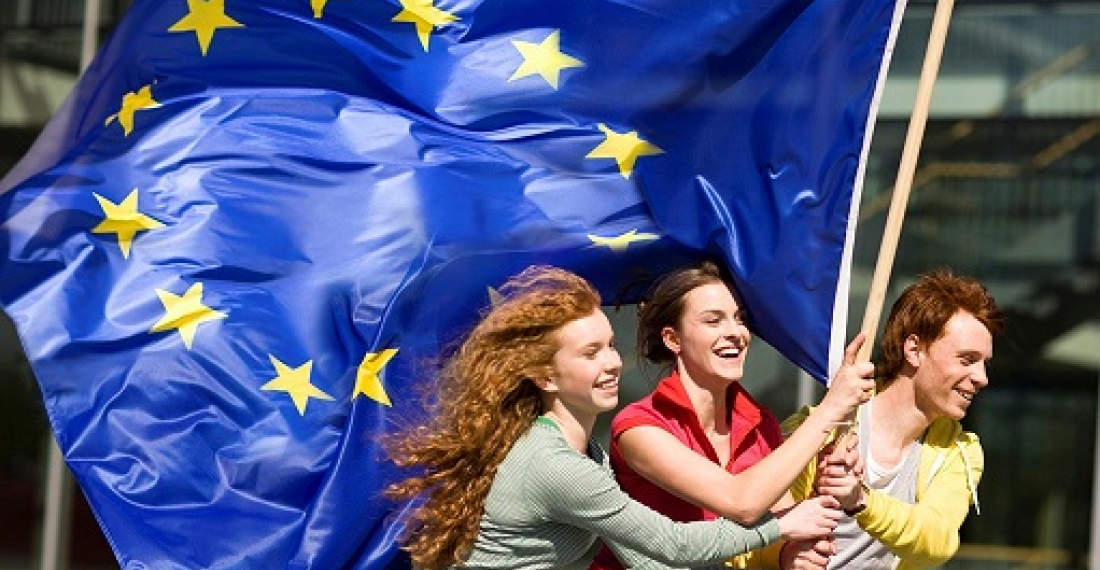
EU celebrates Europe Day with a declaration outlining ambitious social agenda

9 May is Europe, celebrated by the European Union and across the continent to highlight and celebrate peace and unity in Europe. The date marks the anniversary of the historic Schuman declaration, which started Europe on the path to today's European Union.

This year, faced by the challenges of the pandemic and its social and economic consequences, European leaders meeting at an informal summit in Porto, hosted by the current Portuguese Presidency of the EU, focused on social issues, including on how to ensure an inclusive recovery, with education and skills at the heart of the EU's political action.

European leaders adopted the Porto declaration, setting out their vision for Europe's digital, green and fair transition.

The social dimension, social dialogue and the active involvement of social partners have always been at the core of a highly competitive social market economy. Our commitment to unity and solidarity also means ensuring equal opportunities for all and that no one is left behind.

The Porto declaration

You can read the Porto Declaration in full here.

EU leaders discussed the implementation of the European pillar of social rights at EU and national level, as established by the EU strategic agenda 2019-2024.  The action plan presented by the Commission in March 2021 provides guidance on the implementation of the European pillar of social rights, including in the areas of employment, skills and social protection. The action plan also sets three main targets to be achieved throughout the European Union by 2030:

  • an employment rate of at least 78% in the EU
  • at least 60% of adults attending training courses every year
  • a reduction of at least 15 million in the number of people at risk of social exclusion or poverty

What is the Schuman Declaration?

In 1950, European countries were slowly recovering from the human and economic devastation caused by World War II, under the shadow of the renewed global tensions sparked by the Cold War. On 9 May 1950, in what became known as the Schuman Declaration, French Foreign Minister and future European Parliament President Robert Schuman announced the creation of a European Coal and Steel Community placed under the control of a common High Authority.

Robert Schuman wanted the countries to share production of coal and steel in order to make war ‘not merely unthinkable, but materially impossible’. His call was heard around Europe and other European countries joined the initiative, laying the foundations for lasting peace. The Schuman Declaration, and the model of international collaboration at its heart, proved to be the first step on the path to today’s European Union.

The editorial team of commonspace.eu extends our best wishes to all our European readers, subscribers and supporters on the occasion of Europe Day 2021: HAPPY EUROPE DAY

source: commonspace.eu with the Council of the European Union

Related articles

Editor's choice
News
Borrell tells the European Parliament that the situation in Afghanistan was critical, but the EU will remain engaged

Borrell tells the European Parliament that the situation in Afghanistan was critical, but the EU will remain engaged

Borrell underlined that the European Union will make every effort to support the peace process and to remain a committed partner to the Afghan people. "Of course, we will have to take into account the evolving situation, but disengagement is not an option.  We are clear on that: there is no alternative to a negotiated political settlement, through inclusive peace talks.
Editor's choice
News
Germany accuses Russia of cyberattacks and disinformation campaign

Germany accuses Russia of cyberattacks and disinformation campaign

The German government holds Russia responsible for a cyberattack on German air traffic control, and for targeted disinformation campaigns before the last federal election. According to the German Foreign Office in Berlin, the incidents could be clearly attributed to the Russian military intelligence service, the GRU. In response, the Russian ambassador to Berlin was summoned to the Foreign Ministry. "We have been observing a massive increase in threatening hybrid activities by Russia for some time now," a spokesperson for the Foreign Ministry stated. These range from disinformation campaigns and espionage to cyberattacks and sabotage attempts. The aim is to divide society, sow distrust, and undermine confidence in democratic institutions. The spokesperson added that with these actions, Russia is "very concretely threatening our security, not only through its war of aggression against Ukraine, but also here in Germany."  The Foreign Ministry spokesperson explained that the cyberattack on air traffic control in August 2024 was clearly attributed to the hacker collective "APT28," known as "Fancy Bear," and to the responsibility of the Russian military intelligence service, the GRU. Furthermore, it could now be "conclusively stated" that Russia had attempted "to influence and destabilize both the last Federal election and the ongoing internal affairs of the Federal Republic of Germany." There was "absolutely irrefutable evidence" for this". The so-called "Storm 1516" campaign, which has been running since 2024, is allegedly backed by "reliable information" that the Moscow-based think tank "Center for Geopolitical Expertise" is behind it. The Center is also said to be supported by Russian military intelligence. Its primary aim is to influence democratic elections in the West. (Click the image to read more).

Popular

Editor's choice
News
Germany accuses Russia of cyberattacks and disinformation campaign

Germany accuses Russia of cyberattacks and disinformation campaign

The German government holds Russia responsible for a cyberattack on German air traffic control, and for targeted disinformation campaigns before the last federal election. According to the German Foreign Office in Berlin, the incidents could be clearly attributed to the Russian military intelligence service, the GRU. In response, the Russian ambassador to Berlin was summoned to the Foreign Ministry. "We have been observing a massive increase in threatening hybrid activities by Russia for some time now," a spokesperson for the Foreign Ministry stated. These range from disinformation campaigns and espionage to cyberattacks and sabotage attempts. The aim is to divide society, sow distrust, and undermine confidence in democratic institutions. The spokesperson added that with these actions, Russia is "very concretely threatening our security, not only through its war of aggression against Ukraine, but also here in Germany."  The Foreign Ministry spokesperson explained that the cyberattack on air traffic control in August 2024 was clearly attributed to the hacker collective "APT28," known as "Fancy Bear," and to the responsibility of the Russian military intelligence service, the GRU. Furthermore, it could now be "conclusively stated" that Russia had attempted "to influence and destabilize both the last Federal election and the ongoing internal affairs of the Federal Republic of Germany." There was "absolutely irrefutable evidence" for this". The so-called "Storm 1516" campaign, which has been running since 2024, is allegedly backed by "reliable information" that the Moscow-based think tank "Center for Geopolitical Expertise" is behind it. The Center is also said to be supported by Russian military intelligence. Its primary aim is to influence democratic elections in the West. (Click the image to read more).

