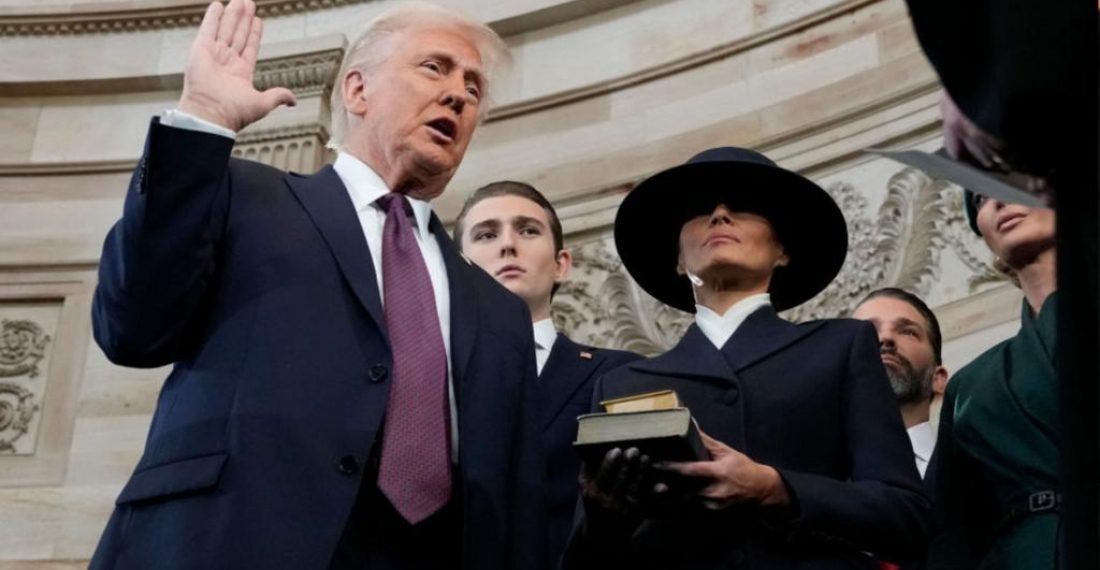
Donald Trump takes oath of office as US President, says he will save America from decline.

Donald Trump aged 78 was sworn in as the 47th president of the US and pledged in his inauguration address to rescue America from what he described as years of betrayal and decline, prioritizing a crackdown on illegal immigration. Trump declared his intention to sign a number of executive actions in his first hours as president, including a number focused on border security and immigration, his top priority. Trump announced a "national emergency" at the US-Mexico border, declared drug cartels as terrorists, and will scrap government diversity programmes. His vice president, JD Vance, was sworn in just before him.

"First, I will declare a national emergency at our southern border," he said. "All illegal entry will be immediately halted and we will begin the process of returning millions and millions of criminal aliens back to the places from which they came." The speech echoed many of the themes he sounded at his first inauguration in 2017 when he spoke darkly of the "American carnage" of crime and job loss that he said had ravaged the country.

The inauguration completes a significant comeback for a political disruptor who survived two impeachment trials, a felony conviction, two assassination attempts and an indictment for attempting to overturn his 2020 election loss. Trump will be the first felon to occupy the White House after a New York jury found him guilty of falsifying business records to cover up hush money paid to a porn star.

"The journey to reclaim our republic has not been an easy one, that I can tell you," Trump said, before referring to the assassin's bullet that grazed his ear in July. "I was saved by God to make America great again." The ceremony was moved inside the Capitol due to the cold, four years after a mob of Trump supporters breached the building, a symbol of American democracy, in an unsuccessful effort to forestall Trump's loss to Democrat Joe Biden.

Biden and outgoing Vice President Kamala Harris, who lost to Trump in November, were present inside the Capitol's Rotunda, along with former Presidents Barack Obama, George W. Bush and Bill Clinton. Former Secretary of State Hillary Clinton, who lost to Trump in 2016, arrived with her husband Bill, but Obama's wife, Michelle, chose not to attend. Numerous tech executives who have sought to curry favor with the incoming administration - including the three richest men in the world, Tesla and SpaceX CEO Elon Musk, Amazon CEO Jeff Bezos and Meta CEO Mark Zuckerberg - had prominent seats on stage, next to cabinet nominees and members of Trump's family.

Trump, the first US president since the 19th century to win a second term after losing the White House, has said he would pardon on day one any of the more than 1,500 people charged in connection with the Jan. 6, 2021, attack. He skipped Biden's inauguration and has continued to claim falsely that the 2020 election he lost to Biden was rigged.

In another controversial announcement  in his inaugural speech Trump said that in "a short time from now," the name of Gulf of Mexico will be changed to "Gulf of America." 
Source: commonspace.eu with agencies Photo: BBC

Related articles

Editor's choice
News
Mecca Joint Defence Agreement is a historic development that may change the face of the Wider Middle East

Mecca Joint Defence Agreement is a historic development that may change the face of the Wider Middle East

The Mecca Joint Defence Agreement, signed on 7 August 2026 in Mecca, by Saudi Crown Prince Mohammed bin Salman, Turkish President Recep Tayyip Erdoğan, and Pakistani Prime Minister Shehbaz Sharif, establishes a collective defence arrangement under which an armed attack against any one of the three states is to be regarded as an attack against all three. This is a historic step, and the agreement is a landmark event, that will change the future of the wider Middle East. Saudi Arabia, Turkiye and Pakistan are different countries with many particular features. But there is enough common ground between them to make the new situation created by the Mecca Defence Agreement significant, and their efforts credible. They are also complimentary in terms of what they can bring to the process that they are about to start.Pakistan and Turkiye have large and developed standing armiies; Pakistan has nuclear weapons; Turkiye has a dynamic and expanding arms industry; Saudi Arabia has financial resources, and extensive diplomatic kudos in the Islamic world and beyond. The official statement announcing the new agreement said: “Guided by the longstanding historical ties among the three states, based on the enduring bonds of brotherhood and Islamic solidarity that unite them, and building upon their shared strategic interests and longstanding defense cooperation, HRH the Crown Prince, the President of Türkiye, and the Prime Minister of Pakistan signed the Makkah Joint Defence Agreement, reflecting the three states' shared commitment to further strengthening their collective security and to promoting peace, security, and stability in the region and beyond, in pursuit of a secure and prosperous future. The agreement is intended to strengthen collective deterrence against any act of aggression, and stipulates that any armed attack against any one of the three states shall be regarded as an attack against them all. It further provides for the enhancement of all aspects of defense cooperation among the three states”. Turkish foreign minister Hakan Fidan said that the pact would function similar to NATO, with a minister's committee, political and military committees, and a permanent secretariat to oversee the implementation of decisions. The permanent general secretariat is expected to be based in Saudi Arabia.

Popular

Editor's choice
Interview
Thursday Interview: Murad Muradov

Thursday Interview: Murad Muradov

Today, commonspace.eu starts a new regular weekly series. THURSDAY INTERVIEW, conducted by Lauri Nikulainen, will host  persons who are thinkers, opinion shapers, and implementors in their countries and spheres. We start the series with an interview with Murad Muradov, a leading person in Azerbaijan's think tank community. He is also the first co-chair of the Action Committee for a new Armenian-Azerbaijani Dialogue. Last September he made history by being the first Azerbaijani civil society activist to visit Armenia after the 44 day war, and the start of the peace process. Speaking about this visit Murad Muradov said: "My experience was largely positive. My negative expectations luckily didn’t play out. The discussions were respectful, the panel format bringing together experts from Armenia, Azerbaijan, and Turkey was particularly valuable during the NATO Rose-Roth Seminar in Yerevan, and media coverage, while varied in tone, remained largely constructive. Some media outlets though attempted to represent me as more of a government mouthpiece than an independent expert, which was totally misleading.  Overall, I see these initiatives as important steps in rebuilding trust and normalising professional engagement. The fact that soon a larger Azerbaijani civil society visits to Armenia followed, reinforces the sense that this process is moving in the right direction." (click the image to read the interview in full)