


Chairmanship of Non-Aligned Movement passes from Azerbaijan to Uganda

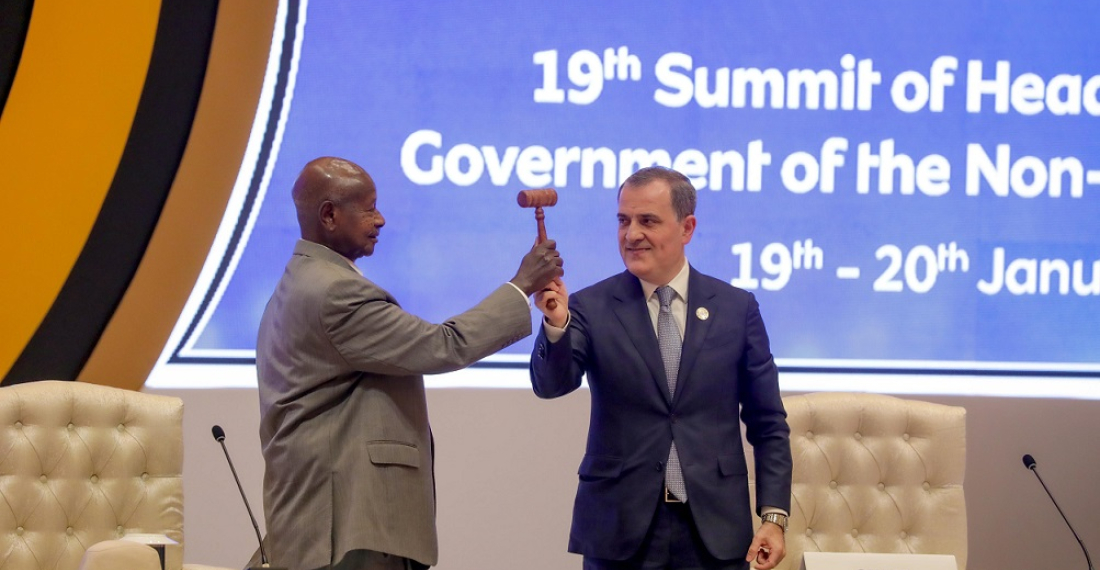
The chairmanship of the Non-Aligned Movement, a grouping of 120 countries, mainly in the global South, passed on Friday morning from Azerbaijan to Uganda.

President Yoweri Museveni was elected by acclamation as the chair of the 19th NAM Heads of State and Government Summit taking over from Ilham Aliyev.

Azerbaijani foreign minister, Jeyhun Bayramov, represented the outgoing president Aliyev. He congratulated Uganda and President Museveni for assuming the NAM chairmanship and promised that his country will extend all the necessary support to ensure success of the movement.

“Azerbaijan chairmanship has done its best to make the voice of our members heard in all possible platforms with successful initiatives and there’s no doubt that Uganda’s chairmanship will continue with this legacy, even further building upon it,” he said.

“At this historic moment, after four years of proudly chairing the movement, we are handing over the chairmanship to the Republic of Uganda with a rich substantial and institutional legacy and we are confident that Uganda will further enhance the development feasibility of the movement and strengthen unity among its member states. I would like to reiterate that our passion and determination for the success of NAM will always remain strong and we will continue to contribute to the just cause.”

Bayramov also highlighted some of the successes they have achieved during their chairmanship. He said during their term, they played a key role in the institutional development of the movement as well as putting up a number of initiatives to combat Covid-19, among other challenges affecting member states.

“During its chairmanship, Azerbaijan took practical steps to uphold the interests of member states at the international arena, guided by the principle of cementing solidarity and extending mutual support,” he said.

On the other hand, Bayramov revealed that at the Ministerial meeting held in Baku in July, 2023, they agreed to forward the request of South Sudan, the only non-member state of NAM from the African continent, for a fully-fledged membership in the movement.

“The admission of South Sudan will be the first expansion of NAM membership in 13 years bringing the number of members to 121. This proves the increasing importance of our movement in the international relations system.”

In his speech, President Museveni informed the Heads of State and Heads of Delegations that Uganda’s stand is that the world should concentrate on the common human problems ─ prosperity through trade, the advance of science and technology to deal with human problems, the environment, crime and terrorism. He said such ideas are in line with the Bandung Principles, a basis on which NAM was formed.

“It is on these principles that NAM was founded. We, the resistance fighters of Uganda, can testify that by synthesizing the package of ideas, we have got very good results. Using the ideas of the free market, combined with the ideas of selective State intervention in the economy in some sectors like banking, energy, transport, etc. and also bringing back some aspects of the pre-capitalist institutions such as reformed cultural institutions, Uganda, although starting from a very low base, has had growth rates of 6.2% per year, for the last 37 years.”

He further urged that the world should only have free associations of nations where people of a common or shared origin, interact for mutual advantage with the peoples of the World.

“The future is bright if we act right,” he said.

The President further disclosed that as the resistance fighters of Uganda, they are flabbergasted and look down with contempt, at the philosophical, ideological and strategic shallowness of some of the actors in the World who use their scientific advancements to oppress others. He also cautioned leaders against imposing their narrow uni-ideological orientation to a society they live in , let alone the world.

“The oppressors miscalculate when they use their temporary advantage in science and technology to think that they can use that to indefinitely oppress other people.  The oppressed will learn, catch up and defeat the oppressor.  That is why Empires always collapse.  The idea of Empires is an evil idea,” President Museveni asserted.

“Why do you not seek to influence people by your good example, instead of manipulation, lectures and threats? Chauvinists of race, religion, tribe or gender, should stop wasting our time and opportunities, with their shallow schemes. Action will, inevitably, invite counteraction. Oppression will invite Resistance. We are, therefore, not impressed and cannot be part of the morbid bigotry of uni-ideological thinking of this or that type.  The universe has been here for the last 30 billion years, and human society has been here for the last 4½million years,” he added.

On the other hand, the President advised that the strength of NAM should be used to exercise considerable influence particularly at the UN for the effective transformative process for a better common future.

“In the negotiations for the Pact of the Future, the outcome document of the upcoming United Nations Summit of the Future to be held in New York in September, 2024, we should clearly define priorities that favour developing countries by maintaining unity, solidarity and collective coordination among our Member States, in line with the Bandung principles.  I assure you all that my team, led by the Permanent Representative in New York has my full support to chair the Coordinating Bureau of the Non-Aligned Movement,” he emphasised.

source: commonspace.eu with Ugandan media and agencies
photo: Azerbaijan foreign minister Jeyhun Bayramov formally handing the chairmanship of the NAM movement ot the President of Uganda, Yoweri Mouseveni (picture courtesy of the press service of the Government of Uganda)

 

Related articles

Editor's choice
News
Israeli parliament votes to bring back the death penalty, but only for Palestinians

Israeli parliament votes to bring back the death penalty, but only for Palestinians

srael’s parliament approved a bill on Monday that would allow the execution of Palestinians convicted on terror charges for deadly attacks, a move that has been criticized as discriminatory and immediately drew a court challenge. Sixty-two lawmakers, including Prime Minister Benjamin Netanyahu, voted in favor and 48 against the bill, championed by far-right National Security Minister Itamar Ben Gvir. There was one abstention and the rest of the lawmakers were not present. Ben Gvir in the run-up to the vote had worn a lapel pin in the shape of a noose, symbolising his support for the legislation. “We made history!!! We promised. We delivered,” he posted on X after the vote. The bill would make the death penalty the default punishment for Palestinians in the Israeli-occupied West Bank found guilty of intentionally carrying out deadly attacks deemed “acts of terrorism” by an Israeli military court. The bill says that the sentence may be reduced to life imprisonment under “special circumstances.” Palestinians in the West Bank are automatically tried in Israeli military courts. Meanwhile, under the bill, in Israeli criminal courts anyone “who intentionally causes the death of a person with the aim of harming an Israeli citizen or resident out of an intention to put an end to the existence of the State of Israel shall be sentenced to death or life imprisonment.” Criminal courts try Israeli nationals, including Palestinian citizens and residents of east Jerusalem. The bill sets the execution method as hanging, adding that it should be carried out within 90 days of the sentencing, with a possible postponement of up to 180 days. - ‘Parallel tracks’ - The bill appears to conflict with Israel’s Basic Laws, which prohibit arbitrary discrimination, and shortly after it was passed, a leading human rights group announced that it had filed a petition with the Supreme Court demanding the legislation’s annulment. “The law creates two parallel tracks, both designed to apply to Palestinians,” the Association for Civil Rights in Israel said in a statement. “In military courts — which have jurisdiction over West Bank Palestinians — it establishes a near-mandatory death sentence,” the rights group said. In civilian courts, the law’s stipulation that defendants must have acted “with the aim of negating the existence” of Israel “structurally excludes Jewish perpetrators,” the group added. The association argued the law should be annulled on both jurisdictional and constitutional grounds. During the debate in parliament, opposition lawmaker and former deputy Mossad director, Ram Ben Barak, expressed outrage at the legislation. “Do you understand what it means that there is one law for Arabs in Judea and Samaria, and a different law for the general public for which the State of Israel is responsible?” he asked fellow parliamentarians, using the Israeli name for the West Bank. “It says that Hamas has defeated us. It has defeated us because we have lost all our values.” - ‘Discriminatory application’ - Lawmaker Limor Son Har-Melech from Ben Gvir’s party, who years ago survived an attack by Palestinian militants in which her husband was killed, urged fellow parliamentarians to approve the bill. “For years, we endured a cruel cycle of terror, imprisonment, release in reckless deals, and the return of these human monsters to murder Jews again ... And today, my friends, this cycle has come full circle.” The Palestinian Authority condemned the law’s adoption, saying that “Israel has no sovereignty over Palestinian land.” “This law once again reveals the nature of the Israeli colonial system, which seeks to legitimize extrajudicial killing under legislative cover,” it added. In February, Amnesty International had urged Israeli lawmakers to reject the legislation, citing its “discriminatory application against Palestinians.” On Sunday, Britain, France, Germany and Italy expressed “deep concern” over the bill, which they said risked “undermining Israel’s commitments with regards to democratic principles.” While the death penalty exists for a small number of crimes in Israel, it has become a de facto abolitionist country — the Nazi Holocaust perpetrator Adolf Eichmann was the last person to be executed in 1962. Israel has occupied the West Bank since 1967 and violence there has soared since Hamas’s October 7, 2023 attack on Israel triggered the Gaza war. (read more by clicking the image above).

Popular

Editor's choice
Interview
Thursday Interview: Murad Muradov

Thursday Interview: Murad Muradov

Today, commonspace.eu starts a new regular weekly series. THURSDAY INTERVIEW, conducted by Lauri Nikulainen, will host  persons who are thinkers, opinion shapers, and implementors in their countries and spheres. We start the series with an interview with Murad Muradov, a leading person in Azerbaijan's think tank community. He is also the first co-chair of the Action Committee for a new Armenian-Azerbaijani Dialogue. Last September he made history by being the first Azerbaijani civil society activist to visit Armenia after the 44 day war, and the start of the peace process. Speaking about this visit Murad Muradov said: "My experience was largely positive. My negative expectations luckily didn’t play out. The discussions were respectful, the panel format bringing together experts from Armenia, Azerbaijan, and Turkey was particularly valuable during the NATO Rose-Roth Seminar in Yerevan, and media coverage, while varied in tone, remained largely constructive. Some media outlets though attempted to represent me as more of a government mouthpiece than an independent expert, which was totally misleading.  Overall, I see these initiatives as important steps in rebuilding trust and normalising professional engagement. The fact that soon a larger Azerbaijani civil society visits to Armenia followed, reinforces the sense that this process is moving in the right direction." (click the image to read the interview in full)

