


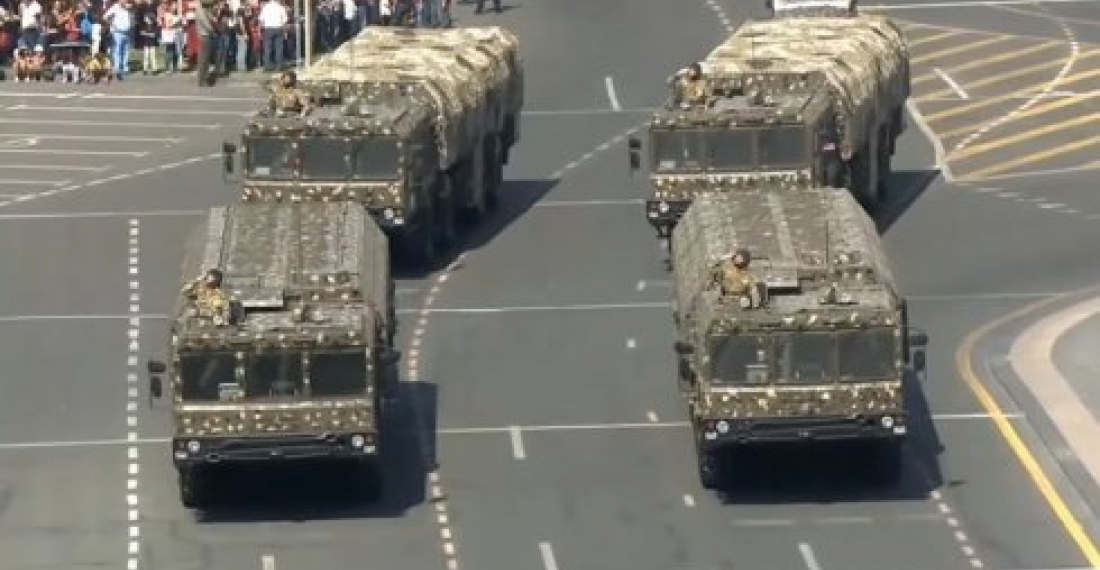
Armenian Defence Minister spells out how Armenia sees the use of its newly acquired Iskander missile system

Armenia's Defence Minister, Vasgen Sargsyan has spelled out how Armenia sees the use of its newly aquired Iskander Missile system

The Minister said that "the system is a weapon that is capable to cool a hothead while making a decision". Speaking to RIA Novosti, the Russian news agency, the Minister said, "I can present the algorithm. The function and characteristics of this weapon enable it to cause irreparable damage to the infrastructure of the country against which it is used. So, the decision to use Iskanders will be closely linked to the development of the situation".

The Defence Minister noted that although the Iskander systems were considered to be a deterrent weapon, they could be used as "a guaranteed strike weapon if the necessity arises." The Minister added that Iskander missile systems are owned by the Armenian armed forces and are managed by Armenian army officers.

The Minister however refused to give any information with regards to the conditions and cost under which Russia supplied the system to Armenia, saying that it was top secret.

Armenia displayed the Iskander Missile system for the first time during a military parade in Yerevan on 21 September 2016 marking the 25th anniversary of Armenian independence. Since then there has been speculation as to whether the weapon system was under the operational control of the Armenian Armed Forces, or if the Russians still held a control over its ultimate use.

source: commonspace.eu with agencies

photo: Iskander Missiles on display at a military parade in Yerevan on 21 September 2016. (archive picture)
Related articles

Editor's choice
News
Borrell tells the European Parliament that the situation in Afghanistan was critical, but the EU will remain engaged

Borrell tells the European Parliament that the situation in Afghanistan was critical, but the EU will remain engaged

Borrell underlined that the European Union will make every effort to support the peace process and to remain a committed partner to the Afghan people. "Of course, we will have to take into account the evolving situation, but disengagement is not an option.  We are clear on that: there is no alternative to a negotiated political settlement, through inclusive peace talks.
Editor's choice
News
UN General Assembly demands that Russia returns Ukrainian children

UN General Assembly demands that Russia returns Ukrainian children

The UN General Assembly, in a vote on Wednesday (3 December) overwhelmingly voted in favour of a resolution demanding that Russia returns Ukrainian children kidnapped since the start of the Russian invasion in February 2022. 91 countries voted in favour of the resolution, 12 voted against, and 57 countries abstained or were not present. Russia and Belarus were joined by ten countries in voting against the resolution, namely, Iran, Cuba, Nicaragua, Burundi, Burkina Faso, Niger, Mali, Democratic Republic of Congo, Sudan, and Eritrea. From the South Caucasus, Georgia voted in favour of the resolution, but Armenia and Azerbaijan abstained, as did Turkiye and the five Central Asian republics. Also abstaining were the six Gulf monarchies and most Arab countries. The resolution calls for the immediate return of Ukrainian children who were deported to Russia. The Ukrainian government says more than 19,000 children have been taken away from Russian-occupied areas and elsewhere since Moscow's invasion began in February of 2022. The draft resolution submitted on Wednesday demands that Russia "ensure the immediate, safe and unconditional return" of the children. (Read more by clicking the image)

Popular

Editor's choice
News
UN General Assembly demands that Russia returns Ukrainian children

UN General Assembly demands that Russia returns Ukrainian children

The UN General Assembly, in a vote on Wednesday (3 December) overwhelmingly voted in favour of a resolution demanding that Russia returns Ukrainian children kidnapped since the start of the Russian invasion in February 2022. 91 countries voted in favour of the resolution, 12 voted against, and 57 countries abstained or were not present. Russia and Belarus were joined by ten countries in voting against the resolution, namely, Iran, Cuba, Nicaragua, Burundi, Burkina Faso, Niger, Mali, Democratic Republic of Congo, Sudan, and Eritrea. From the South Caucasus, Georgia voted in favour of the resolution, but Armenia and Azerbaijan abstained, as did Turkiye and the five Central Asian republics. Also abstaining were the six Gulf monarchies and most Arab countries. The resolution calls for the immediate return of Ukrainian children who were deported to Russia. The Ukrainian government says more than 19,000 children have been taken away from Russian-occupied areas and elsewhere since Moscow's invasion began in February of 2022. The draft resolution submitted on Wednesday demands that Russia "ensure the immediate, safe and unconditional return" of the children. (Read more by clicking the image)

