


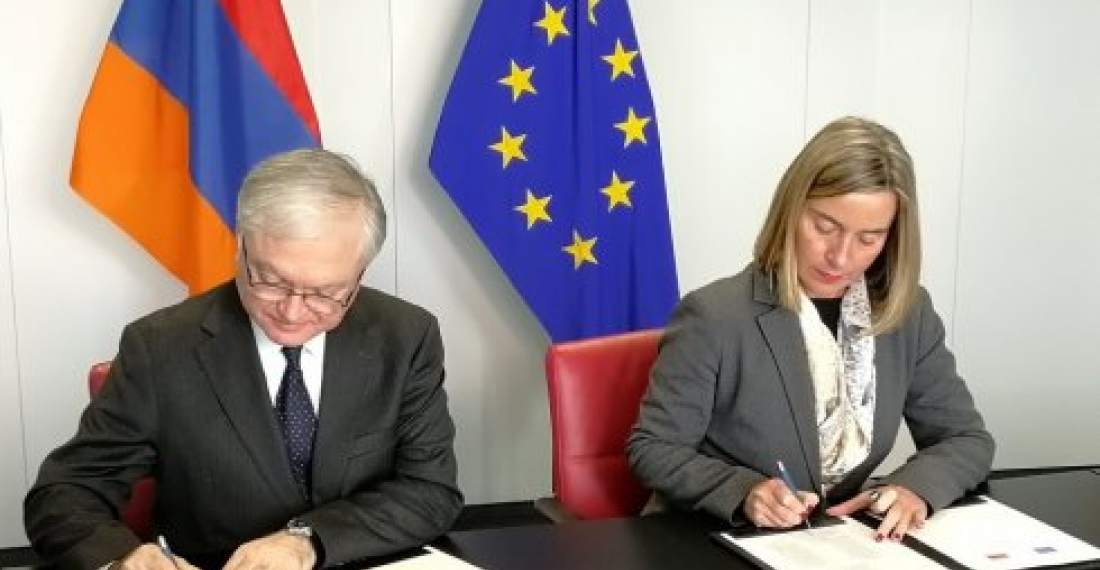
The European Union and Armenia on Wednesday (21 February) signed a document that sets out the joint policy priorities for the coming years, in line with the new EU-Armenia Comprehensive and Enhanced Partnership Agreement.
The document highlights the four main areas of cooperation, namely: Strengthening institutions and good governance; Economic development and market opportunities; Connectivity, energy efficiency, environment and climate action; Mobility and people-to-people contacts.
The Partnership Priorities will be key in guiding EU financial assistance to Armenia until 2020. For that period, the EU has earmarked around €160 million for Armenia to invest, among other areas, in education and innovation, which are key for Armenia's economic development.
The document was signed in Brussels by EU High Representative, Federica Morgherini, and Armenian Foreign Minister, Eduard Nalbandian.
"The European Union and Armenia are, with these Partnership Priorities, further enhancing our already strong friendship and cooperation", said the EU High Representative Federica Mogherini. "Combined with our new Comprehensive and Enhanced Partnership Agreement that we signed only three months ago at the Eastern Partnership Summit in Brussels, we are reinforcing our joint commitment to delivering positive results in areas that really make a difference to peoples' lives, both in the EU and in Armenia. We stay engaged to push ahead and work to turn those commitments into reality."
source: commonspace.eu with the press service of the European External Action Service
photo: EU High Representative, Federica Morgherini, and Armenian Foreign Minister, Eduard Nalbandian signing the document on joint priorities in Brussels on 21 February 2018 (picture courtesy of the EEAS press service)



